Book of Mormon Witnesses
Prophets are intermediaries between God and humanity. All revealed religions build on a foundation of their prophet's credibility and trustworthiness as intercessors with the divine. For example, if Abraham's early followers did not believe the truth of his testimony revealing God's first covenant with the Jewish people, Judeo-Christian religions as we know them would not have arisen. Like Abraham, Joseph Smith proclaimed to have divine communication with God concerning a new covenant. God's will was revealed to Joseph through miraculous visitations, and through the history inscribed on the golden plates the angel Moroni entrusted him with. In addition to Joseph's own testimony, a total of 11 witnesses swore in writing to have seen or handled the miraculous plates that became the Book of Mormon, the cornerstone of LDS faith.
Overview of LDS position
Devout Latter-day Saints believe that the truth of Joseph's extraordinary revelations was validated by a group of upstanding witnesses. Every Book of Mormon begins with the signed statement of 11 witnesses. The three special witnesses confirm having seen the Angel Moroni and the plates. Eight other witnesses attest to seeing and handling the golden plates:
And this we bear record with words of soberness, that the said Smith has shown unto us, for we have seen and hefted, and know of a surety that the said Smith has got the plates of which we have spoken.[1]
Faithful Latter-day Saints believe witnesses did in fact see and touch the plates, and that even though many of the witnesses later left the church, none of them denied their testimony.
Overview of Critics' position
The witnesses, by their own admission, seemed to have only seen the angel and plates in a 'visionary state' in their minds as Joseph suggested to them and not really with their natural eyes as members are taught. Why would real, metal plates need to be seen in a vision or with 'spiritual eyes' as many of the witnesses later testified?
Critics also point out several issues that call into question the witnesses' reliability and trustworthiness. For example, all the witnesses had close ties to Joseph and his family. Martin Harris, had a substantial financial stake in the success of the Book of Mormon. Moreover, in the upcoming years, many of the witnesses ended up leaving the church and following other leaders and religions. By 1847, not one of the surviving eleven witnesses was part of the LDS Church. If they believed Joseph Smith's miraculous revelations from God were true, why would they have left the Church?
References
- "Testimony of Eight Witnesses," Book of Mormon. Link is here.
Contents for this page
Introduction
Member beliefs
Problem summary
Amazing events witnessed
BOM and Spalding witnesses
Affidavits against Joseph
Proper witnessing procedure
Governor Ford's thoughts
Abagail & Lucy Testimony
Analogy
Was Joseph a magician?
Did Cowdery deny testimony?
Martin Harris' reliability?
What about David Whitmer?
Summary of the 11 Witnesses
What about the 8 Witnesses
Did the 11 see plates?
Witnesses Revisited
Video on the Witnesses
Church's response
Editor's comments
Links
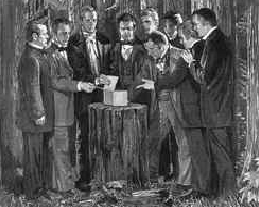
Member beliefs
In every copy of the Book of Mormon is the signed statement by the witnesses of the BOM. The three special witnesses saw the Angel Moroni and the plates. The eight other witnesses just saw and handled the golden plates.
The 11 witnesses were all good, honorable men and regarded as upstanding members of the community.
The three special witnesses all saw the Angel and the plates together as a group. The eight witnesses also saw the plates as a group.
Most members are aware that many of the witnesses, including all three of the special witnesses, apostatized and left the church. Oliver Cowdery and perhaps Martin Harris rejoined the church shortly before they died.
Although many of the witnesses left the church, none of them ever denied their testimony regarding seeing the plates.
The witnesses' testimonies are regarded as literally being true. They all did in fact see and touch the plates with their own eyes and hands.
The title page of the Book of Mormon reads:
The Testimony Of Three Witnesses
BE IT KNOWN unto all nations, kindreds, tongues, and people, unto whom this work shall come: That we, through the grace of God the Father, and our Lord Jesus Christ, have seen the plates which contain this record, which is a record of the people of Nephi, and also of the Lamanites, their brethren, and also of the people of Jared, who came from the tower of which hath been spoken. And we also know that they have been translated by the gift and power of God, for his voice hath declared it unto us; wherefore we know of a surety that the work is true. And we also testify that we have seen the engravings which are upon the plates; and they have been shown unto us by the power of God, and not of man. And we declare with words of soberness, that an angel of God came down from heaven, and he brought and laid before our eyes, that we beheld and saw the plates, and the engravings thereon; and we know that it is by the grace of God the Father, and our Lord Jesus Christ, that we beheld and bear record that these things are true. And it is marvelous in our eyes. Nevertheless, the voice of the Lord commanded us that we should bear record of it; wherefore, to be obedient unto the commandments of God, we bear testimony of these things. And we know that if we are faithful in Christ, we shall rid our garments of the blood of all men, and be found spotless before the judgment-seat of Christ, and shall dwell with him eternally in the heavens... And the honor be to the Father, & to the Son, & to the Holy Ghost, which is One God. Amen.'
Oliver Cowdery
David Whitmer
Martin Harris
And Also The Testimony Of Eight Witnesses
BE IT KNOWN unto all nations, kindreds, tongues, and people, unto whom this work shall come: That Joseph Smith, Jun., the translator of this work, has shown unto us the plates of which hath been spoken, which have the appearance of gold ; and as many of the leaves as the said Smith has translated we did handle with our hands; and we also saw the engravings thereon, all of which has the appearance of ancient work, and of curious workmanship. And this we bear record with words of soberness, that the said Smith has shown unto us, for we have seen and hefted, and know of a surety that the said Smith has got the plates of which we have spoken. And we give our names unto the world, to witness unto the world that which we have seen. And we lie not, God bearing witness of it.
Christian Whitmer Joseph Smith, Sr.
Jacob Whitmer Hyrum Smith
Peter Whitmer Hiram Page
John Whitmer Samuel H. Smith
Summary of the problem
Critic Essays
The following two essays provide a very good analysis of the arguments against the witnesses by critics. Note: these essays are very similar with many common elements. Please do not skip reading the following essays as the information presented below is for the most part, in addition to what's presented in those two essays.
IRR - Facts on the Book Of Mormon Witnesses - Jole Groat
Link is here.
Here are a few key points from the essays listed above:
- The witnesses' experiences may have only been visionary in nature. There are many statements given by the witnesses that indicate they only saw the angel and the plates in a visionary experience. Why would people need to see real, physical plates in a vision or a real angel that was physically on the earth? There are also several statements saying that the only time they saw the plates was when the plates were covered in a cloth or tow frock.
- The three witnesses did not all see the plates or angel at the same time. Only David Whitmer and perhaps Oliver Cowdery saw the angel together. Martin Harris removed himself from the group and did not see the angel until perhaps three days later (Anthony Metcalf, Ten Years Before the Mast, n.d., microfilm copy, p. 70-71). (note: FAIR says that this is well-documented in official Church sources - but why then do the vast majority of members not know of this? Every painting and image of the three witnesses has them all together - doesn't sound that well-documented to us.
- David Whitmer said "If you believe my testimony to the Book of Mormon; if you believe that God spake to us three witnesses by his own voice, then I tell you that in June, 1838, God spake to me again by his own voice from the heavens, and told me to separate myself from among the Latter-day Saints, for as they sought to do unto me, so should it be done unto them." So which statement was David Whitmer lying about or had been mistaken about? Either way he doesn't sound like a completely trustworthy witness. Note: LDS apologist rebuttal to this issue here and a critic's response here.
- All the witnesses had close ties to Joseph and his family. Some like Martin Harris had a substantial financial investment in the success of the Book of Mormon.
- These men lived in the early 1800s and believed in magical things like many people did during that time period such as divining rods, second sight, magic, dreams, seer stones, etc. Some of the witnesses, especially Martin Harris, were easily swayed by tales of the supernatural, especially in a religious context.
- Many of the witnesses ended up leaving the church and following other leaders and religions such as James Strang, the Shakers, Methodists, etc. By 1847 not a single one of the surviving eleven witnesses was part of the LDS Church.
- Of the witnesses that left the church, most believed that Joseph was at best a fallen prophet, the church changed its doctrines in error and changed revelations against God's will.
- The witnesses, who have been heralded as good, honest, Abe Lincoln-type of men were later called liars, counterfeiters, thieves, etc. by Joseph Smith himself.
- The "testimony of the witnesses" is similar to testimonials which were commonly included in books etc. in those days to help spur sales. And of course, the BOM's producers originally intended to sell copies for $1.75 each.
- All three witnesses believed that God Himself had told them
(through Joseph Smith) that they had been specially
chosen to testify to the world that they had seen the angel
and the plates –– if they had enough faith. Martin Harris
was even told the exact words he must use: Joseph Smith
said he had a revelation in which the Lord commanded
Harris to say, "I have seen the things which the Lord hath
shown unto Joseph Smith Jun., and I know of a surety that
they are true, for I have seen them." And just to clinch
the command, God threatened Martin Harris, saying, "But
if he deny this he will break the covenant which he has
before covenanted with me, and behold, he is condemned."
A personal promise (and a threat of condemnation)
coming directly from God is bound to have a powerful
influence on a person's thinking!
Witnesses to other amazing events
Many people that whole-heartedly believe the Book of Mormon witnesses do so because they have a hard time thinking that these people would either lie or could have been deceived. That's fair enough. But why then should we not believe the witnesses to the following stories:
There are seven witnesses that say Solomon Spalding was the author of the Book of Mormon. Seven people wrote affidavits testifying that they had read early drafts of a book by author Solomon Spalding that appeared to be an early draft of the BOM. In some ways they are more credible than the BOM witnesses as they each wrote their own account instead of merely signing a prepared statement.
Here's the testimony of the first of these seven witnesses, the brother of Solomon Spalding:
He [Solomon] then told me had he been writing a book, which he intended to have printed, the avails of which he thought would enable him to pay all his debts. The book was entitled the "Manuscript Found," of which he read to me many passages. -- It was an historical romance of the first settlers of America, endeavoring to show that the American Indians are the descendants of the Jews, or the lost tribes. It gave a detailed account of their journey from Jerusalem, by land and sea, till they arrived in America, under the command of NEPHI AND LEHI. They afterwards had quarrels and contentions, and separated into two distinct nations, one of which he denominated Nephites and the other Lamanites. Cruel and bloody wars ensued, in which great multitudes were slain. They buried their dead in large heaps, which caused the mounds so common in this country. Their arts, sciences and civilization were brought into view, in order to account for all the curious antiquities, found in various [280] parts of North and South America. I have recently read the Book of Mormon, and to my great surprize I find nearly the same historical matter, names, &c. as they were in my brother's writings. I well remember that he wrote in the old style, and commenced about every sentence with "and it came to pass," or "now it came to pass," the same as in the Book of Mormon, and according to the best of my recollection and belief, it is the same as my brother Solomon wrote, with the exception of the religious matter. -- By what means it has fallen into the hands of Joseph Smith, Jr. I am unable to determine.
JOHN SPALDING."
To read the rest of the witnesses claiming Solomon Spalding wrote the book that was modified into the Book of Mormon: Link is here.
Witnesses that said Rigdon admitted to them he used the Spalding Manuscript
There are people that signed affidavits stating that Sidney Rigdon admitted to them that he used the Spalding Manuscript to make the Book of Mormon. One such witness is James Jeffries of St. Louis:
STATEMENT OF JAMES JEFFERY.
I know more about the Mormons than any man east of the Alleghenies, although I have given no attention to the matter for twenty-five years. I did not know I was in possession of any information concerning the Book of Mormon unknown to others. I supposed that as Rigdon was so open with me, he had told others the same things.
Forty years ago I was in business in St. Louis. The Mormons then had their temple in Nauvoo, Ill. I had business transactions with them. Sidney Rigdon I knew very well. He was general manager of the affairs of the Mormons.
Rigdon, in hours of conversation told me a number of times there was in the printing office with which he was connected in Ohio, a manuscript of Rev. Spaulding, tracing the origin of the Indian race from the lost tribes of Israel; that this manuscript was in the office for several years; that he was familiar with it; that Spaulding had wanted it printed, but had not the money to pay for the printing; that he (Rigdon) and Joe Smith used to look over the manuscript and read it over Sundays.
Rigdon and Smith took the manuscript and said -- "I'll print it," and went off to Palmyra, N. Y.
I never knew the information was of any importance -- thought others were aware of these facts. I do not now think the matter is of any importance. It will not injure Mormonism. That is an "ism," and chimes in with the wishes of certain classes of people. Nothing will put it down but the strong arm of the law. Otherwise it will go on forever, like Tennyson's "Brook."
This is the substance of what I remember about the matter. JAMES JEFFERY.
I hereby certify that I wrote the above paper at the dictation of Mr. James Jeffery, in the presence of Mrs. James Jeffery, and and Dr. John M. Finney. (Rev.) CALVIN D. WILSON.
Mrs. James Jeffery. |
J. M. Finney, M. D. |Witnesses.
Churchville, Hartford Co., Md., Jan. 29, 1884.
Reference: Link is here.
Link to other witnesses that testified: Rigdon had the Spalding Manuscript.
Obviously both sets of witnesses cannot be correct. At least one set, possibly both sets, of witnesses were either lying or were mistaken or deceived. Which group is to be believed or are they both in error?
We're not saying we believe the Spalding witnesses over the Book of Mormon witnesses, but it proves the point that just because a group of people claims something extraordinary happened to them, it doesn't make it so.
For more on the Spalding theories:
Link is here.
Link is here.
LDS leader James Strang claimed to be the true prophet that succeeded Joseph after he was killed. Many Mormons followed Strang after he sent a letter claiming he had received a revelation that he should be prophet.
The letter convinced most of Smith's family and several other prominent Mormons that Strang's claims were genuine. John Whitmer, David Whitmer, Martin Harris, Hiram Page, John E. Page, William E. McLellin, William Smith, Smith's first wife and widow, Emma Hale Smith, the sisters of Joseph Smith, William Marks, George Miller, and others, including Joseph Smith's mother, Lucy Mack Smith. Lucy wrote to Reuben Hedlock: "I am satisfied that Joseph appointed J.J. Strang. It is verily so."(ibid) According to William Smith, all of Joseph Smith's family (excepting Hyrum Smith's widow), endorsed Strang; (Palmer, 211)
Here we have all of the living Book of Mormon witnesses, except Oliver Cowdery, as well as most of Smith's family and several other prominent members of the early LDS church accept Strang's claim of being a prophet by merely reading his letter. How much credibility can we give these people when they accept someone so easily as a prophet who later turns out to be a fraud?
In all, about 12,000 Latter-day saints recognized Strang's claims. A smaller group followed him to Beaver Island in Lake Michigan.
Most of his initial followers, including those listed above, would leave Strang's church before his death. Some eventually followed Brigham Young, but Smith's immediate family never did, and many of them formed the Reorganized Church of Jesus Christ of Latter Day Saints a few years later.
There are many witnesses to James Strang's claim of having unearthed metal plates which he translated into scripture. Strang's translation of the metal plates was transcribed by Samuel Graham, and published as the 336 page Book of the Law of the Lord, said to be the original law as it was given to Moses.
The following is from the first page of the Book of the Law of the Lord with the testimony of the witnesses to the plates from which the book was translated from. Does this sound familiar?
T E S T I M O N Y .
Be it known unto all nations, kindreds, tongues and people, to whom this Book of the Law of the Lord shall come, that James J. Strang has the plates of the ancient Book of the Law of the Lord given to Moses, from which he translated this law, and has shown them to us. We examined them with our eyes, and handled them with our hands. The engravings are beautiful antique workmanship, bearing a striking resemblance to the ancient oriental languages; and those from which the laws in this book were translated are eighteen in number, about seven inches and three-eights wide, by nine inches long, occasionally embellished with beautiful pictures.
And we testify unto you all that the everlasting kingdom of God is established, in which this law shall be kept, till it brings in rest and everlasting righteousness to all the faithful.
SAMUEL GRAHAM,
SAMUEL P. BACON,
WARREN POST,
PHINEAS WRIGHT,
ALBERT N. HOSMER,
EBENEZER PAGE,
JEHIEL SAVAGE.
Link is here.
Here's the detailed accounts of several witnesses that seem very similar to the BOM witnesses:
Testimony of Witnesses to the Voree Plates.
- On the thirteenth day of September, 1845, we, Aaron Smith, Jirah B. Wheelan, James M. Van Nostrand, and Edward Whitcomb, assembled at the call of James J. Strang, who is by us and many others approved as a Prophet and Seer of God. He proceeded to inform us that it had been revealed to him in a vision that an account of an ancient people was buried in a hill south of White River bridge, near the east line of Walworth County; and leading us to an oak tree about one foot in diameter, told us that we would find it enclosed in a case of rude earthen ware under that tree at the depth of about three feet; requested us to dig it up, and charged us to so examine the ground that we should know we were not imposed upon, and that it had not been buried there since the tree grew. The tree was surrounded by a sward of deeply rooted grass, such as is usually found in the openings, and upon the most critical examination we could not discover any indication that it had ever been cut through or disturbed.
- We then dug up the tree, and continued to dig to the depth of about three feet, where we found a case of slightly baked clay containing three plates of brass. On one side of one is a landscape view of the south end of Gardner's prairie and the range of hills where they were dug. On another is a man with a crown on his head and a scepter in his hand, above is an eye before an upright line, below the sun and moon surrounded with twelve stars, at the bottom are twelve large stars from three of which pillars arise, and closely interspersed with them are seventy very small stars. The other four sides are very closely covered with what appear to be alphabetic characters, but in a language of which we have no knowledge.
- The case was found imbedded in indurated clay so closely fitting it that it broke in taking out, and the earth below the soil was so hard as to be dug with difficulty even with a pickax. Over the case was found a flat stone about one foot wide each way and three inches thick, which appeared to have undergone the action of fire, and fell in pieces after a few minutes exposure to the air. The digging extended in the clay about eighteen inches, there being two kinds of earth of different color and appearance above it.
- We examined as we dug all the way with the utmost care, and we say, with utmost confidence, that no part of the earth through which we dug exhibited any sign or indication that it had been moved or disturbed at any time previous. The roots of the tree stuck down on every side very closely, extending below the case, and closely interwoven with roots from other trees. None of them had been broken or cut away. No clay is found in the country like that of which the case is made.
- In fine, we found an alphabetic and pictorial record, carefully cased up, buried deep in the earth, covered with a flat stone, with an oak tree one foot in diameter growing over it, with every evidence that the sense can give that it has lain there as long as that tree has been growing. Strang took no part in the digging, but kept entirely away from before the first blow was struck till after the plates were taken out of the case; and the sole inducement to our digging was our faith in his statement as a Prophet of the Lord that a record would thus and there be found.
AARON SMITH,
JIRAH B. WHEELAN,
J. M. VAN NOSTRAND,
EDWARD WHITCOMB,
Link is here.
Strang actually had his plates in a museum for all to see for a time. If he was a fraud then it was obvious that he had made a prop of sufficient quality to fool a prolonged, detailed visual inspection by the public. This shows that making a prop of ancient plates during Joseph's time wasn't all that difficult. Also Joseph's plates were never shown in public and were always covered and if they were ever actually shown to the witnesses, it was only very briefly.
James J. Strang. "The Record of Rajah Manchou of Vorito."
(Facsimile of the Brass Plates). Voree, Wisconsin Territory: 1845.
19.6 cm. x 10.6 cm. Broadside.
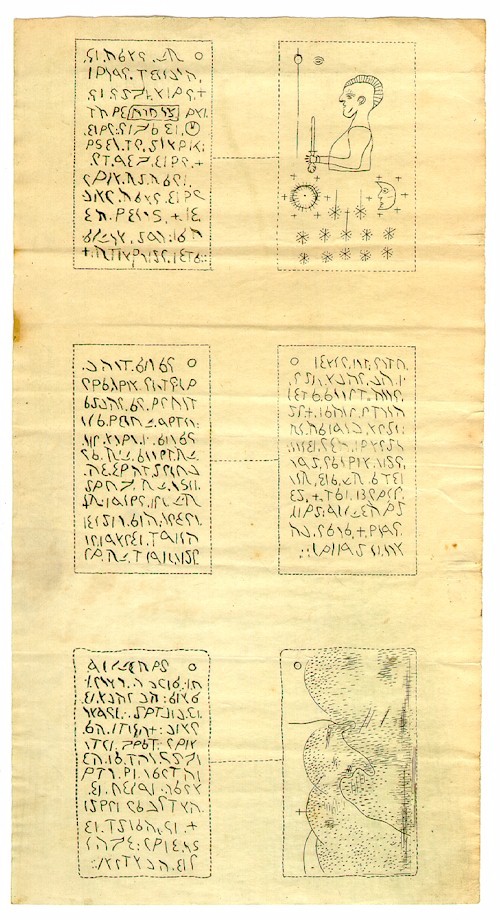
James Strang also reportedly had someone coated with phosphorescent paint to appear to be an angel in order to have witnesses that really believed in him.
Note 3: For an exemplary "amusing experiment" involving phosphorus, see Patriarch William Smith's 1849 account of how the Mormon leader James J. Strang made serruptitious use of the glowing substance in a darkened room: "The phosphorus then gave a most brilliant light upon the heads of the saints. The Holy Ghost was poured out in this way, and the sign given that Strang was a prophet." Elder J. J. Moss, who observed the advent of Mormonism at Kirtland, Ohio, provided his opinion of how the luminous angels observed thereabouts (David Whitmer saw one at the Temple) might have been similarly manufactured: "The Morley family would invite strangers... to stay with them all night & every one that stayed however strong their opposition before were baptized the next morning. Having studied in my boyhood the Black Art Ledgerdemain & jugling I had my suspicions aroused... & I told how Angels could be manufactured & strange wonders made to appear in the night & from that time forth invitations to stay over night ceased to be given & no more converts were made in that way..." etc., etc.
sidneyrigdon.com (click on the link to "RF June 12 '30")
Strang's plates have since been lost and he continues to have a following even today by those who believe his story the same as the faithful LDS believe Joseph's story, when no plates exist today to be examined for either Joseph Smith or James Strang.
References
The Shakers felt that "Christ has made his second appearance on earth, in a chosen female known by the name of Ann Lee, and acknowledged by us as our Blessed Mother in the work of redemption" (Sacred Roll and Book, p.358). The Shakers, of course, did not believe the Book of Mormon, but they had a book entitled A Holy, Sacred and Divine Roll and Book; From the Lord God of Heaven, to the Inhabitants of Earth. More than sixty individuals gave testimony to the Sacred Roll and Book, which was published in 1843. Although not all of them mention angels appearing, some of them tell of many angels visiting them. One woman told of eight different visions.
Martin Harris joined the Shakers for about two years. Here is the statement of members of the Shakers:
We, the undersigned, hereby testify, that we saw the holy Angel standing upon the house-top, as mentioned in the foregoing declaration, holding the Roll and Book.
|
Betsey Boothe.
Louisa Chamberlain.
Caty De Witt.
Laura Ann Jacobs.
|
Sarah Maria Lewis.
Sarah Ann Spencer.
Lucinda McDoniels.
Maria Hedrick.
|
Joseph Smith only had three witnesses who claimed to see an angel. The Shakers, however, had a large number of witnesses who claimed they saw angels and the Roll and Book. There are over a hundred pages of testimony from "Living Witnesses." The evidence seems to show that Martin Harris accepted the Sacred Roll and Book as a divine revelation. Clark Braden stated: "Harris declared repeatedly that he had as much evidence for a Shaker book he had as for the Book of Mormon" (The Braden and Kelly Debate, p.173).
Why should we believe the Book of Mormon witnesses but not the Shakers witnesses? What are we to make of the reported Martin Harris's comment that he had as much evidence for the Shaker book he had as for the Book of Mormon?
Link is here.
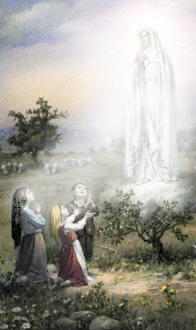
The are countless stories of people, even groups of people, that claim to have seen the Virgin Mary. These people are almost always Catholics and they take this as a sign that the Catholic Church is true and they are following God's correct path. Obviously if all these people are really witnessing visions of the Virgin Mary, then how can the LDS church be true?
There is a well-known vision of the Virgin Mary to three children at Fatima and subsequent regular visits and prophesies regarding world events. There's also a famous town in Egypt called Zeitoun where hundreds of people claimed to see images of St. Mary all at the same time.
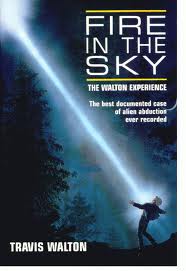
On November 5, 1975, seven men witnessed a spacecraft from another world hovering silently between tall pines in the Apache-Sitgreaves National forest of north-eastern Arizona. One of those men, Travis Walton, became an unwilling captive of an alien race when the other men fled in fear.
There were seven witnesses to this event. They all passed lie-detector tests and none of them have ever recanted their story. This was even made into a movie called 'Fire in the Sky' with James Garner playing the sheriff who investigated the story.
We don't know if the story is really true or not but if it is our country and even the world is in serious danger. Any human could be abducted by aliens at any time and subjected to horrific medical tests as Travis Walton claimed was performed on him by beings from another planet. Yet if it was true, wouldn't the governments and the people of the world be more concerned about this? Or is it that, despite the fact that we have seven honorable witnesses to the event and no evidence of a fraud, we really don't believe these witnesses? Link is here.
And of course there are countless others that have also claimed to have been abducted by aliens and the list grows every year.
The appearance of the angel Gabriel to Muhammad and his subsequent divine commission to bring forth new scripture that, today, is revered by approximately 2 billion Muslims the world over. Link is here.
There are many, many reported witnesses to UFOs, Bigfoot, the Lochness Monster, Abominable Snowman, alien abductions, gurus with magic powers, psychics, etc. There are literally hundreds of thousands of witnesses to these amazing phenomena. Should they be believed as well?
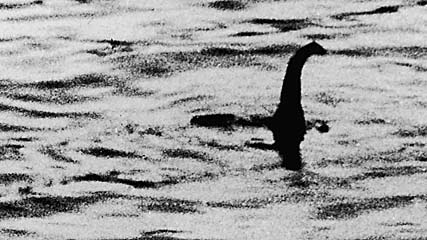
The famous Lochness Monster photo taken in 1934 by a surgeon was believed to be genuine by many people due to the credibility of the witness. It wasn't until March 1994 that it was revealed that the "surgeon's picture" was a practical joke after all by his son, Ian. There are many witnesses that claimed to have seen the Loch Ness Monster.
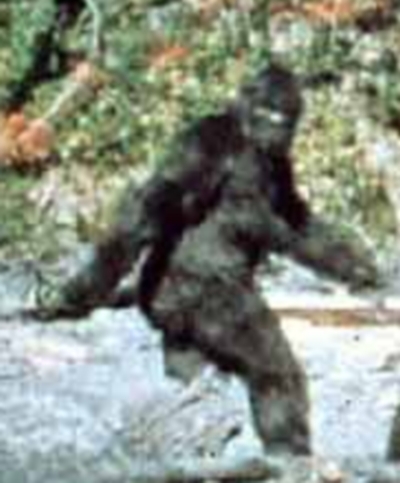
The famous 1967 Bigfoot video referred to as the Patterson video was believed by many people to be genuine as well. One of the main reasons was the credibility of one of the witnesses. He seemed very sincere in his statements and had a very good upstanding reputation as an honest man.
It wasn't until many years later that he started to believe that he was tricked. He now thinks he was carefully led down a ravine where someone had been waiting in an ape suit to purposely trick him. The best witness of course is someone that really believes he saw the event. The Book of Mormon witnesses may have been deceived as well and were not lying as far as they were concerned.
Many fantastic stories that have had numerous witnesses have been proved to be hoaxes yet many people still hold steadfast to their unbelievable claims. It just proves that there are many, many people that have said, and will say, they are witnesses to very improbable events. Many of these phenomena are in opposition to LDS church's beliefs, so all of these other amazing accounts can't be true despite the sheer number of witnesses, no matter how credible and sincere they seem to be.
What if the witnesses' story happened now instead of 200 years ago?
We wonder how many of us would actually believe the Book of Mormon witnesses if they lived today instead of the 19th century. Would you honestly believe a group of people that all told the story of some fantastic event if they lived when you did? Frankly it's easy to believe strange things as long as they happened a long time ago - the further back, the stranger e.g. Noah's Ark. But that doesn't mean it actually happened just because it was 200 years ago and not today.
Editor comment: Just because three witnesses signed a statement saying they saw an angel, doesn't mean it really happened or that it didn't happen either.
Comparing the BOM and Spalding witnesses.
Not all witnesses are the same. We can compare the witnesses for the Book of Mormon to the witnesses of Manuscript Found. Here are some critics' thoughts on that (thanks to Gary Porter and Craig Criddle for these):
1. The statement of the 3 witnesses for the Book of Mormon was a single statement signed by all three men. The statement of the 8 witnesses was also a single statement "signed" by all 8 men (Oliver Cowdery actually "signed" each of the eight witnesses' names). This has the appearance of fraud. By contrast, the Conneaut witnesses' statements were individually produced, dated and witnessed by Hurlbut and Howe.
2. The eight Conneaut witnesses signed affidavits that are quite different in content (contrary to Fawn Brodie's incorrect analysis). Their memories were not vague recollections made after reading the Book of Mormon. Spalding read his manuscript to them for entertainment, in a time before television, radio, or newspapers. They were thus reporting on actual events from memory witnessed with the physical senses, not "spiritual eyes". They lived in the vicinity of Spalding from 1809 to 1812, and personally knew him. One way to crosscheck memory accuracy is to seek corroborating evidence regarding the witnesses themselves – their reputations, attention to detail, memory skills, biases, and trustworthiness. Many were leading citizens of the community. One was John Spalding, Solomon's brother, who reportedly heard Manuscript Found repeatedly and in its entirety. Artemus Cunningham was owed money by Spalding. Another was Henry Lake, Solomon's business partner. Yet another, Aaron Wright, was a Justice of the Peace who investigated the mounds of Conneaut and described finding bones in the mounds that disintegrated when he dug them up. These were credible people, with no known conflicts of interest. These people had no connection to Mormonism either before or after their statements were published. They didn't retract or modify what was quoted in "Mormonism Unvailed".
3. Hurlbut went to Conneaut to collect statements because of previous allegations. Those allegations were made when Orson Hyde and Samuel Smith visited Conneaut and read from the Book of Mormon. Nehemiah King, a respected citizen of Conneaut, said they were reading from the book of his deceased friend Solomon. Later, Hurlbut traveled hundreds of miles searching for the Spalding manuscript. This indicates that he thought the Spalding manuscript was authentic.
4. Statements opposing the Conneaut witness statements were made at least a decade after the Conneaut witnesses gave their statements. This is important because the Conneaut witness statements were not attacked at the time their evidence was published. These people lived only 40 miles from Kirtland. Why didn't the Church point out faults in their statements at the time?
5. Eber Howe traveled to Conneaut to interview the witnesses and confirm the facts before he printed their statements.
6. Howe was friendly with Joseph Smith, had dinner at Joseph Smith's house after "Mormonism Unvailed" was published, and was married to a Mormon. "Mormonism Unvailed" is widely respected and widely quoted by both Mormon scholars and non-Mormon scholars. In it, Howe acknowledged that the Spalding manuscript he received from Hurlbut (the Oberlin Manuscript also called Manuscript Story) was not Manuscript Found, and he connects Rigdon to Spalding (more on that later). Howe later said he didn't know what happened to the Spalding manuscript he received from Howe but assumed it was lost in a fire after he sold the print shop. Later, the new print shop owner, L.L. Rice, found the manuscript among the texts shipped to Hawaii. These data do not indicate lying or bias on Howe's part.
7. The 8 Conneaut statements are the tip of the witness iceberg. At least 19 different witnesses linked Spalding to the Book of Mormon. Besides the eight published Conneaut witnesses, additional credible witnesses in Conneaut and in Amity, Pennsylvania, stated that they saw the actual Spalding manuscript, the one that identified Lehi and Nephi. The biggest problem with much of this evidence was the time period that elapsed between their encounters with Spalding's work and their statements. The earliest statements came 18-22 years after Spalding allegedly exposed them to his work; the latest came 74 years after the alleged encounter with Spalding. Old evidence is susceptible to memory fallibility, the possibility of witness tampering. The 8 Conneaut witnesses remembered events that transpired about 18-22 years before their statements were taken. To claim that the witnesses couldn't possibly remember the names or events after 18-22 years, is speculation. Most people remember many people's names and details after 18-22 years. I certainly do (even despite some memory problems).
Another way to crosscheck details of the testimony provided by the 8 Conneaut witnesses and later witnesses is to test the predictive power of their testimony. Based on their comments and Howe's analysis, we can expect to find a link between Spalding and Sidney Rigdon. A strong connection comes through the testimony of Rebecca Eichbaum. Eichbaum was the clerk in the Pittsburgh post office where Spalding and Rigdon collected their mail. Her testimony connects Spalding to Rigdon at the post office. It also connects Rigdon to printer Silas Engles and to J. Harrison Lambdin, the ward of Robert Patterson and eventual junior partner in the Patterson printing and book selling operation. But Eichbaum's testimony was not collected until September 18, 1872 - over 56 years after the alleged incidents! The reliability of her memory could certainly be a problem. Some form of independent confirmation is needed, and in her case, such a confirmation was possible. Several witnesses testified that Eichbaum had a superior memory and was superbly attentive to detail. But more impressive was the predictive power of her testimony: when researchers crosschecked her testimony by investigating post office records, they found the names of both Spalding and Rigdon on the same June 30, 1816, list of unclaimed letters. See: Link is here.
8. One of the later witnesses for Manuscript Found was Hurlbut's lawyer, Jason Briggs, who wrote five letters to newspapers later in his life claiming that he had seen and handled Manuscript Found in December of 1833. This lawyer had a distinguished career unrelated to Mormonism. Another person was J.D. Dowan, the Justice of the Peace who signed the warrant against Hurlbut. Dowan also had no alleged interest against Mormonism. His statement says that Spalding's manuscript conformed specifically to the Book of Mormon. The statement is attested by his grandchild, and is kept in the Chicago Historical Society.
9. The recent text analyses of the Book of Mormon appear consistent with statements made by the Conneaut witnesses and other witnesses of Manuscript Found, but are inconsistent with statements made by the Book of Mormon witnesses. This is also evidence of the predictive power of the Spalding witnesses: our recent text analyses could have disproved the Spalding-Rigdon theory, but failed to do so.
Editor comment: Faithful members would likely come up with explanations to counter these claims like the 3+8 witnesses signed a single statement because they so strongly agreed with their unified experience. However, this comparison shows some of the inherent weaknesses of the using just witnesses to prove historical events. This also underscores the weaknesses in the BOM process to obtain witnesses to verify the BOM.
Affidavits against Joseph
In contrast to what the BOM witnesses have stated, many members of the community that knew Joseph made the following sworn statements.
Many of these affidavits are in direct conflict with Joseph's account of the beginnings of the LDS Church. The following is an excerpt from just one of these affidavits. It is a signed affidavit sworn out by Peter Ingersall before Judge Baldwin of Wayne County Court in New York in December, 1833. He recounts what Joseph told him:
As I was passing, yesterday, across the woods, after a heavy shower of rain, I found, in a hollow, some beautiful white sand, that had been washed up by the water. I took off my frock, and tied up several quarts of it, and then went home. On my entering the house, I found the family at the table eating dinner. They were all anxious to know the contents of my frock. At that moment, I happened to think of what I had heard about a history found in Canada, called the golden Bible; so I very gravely told them it was the golden Bible.
To my surprise, they were credulous enough to believe what I said. Accordingly I told them that I had received a commandment to let no one see it, for, says I, no man can see it with the naked eye and live. However, I offered to take out the book and show it to them, but they refuse to see it, and left the room." Now, said Jo, "I have got the damned fools fixed, and will carry out the fun." Notwithstanding, he told me he had no such book, and believed there never was any such book, yet, he told me that he actually went to Willard Chase, to get him to make a chest, in which he might deposit his golden Bible. But, as Chase would not do it, he made a box himself, of clap-boards, and put it into a pillow case, and allowed people only to lift it, and feel of it through the case.
Mormonsim Unvailed, pp. 235-236.
Why should we believe all the Book of Mormon witnesses over the sworn affidavits of over dozens of unrelated townspeople?
Editor comment: The LDS church must find Ingersoll's affidavit somewhat credible as the Ensign magazine quoted from it, as well as Isaac Hale's affidavit, as historical sources in an article about Joseph Smith's early years.
Link is here.
And of course there are many other accounts from witnesses that offer damaging testimony against Joseph such as this encounter these men said they had with Joseph:
The testimony of the tile brick
[Joseph] Smith told a frightful story of the display of celestial pyrotechnics on the exposure to his view of the sacred book—the angel who had led him to the discovery again appearing as his guide and protector, and confronting ten thousand devils gathered there, with their menacing sulphureous flame and smoke, to deter him from his purpose! This story was repeated and magnified by the believers, and no doubt aided the experiment upon superstitious minds which eventuated so successfully.
Mr. Willard Chase, a carpenter and joiner, was called upon by Smith and requested to make a strong chest in which to keep the golden book under lock and key, in order to prevent the awful calamity that would follow against the person other than himself who should behold it with his natural eyes. He could not pay a shilling for the work, and therefore proposed to make Mr. Chase a sharer in the profits ultimately anticipated in some manner not definitely stated; but the proposition was rejected—the work was refused on the terms offered. It was understood, however, that the custodian of the precious treasure afterward in some way procured a chest for his purpose, which, with its sacred deposit, was kept in a dark garret of his father’s house, where the translations were subsequently made, as will be explained.
An anecdote touching this subject used to be related by William T. Hussey and Azel Vandruver. They were notorious wags, and were intimately acquainted with Smith. They called as his friends at his residence, and strongly importuned him for an inspection of the "golden book," offering to take upon themselves the risk of the death-penalty denounced. Of course, the request could not be complied with; but they were permitted to go to the chest with its owner, and see where the thing was, and observe its shape and size, concealed under a piece of thick canvas. Smith, with his accustomed solemnity of demeanor, positively persisting in his refusal to uncover it, Hussey became impetuous, and (suiting his action to his word) ejaculated, "Egad! I'll see the critter, live or die!" And stripping off the cover, a large tile-brick was exhibited. But Smith's fertile imagination was equal to the emergency. He claimed that his friends had been sold by a trick of his; and "treating" with the customary whisky hospitalities, the affair ended in good-nature.
Origin, Rise and Progress of Mormonism, Pomeroy Tucker, 1867, pp. 30-33.
(Note: others name 'Azel Vandruver' as "Ashley VanDuzer")
Also, mentioned in passing:
…He had an old glass box [i.e. a box used for holding plates or panes of glass] with a tile in it, about 7×8 inches, and that was the gold plates and Martin Harris didn't know a gold plate from a brick at this time.
Charles A Shook, "Statement from Lorenzo Saunders," 1885, printed by Charles A. Shook, The True Origin of the Book of Mormon, 1914, p. 135.
How should it have been done?
If someone was going to have witnesses to some earth-shattering event, and they wanted people to believe them, they would have done it very differently than Joseph did. The whole witnesses' portion of the BOM would have been much better served if the following things had been done:
- None of the witnesses should have been related to Joseph or each other. Most of the witnesses were either related or good friends. Having unrelated people as witnesses would be far more effective than using your brothers and father.
- The witnesses should not have already been eager believers. There should have been some skeptics.
- There should have been no financial motive. Martin Harris mortgaged his farm and invested at least $3,000 of his own money into printing the Book of Mormon, so of course he had incentive to 'promote' the book.
- Each of the witnesses should each have written their own testimony instead of merely signing a prepared statement written by Joseph. If the prepared document wasn't 100% accurate many people would simply sign it anyway as it would be too much of a hassle to have it completely rewritten by hand - especially in the 1800s.
- The witnesses should have been much more detailed about this amazing event. What did the angel look like? What exactly did he say? How did he speak? There are almost no details provided which can be analyzed and compared. If each witness had simply written their own account and provided significant details then their individual testimonies could corroborate each other.
- The witnesses should have been interviewed independently immediately after going public. They should have been interviewed the same way police do with witnesses to crimes or that investigators do with UFO cases. Ask questions to see if their stories match; How was the angel dressed? How tall was he? How did he speak?, etc.
- The witnesses should not have used subjective language and say strange things like comparing seeing the plates with seeing a city through a mountain or using spiritual eyes instead of their natural eyes to view physical plates
- The witnesses should not have been gullible people that believed in things like 'second sight', divining rods, finding treasure by placing a rock in a hat, etc. That the Three Witnesses were a gullible sort is illustrated by an incident in July, 1837. Joseph had left on a five-week missionary tour to Canada, only to find on his return that all three of the Witnesses had joined a faction opposing him. This faction rallied around a young girl who claimed to be a seeress by virtue of a black stone in which she read the future. David Whitmer, Martin Harris, and Oliver Cowdery all pledged her their loyalty, and Frederick G. Williams, formerly Joseph's First Counselor, became her scribe. The girl seeress would dance herself into a state of exhaustion, fall to the floor, and burst forth with revelations. (See Lucy Smith: Biographical Sketches, pp. 211-213).
- All of the witness should have been much more vocal and been interviewed much more often. There are very few interviews done with the witnesses that provide any additional information or corroboration of their statements. You would think that these people, after seeing such a magnificent sight, would spend their time testifying to the world about their experience instead of largely just signing a prepared statement and avoiding interviews by the media. Only three of the eight witnesses made separate statements that they had handled the plates. They were Joseph's two brothers, Hyrum and Samuel, and John Whitmer.
- And of course it would have helped had all the witnesses remained loyal to the Church for the rest of their lives instead of having most of them abandon it later on. It doesn't make much sense to leave the one, true Church of God if you have really received an indisputable witness that it was true. Why would these people risk being cast in Outer Darkness for all eternity for denying what they KNEW to be true unless they maybe had some doubts?
Governor Ford's thoughts
The governor of Illinois, Thomas Ford, who was very aware of the Mormon movement in his state, had given his own opinion as to how Joseph Smith collected the testimony of the witnesses, having known several well-known men of Smith's acquaintance:
... the witnesses were "set to continual prayer and other spiritual exercises." Then at last "he assembled them in a room, and produced a box, which he said contained the precious treasure. The lid was opened; the witnesses peeped into it, but making no discovery, for the box was empty, they said, "Brother Joseph, we do not see the plates." The prophet answered them, 'O ye of little faith! how long will God bear with this wicked and perverse generation? Down on your knees, brethren,every one of you, and pray God for the forgiveness of your sins '.. The disciples dropped to their knees, and began to pray in the fervency of their spirit, supplicating God for more than two hours with fanatical earnestness; at the end of which time, looking again into the box, they were now persuaded that they saw the plates."
Through the sheer force of Smith's suggestions, coercive threats and their own earnest desire to see what he said was there, yet obscured by their "sinfulness", the eight men "saw" the plates. This certainly is what Harris meant by seeing "plates" with the "eyes of faith" that did not exist. Cowdery's own admission that he didn't see the plates at all during the translation work and his spasms of wavering faith that they existed certainly aren't faith building for Mormons, but they are disarmingly candid admissions. What all of these men actually did was to help create a bogus set of testimonials to events and objects that never existed, except in their minds.
Note: Some LDS apologists state that Governor Ford did not make this hypothesis or at least he wasn't the first person to suggest this. Whether or not that is true, this hypothesis is a reasonable one and cannot be dismissed - regardless of who may have said it first.
No Man Knows My History by Fawn McKay Brodie
Link is here.
Testimony of Abagail and Lucy Harris
Here is some compelling testimony against Martin Harris, by two witnesses that knew him best:
Mrs. Abigail Harris: a sister-in-law of Martin Harris:
"... Martin Harris and Lucy Harris, his wife, were at my house [early part of winter, 1828]. In conversation with the Mormonites, she [Lucy Harris] observed that she wished her husband would quit them, as she believed it all false and a delusion. To which I heard Mr. Harris reply: 'What if it is a lie; if you will let me alone I will make money out of it!' I was both an eye- and ear-witness of what has been above stated, which is now fresh in my memory, and I speak the truth and lie not, God being my witness."
Lucy Harris: wife of Martin Harris:
"Whether the Mormon religion be true or false, I leave the world to judge; for its effects on Martin Harris have been to make him more cross, turbulent and abusive to me. His whole object was to make money out of it. I will give a proof of this. One day at Peter Harris' house (Abigail Harris' husband) I told him he had better leave the company of the Smiths, as their religion was false. To this he replied, "If you would let me alone, I could make money out of it.' It is in vain for the Mormons to deny these facts, as they are well known to most of his former neighbors."
Link is here.
Link is here.
Analogy
As an analogy, say that 11 witnesses claimed to have seen a murder. Would that be enough evidence to have somebody executed?
To make this comparable to the Book of Mormon witnesses, let's add some details. There are two stores across the street from each other, and the respective owners don't get along too well. One of the owners claims that his rival committed murder, and says that he can prove it because he captured the act on his store's video surveillance camera. Rather than submitting the tape to the police, he invites over 11 of his good friends and family members. He shows them the tape, and then asks that they sign a joint statement that he had earlier prepared. He then erases the tape.
No other evidence exists-there is no blood on the ground, no gunpowder residue on the hand of the accused, and no murder weapon. In fact, there isn't a body. There isn't even any evidence that the alleged victim even ever existed. All we have is the statement written by the shop owner and signed by his friends that they saw the video tape which then conveniently vanished.
Based solely on their joint statement, would you convict?
We're trying to illustrate a couple of things here. First, the testimony of the eleven witnesses has a contrived feeling to it. Usually, Joseph went to great lengths to prevent anybody from seeing the plates. There aren't any witnesses who were independent observers, much less reports from the careful examination of independent experts. We just have a couple of carefully orchestrated and contrived events followed by jointly signing previously-prepared statements.
Secondly, we're trying to illustrate what Grissom said, "Normally, an eyewitness is the least reliable evidence we have." If there were literally no physical evidence to support an eyewitness account of an event, and if the event in question is fantastical in nature, then the reasonable thing to do would be to disregard the witnesses.
Analytics
Was Joseph Smith a magician?
The following quote comes from BYU's website by LDS author, retired BYU professor and LDS historian Marvin S. Hill:
Now, most historians, Mormon or not, who work with the sources, accept as fact Joseph Smith's career as village magician. Too many of his closest friends and family admitted as much, and some of Joseph's own revelations support the contention.
Hill, Marvin S., Review of Roger Anderson's book, Joseph Smith's New York Reputation Reexamined.
We've all seen very impressive things that magicians can do from baffling us with amazing street magic to making the Statue of Liberty disappear. And most magic is not done with high-tech devices. Most magic is done with props and tricks possible to perform in the 19th century when Joseph lived.
In Michael's Quinn's book Early Mormonism and the Magic World View, he talks about a man named Walters the Magician who knew Joseph. He real name was likely Luman Walters. He was reportedly skilled in the art of hypnotism. He briefly joined the church. It's quite possible that Joseph may have learned enough hypnotism from Walters the Magician and used some form of it on the witnesses. Also possible that he used other magicians' tricks learned from Walters to make the witnesses believe they saw an angel.
Reference: Early Mormonism and the Magic World View, Quinn. (starting on page 117)
Dan Vogel also discusses Luman Walters:
Alvin and Willard worked under the direction of a man named Walters, later identified as Luman Walters, a traveling necromancer who offered his services for a fee. Saunders said: "At the time the big hole was dug in the hill they was duped by one Walters who pretended to be a conjurer. I heard Willard Chase say that he was duped. They could not be deceived in it after he had gone through with a certain movements and … charged them $7." Cole, who evidently took an interest in the activities that occurred on his property, said that the Manchester treasure seekers paid Walters three dollars per day.
Walters was more sophisticated and mature than Sally Chase. Sally indicated where treasure was located but was powerless in the face of the treasures' guardians. Walters, on the other hand, claimed to possess secret knowledge by which spells could be broken and guardian spirits vanquished. He appeared in Manchester with all the trappings of a medieval magician—"magic stone," "stuffed toad," "rusty sword" used for drawing magic circles on the ground, esoteric books written in Latin from which he read various incantations, and a flair for the dramatic. Cole reported in 1831 that "Walters assembled his nightly band of money diggers in the town of Manchester, at a point designated in his magical book, and drawing a circle around the laborers, with the point of an old rusty sword, and using sundry other incantations, for the purpose of propitiating the spirit, absolutely sacrificed a fowl, ('Rooster,') in the presence of his awe-stricken companions, to the foul spirit, whom ignorance had created, the guardian of hidden wealth; and after digging until day-light, his deluded employers retired to their several habitations, fatigued and disappointed." When no treasure was recovered and local inhabitants began to suspect Walters of fraud, the magician retreated to the mountains near Sodus Bay, a wilderness region in northern Wayne County on Lake Ontario. The magician had more to fear than dissatisfied clients because a New York law criminalized "all jugglers, and all persons pretending to have skill in physiognomy, palmistry, or like crafty science, or pretending [p. 38]to tell fortunes, or to discover where lost goods may be found." Usually authorities took no action against this type of "disorderly person" unless someone made a formal complaint and money had changed hands. Eventually the law caught up with Walters, for Cole reported in 1831 that he "was once committed to the jail of [Wayne] county for juggling."
Not long after Walters left Manchester, Joseph Smith Jr. began to fill the void left by his departure, perhaps at the urging of Alvin or his father. Impressed by Walters's theatrical style, Joseph successfully imitated some of the older magician's flair, and Cole opined that the "mantle" of Walters had fallen upon the young man. First of all, Joseph had to establish himself as a credible seer and cultivate a reputation of his own. Reputation was everything to a would-be seer, and Joseph was adept and resourceful in this endeavor.
Joseph Smith: The Making of a Prophet, Chapter 4: "Slippery Treasures," Dan Vogel.
Joseph's Persuasive Abilities
- Joseph was able to convince people to pay him to locate buried treasure by looking at a rock placed in his hat. Of course he never found any treasure.
- Joseph was able to convince Martin Harris that if he looked at the golden plates, God would strike him dead.
- Joseph was able to convince dozens of women that an angel with a sword threatened his life if he did not marry them all.
- Joseph was able to convince men, that bones theyfound in Illinois were those from a white, Lamanite warrior named Zelph.
- Joseph was able to convince many people that Egyptians scrolls were written by the hand of Abraham and that he could translate them.
- Joseph was able to convince his followers that a pile of rocks they stumbled upon in Missouri was once an alter built by Adam 6,000 years ago.
- Joseph was able to convince people that the bones buried in a mound in Kinderhook, Illinois were from an ancient Jaredite and that he could translate the plates found with him.(plates were later proven to be a forgery).
Even if all of that were true, Joseph had a remarkable talent to be able to persuade people to believe what most people would consider totally absurd.
Did Oliver Cowdery deny his testimony?
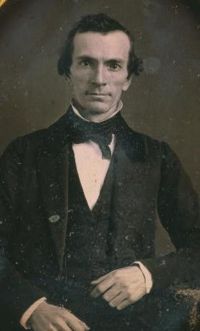
There is no hardcore evidence that Oliver denied his testimony. The church has always maintained that Oliver held true to his testimony even after he left the church and this is supported by statements made by David Whitmer and others. But there are several reports suggesting perhaps Oliver did deny his testimony, if only briefly or in confidence.
The Poem
A poem is hardly convincing evidence but the fact that it was printed in the LDS Church-owned newspaper Times and Seasons (of which Joseph Smith was editor) gives it some credibility:
Amazed with wonder! I look round
Or prove that Christ was not the Lord
To see most people of our day,
Because Peter cursed and swore?
Reject the glorious gospel sound,
Or Book of Mormon not his word
Because the simple turn away.
Because denied, by Oliver?
Or does it prove there is no time,
Or prove, that Joseph Smith is false
Because some watches will not go?
Because apostates say tis so?
…
Poetry, For the Times and Seasons, by J.H. Johnsons, Vol. 2, p.482, Thursday, July 15, 1841. (emphasis added)
Cowdery's law partner claims Oliver admitted it was a hoax
Please Note:We removed the Lang letter because it has never been verified by others and based on the notes Dale Broadhurst made concerning the Lang letter:
Note 1: The above reproduced letter of Judge William Lang was apparently written to him, during his lifetime, to Thomas Gregg of Illinois. Gregg did not include the letter in his 1890 book, The Prophet of Palmyra, but his heirs or family passed this and other documents from Mr. Gregg's papers to the "American Anti-Mormon Association" some time after Gregg's death in 1892. The original of Lang's Nov. 5, 1881 letter has been lost and there is now no way to check that document against R. B. Neal's purported typescript to confirm the accuracy of the published text. Some modern researchers have expressed their suspicion that paragraphs 3 and 4 or this text were not contained in Lang's holograph and were inserted prior to R. B. Neal's 1907 publication of the contents.
Note 2: Judge Lang's 1881 letter was again published by R. B. Neal, late in 1906 or early in 1907, as a part of his Anti-Mormon Tracts, No. 9. The text was also reproduced by Charles A. Shook, in a slightly different format, on pages 55-57 of his 1914 book, The True Origin of the Book of Mormon, where Shook mentions that it had originally been "addressed to Thomas Gregg, of Hamilton, Illinois," and that "The letters of Lang, Gibson and Mrs. Bernard have been turned over to the American Anti-Mormon Association by the family of Th. Gregg, to whom they are addressed. I have made these copies directly from the originals." If Shook's assertion in this regard can be trusted, he saw Judge Lang's 1881 holograph and took his typescript from the original -- but it is also possible that R. B. Neal gave Shook only photocopies of the Lang letter to work from and that one of those photocopies was a "doctored" image.
Note 3: Neal must have received some skeptical inquiries concerning his publication of Judge Lang's 1881 letter, for he takes up the matter again in issue 7 of his second volume of "Sword of Laban" leaflets. There he prints his recently received (May, 18, 1907) letter from Judge Lang's son, who confirms that Neal had published his father's letter "correctly" and that the handwriting in the original was his father's. Although this reply appears to clinch the authenticity controversy in Neal's favor, it is still possible that he or one of his associates managed to insert a few sentences into the letter at the time of its initial publication. Judge Lang's purported 1881 reference to Solomon Spalding's "Manuscript Found" should be viewed with a modicum of scholarly distrust.
"Robert B. Neal Anti-Mormon Leaflets," Joseph Smith's History Vaults.
Former apostle claims Oliver admitted Book of Mormon was a fraud
Also, former apostle William McLellin, who left the church and later wrote against it, once remarked to that
…[i]t was a favorite practice with him when half drunk to preach a Mormon sermon. When visited by any of the Saints, or a stranger, he invariably asserted the truth of his "testimony;" but among his friends privately he admitted that it was "all a bottle of smoke."
The Salt Lake Daily Tribune, Vol. IX No. 147, Wednesday, October 6, 1875.
Joseph's Neighbor corroborates Oliver Cowdery was a conspirator
Lorenzo Saunders, a neighbor of the Smith's, gave statements in 1885 and 1887 implicating both Oliver Cowdery and Sidney Rigdon in the production of the Book of Mormon.
In his 1885 statement, Saunders said:
As respecting Oliver Cowdery, he came from Kirtland in the summer of 1826 and was about there [i.e. the Smith's farm] until fall and took a school in the district where the Smiths lived and the next summer he was missing and I didn't see him until fall and he came back and took our school in the district where we lived and taught about a week and went to the schoolboard and wanted the board to let him off and they did and he went to Smith and went to writing the Book of Mormon and wrote all winter. The Mormons say it wasn't wrote there but I say it was because I was there. I saw Sidney Rigdon in the spring of 1827, about the middle of March. I went to Smiths to eat maple sugar, and I saw five or six men standing in a group and there was one among them better dressed than the rest and I asked Harrison Smith who he was and he said his name was Sidney Rigdon, a friend of Joseph's from Pennsylvania.
I saw him in the Fall of 1827 on the road between where I lived and Palmyra, with Joseph. I was with a man by the name of Ingersol. They talked together and when he went on I asked Ingersol who he was and he said it was Rigdon. Then in the summer of 1828 I saw him at Samuel Lawrence's just before harvest. I was cutting corn for Lawrence and went to dinner and he took dinner with us and when dinner was over they went into another room and I didn't see him again till he came to Palmyra to preach. You wanted to know how Smith acted about it. The next morning after he claimed to have got plates he came to our house and said he had got the plates and what a struggle he had in getting home with them. Two men tackled him and he fought and knocked them both down and made his escape and secured the plates and had them safe and secure. He showed his thumb where he bruised it in fighting those men.
After [he] went from the house, my mother says 'What a liar Joseph Smith is; he lies every word he says; I know he lies because he looks so guilty; he can't see out of his eyes; how dare [he] tell such a lie as that.' The time he claimed to have taken the plates from the hill was on the 22 day of September, in 1827, and I went on the next Sunday following with five or six other ones and we hunted the side hill by course [i.e. "in a search pattern"] and could not find no place where the ground had been broke. There was a large hole where the money diggers had dug a year or two before, but no fresh dirt. There never was such a hole; there never was any plates taken out of that hill nor any other hill in country, was in Wayne county. It is all a lie. No, sir, I never saw the plates nor no one else. He had an old glass box [i.e. a box used for holding plates or panes of glass] with a tile in it, about 7x8 inches, and that was the gold plates[;] and Martin Harris didn't know a gold plate from a brick at this time.
Smith and Rigdon had an intimacy but it was very secret and still and there was a mediator between them and that was Cowdery. The manuscript was stolen by Rigdon and modelled over by him and then handed over to Cowdery and he copied them and Smith sat behind the curtain and handed them out to Cowdery and as fast as Cowdery copied them, they was handed over to Martin Harris and he took them to Egbert Granden [sic], the one who printed them, and Gilbert set the type."
Lorenzo Saunders, Letter to Thomas Gregg, 28 January 1885, Charles A. Shook, The True Origin of the Book of Mormon (Cincinnati, Ohio: Standard Publishing Co., 1914, p. 132-33). Cited in: Dan Vogel, ed., Early Mormon Documents, 3 vols. (Salt Lake City: Signature Books, 1996-2000, 3:177-79.
Critic's comment: Although the reported admission by Oliver Cowdery from Judge Lang and William McLellin are only the purported testimonies of two men, why should they be merely dismissed? Their testimonies, as well as others that corroborated their stories such as Lorenzo Saunders, should be given consideration as well in the absence of evidence to the contrary.
Other witnesses testified that Sidney Rigdon told them about the Book of Mormon
Aside from those that claimed that Oliver Cowdery admitted that the Book of Mormon originated with Solomon Spalding's unpublished manuscript, there are also witnesses that testified that Sidney Rigdon personally told them the same thing. Here's one of them:
STATEMENT OF JAMES JEFFERY.
I know more about the Mormons than any man east of the Alleghenies, although I have given no attention to the matter for twenty-five years. I did not know I was in possession of any information concerning the Book of Mormon unknown to others. I supposed that as Rigdon was so open with me, he had told others the same things.
Forty years ago I was in business in St. Louis. The Mormons then had their temple in Nauvoo, Ill. I had business transactions with them. Sidney Rigdon I knew very well. He was general manager of the affairs of the Mormons.
Rigdon, in hours of conversation told me a number of times there was in the printing office with which he was connected in Ohio, a manuscript of Rev. Spaulding, tracing the origin of the Indian race from the lost tribes of Israel; that this manuscript was in the office for several years; that he was familiar with it; that Spaulding had wanted it printed, but had not the money to pay for the printing; that he (Rigdon) and Joe Smith used to look over the manuscript and read it over Sundays.
Rigdon and Smith took the manuscript and said -- "I'll print it," and went off to Palmyra, N. Y.
I never knew the information was of any importance -- thought others were aware of these facts. I do not now think the matter is of any importance. It will not injure Mormonism. That is an "ism," and chimes in with the wishes of certain classes of people. Nothing will put it down but the strong arm of the law. Otherwise it will go on forever, like Tennyson's "Brook."
This is the substance of what I remember about the matter. JAMES JEFFERY.
I hereby certify that I wrote the above paper at the dictation of Mr. James Jeffery, in the presence of Mrs. James Jeffery, and and Dr. John M. Finney. (Rev.) CALVIN D. WILSON.
Mrs. James Jeffery. |
J. M. Finney, M. D. |Witnesses.
Churchville, Hartford Co., Md., Jan. 29, 1884.
"Statement of James Jeffrey," Presbyterian Banner, Pittsburgh, February 13, 1884, Vol. LXX, No. 25.
Dale Broadhurst has amassed a collection of various 1800s newspaper articles that report many accounts of those that support the Spalding Theory and witnesses that claimed Sidney Rigdon admitted his involvement in producing the Book of Mormon. Link is here. [archived backup here]
Why did Oliver rejoin the Saints?
The question many people have is why did Oliver rejoin the Saints if he was an apostate or if he was a co-conspirator? Some people believe that when Oliver rejoined the Saints he did it because he was hoping he could convince the Saints to abandon polygamy which he was strongly against. Unfortunately Oliver died of consumption in Missouri at the home of fellow witness David Whitmer shortly after attempting the journey out West at age 43.
It's interesting to note that Cowdery's funeral was conducted by a Methodist church and not the Mormon church.
Oliver's Integrity
Oliver's honesty has been questioned as evidenced by this article in the June 1838 "Far West":
After Oliver Cowdery had been taken by a state warrant for stealing, and the stolen property found in the house of William W. Phelps; in which nefarious transaction, John Whitmer had also participated. Oliver Cowdery stole the property, conveyed it to John Whitmer, and John Whitmer to William W. Phelps; and then the officers of law found it. While, in the hands of an officer, and under arrest for this vile transaction, and, if possible, to hide your shame from the world, like criminals (which indeed you were), you appealed to our beloved presidents, Joseph Smith, jr. and Sidney Rigdon, men whose characters you had endeavored to destroy by every artifice you could invent, not even the basest lying excepted; and did you find them revengeful? No; but notwithstanding all your scandalous attacks, still such was the nobleness of their character, that even vile enemies could not appeal to them in vain. They enlisted, as you well know, their influence, to save you from your just fate; and they, by their influence, delivered you out of the hands of the officer. While you were pleading with them, you promised reformation; you bound yourselves by the most solemn promises that you would never be employed again in abusing any of the citizens of Caldwell; and by such condescensions did you attempt to escape the work house. But now for the sequel. Did you practice the promised reformation? You know you did not; but, by secret efforts, continued to practise your iniquity, and secretly to injure their character, notwithstanding their kindness to you. Are such things to be borne? You yourselves would answer that they are insufferable, if you were to answer according to the feelings of your own hearts. As we design this paper to be published to the world, we will give an epitome of your scandalous conduct and treachery for the last two years. We wish to remind you, that Oliver Cowdery and David Whitmer were among the principal of those who were the means of gathering us to this place, by their testimony which they gave concerning the plates of the Book of Mormon, that they were shown to them by an angel, which testimony we believe, now, as much as before you had so scandalously disgraced it. You commenced your wickedness by heading a party to disturb the worship of the saints in the first day of the week, and made the house of the Lord, in Kirtland, to be a scene of abuse and slander, to destroy the reputation of those whom the church had appointed to be their teachers, and for no other cause only that you were not the persons.
"The saints in Kirtland, having elected Oliver Cowdery to be a justice of the peace, he used the power of that office to take their most sacred rights from them, and that contrary to law.
The article continues here: Link is here.
Oliver's belief in divining rods
Oliver had a strong belief in using divining rods for revelatory purposes. For more on this, see the Rod of Aaron.
Brief Summary of Oliver's life
OLIVER COWDERY - Was born in Wells, Vermont in 1806. He reportedly learned about JS and his alleged vision, when he was boarding in the home of JS's parents. Oliver Cowdery and Joseph Smith were third or fourth cousins. At the time, his profession was as a clerk, and schoolteacher. In 1829 he was baptized. He signed his name as witness to the BoM in 1830 at the age of 24. On December 18, 1832, he married Elizabeth Ann Whitmer, who was the daughter of Peter Whitmer [one of the 8 witnesses to the BoM] and sister of David Whitmer [one of the 3 witnesses]. He and Elizabeth had six children. Only one daughter, Maria Louise Cowdery, reached adulthood. In 1834 he served as Assistant President of the Church. Oliver had many issues with the early church, as well as personally with JS. Many say his final breaking point with the church stemmed from his unwillingness to accept the revelation concerning plural marriage. He was EXCOMMUNICATED on April 12, 1838. After his excommunication he studied law and became an attorney. In 1848, ten years after he was excommunicated, Oliver re-applied for membership in the church and was re-baptized. He never again held office within the church. Oliver Cowdery died in March of 1850 in Richmond, Missouri at the age of forty-three. He did not die in Utah, but at the home of fellow witness David Whitmer, who had been excommunicated from the church.
From the neutral source Wikipedia (on 4/6/13):
Family background
Cowdery was born October 3, 1806 in Wells, Vermont. His father, William, was a farmer who moved the family to Poultney, Vermont when Oliver was three.[3] William Cowdery may have been a follower of the sectarian leader Nathaniel Wood of Middletown, Vermont, whose small religious sect, the "New Israelites," practiced divining for buried treasure and for revelatory purposes.[4]
View of the Hebrews controversy
The Cowdery family attended the Congregational Church of Poultney, Vermont, where Ethan Smith was pastor for several years.[5] At the time, Ethan Smith was writing View of the Hebrews (1823), one of many books written during the period speculating that Native Americans were of Hebrew origin.[6] In 2000 David Persuitte argued that Cowdery's knowledge of View of the Hebrews significantly contributed to the final version of the Book of Mormon,[7] a connection first suggested as early as 1902.[8] Fawn Brodie wrote in her biography of Smith that it "may never be proved that Joseph saw View of the Hebrews before writing the Book of Mormon, but the striking parallelisms between the two books hardly leave a case for mere coincidence."[9] Mormon scholars Richard Bushman and John W. Welch reject the connection and argue that there is little relationship between the contents of the two books.[10]
Youth
Cowdery was reared in Poultney, but he clerked at a store in New York for several years before beginning to teach school in Manchester in 1829.[11] Cowdery lodged at different houses in the Manchester area, including that of Joseph Smith, Sr., who was said to have provided Cowdery with additional information about the golden plates of which he had heard "from all quarters."[12]
Book of Mormon scribe and witness
Cowdery met Joseph Smith, Jr. on April 5, 1829—a year and a day before the official founding of the church—and heard from him how he had received golden plates containing ancient Native American writings.[13] Like Smith, who was a distant relative,[14] during his youth, Cowdery had engaged in hunting for buried treasure and had used a divining rod.[15] Cowdery told Smith that he had seen the golden plates in a vision before the two ever met.[16]
From April 7 to June 1829, Cowdery acted as Smith's primary scribe for the translation of the plates into what would later become the Book of Mormon. Cowdery unsuccessfully attempted to translate part of the Book of Mormon by himself.[17] Before meeting Cowdery, Joseph Smith had come to a standstill on his translation after the first 116 pages were lost by Martin Harris. But after Smith met Cowdery, he completed the manuscript in a remarkably short period (April–June 1829) during what Richard Bushman called a "burst of rapid-fire translation." [18]
On May 15, 1829, Cowdery and Smith said that they received the Aaronic priesthood from John the Baptist, after which they baptized each other in the Susquehanna River.[19] Cowdery said that he and Smith later went into the forest and prayed "until a glorious light encircled us, and as we arose on account of the light, three persons stood before us dressed in white, their faces beaming with glory." One of the three announced that he was the Apostle Peter and said the others were the apostles James and John.[20]
Later that year, Cowdery reported sharing a vision, along with Smith and David Whitmer, in which an angel showed him the golden plates. Martin Harris said he saw a similar vision later that day, and Cowdery, Whitmer and Harris signed a statement to that effect. They became known as the Three Witnesses, and their testimony has been published with nearly every edition of the Book of Mormon.
Cowdery once said: "I wrote, with my own pen, the entire Book of Mormon (save a few pages) as it fell from the lips of the Prophet Joseph, as he translated it by the gift and power of God, by the means of the Urim and Thummim, or as it is called by the book, Holy Interpreters. I beheld with my eyes, and handled with my hands, the gold plates from which it was transcribed. I also saw with my eyes and handled with my hands the Holy Interpreters. That book is true. Sidney Rigdon did not write it. Mr. Spaulding did not write it. I wrote it myself as it fell from the lips of the prophet.It contains the everlasting gospel, and came forth to the children of men in fulfillment of the revelations of John, where he says he saw an angel come with the everlasting gospel to preach to every nation, kindred, tongue and people. It contains principles of salvation; and if you, my hearers, will walk by its light and obey its precepts, you will be saved with an everlasting salvation in the kingdom of God on high."[21]
Second Elder of the church
When the Church was organized on April 6, 1830, Joseph Smith, Jr. became "First Elder" and Cowdery "Second Elder." Although Cowdery was technically second in authority to Smith from the organization of the church through 1838, in practice Sidney Rigdon, Smith's "spokesman" and counselor in the First Presidency, began to supplant Cowdery as early as 1831. Cowdery held the position of Assistant President of the Church from 1834 until his excommunication in 1838.[22]
On December 18, 1832, Cowdery married Elizabeth Ann Whitmer, the daughter of Peter Whitmer, Sr. and sister of David, John, Jacob and Peter Whitmer, Jr.. They had five children, of whom only one daughter survived to maturity.[23]
Cowdery helped Smith publish a series of Smith's revelations first called the Book of Commandments and later, as revised and expanded, the Doctrine and Covenants. Cowdery was also the editor or on the editorial board of several early church publications, including the Evening and Morning Star, the Messenger and Advocate, and the Northern Times.
When the Church created a bank known as the Kirtland Safety Society in 1837, Cowdery obtained the money-printing plates. Sent by Smith to Monroe, Michigan, he became president of the Bank of Monroe, in which the church had a controlling interest.[24] Both banks failed that same year. Cowdery moved to the newly founded Latter-day Saints settlement in Far West, Missouri and suffered ill health through the winter of 1837-38.
Early written history of the church
In 1834 and 1835, with the help of Smith, Cowdery published a contribution to an anticipated "full history of the rise of the church of Latter Day Saints" as a series of articles in the church's Messenger and Advocate. His version was not entirely congruent with the later official history of the church.[25] For instance, Cowdery ignored the First Vision but described an angel (rather than God or Jesus) who called Smith to his work in September 1823. He placed the religious revival that inspired Smith in 1823 (rather than 1820) and stated that this revival experience had caused Smith to pray in his bedroom (rather than the woods of the official history).[26] Further, after first asserting that the revival had occurred in 1821, when Smith was in his "fifteenth year," Cowdery corrected the date to 1823—Smith's 17th (actually, 18th) year.[27]
Excommunication
By early 1838, Smith and Cowdery disagreed on three significant issues. First, Cowdery competed with Smith for leadership of the new church and "disagreed with the Prophet's economic and political program and sought a personal financial independence [from the] Zion society that Joseph Smith envisioned."[28] Then too, in March 1838, Smith and Rigdon moved to Far West, which had been under the presidency of W. W. Phelps and Cowdery's brothers-in-law, David and John Whitmer. There Smith and Rigdon took charge of the Missouri church and initiated policies that Cowdery, Phelps, and the Whitmers believed violated separation of church and state. Finally, in January 1838, Cowdery wrote his brother Warren that he and Joseph Smith had "had some conversation in which in every instance I did not fail to affirm that which I had said was strictly true. A dirty, nasty, filthy affair of his and Fanny Alger's was talked over in which I strictly declared that I had never deserted from the truth in the matter, and as I supposed was admitted by himself." Alger, a teenage maid living with the Smiths, may have been Joseph Smith's first plural wife, a practice that Cowdery opposed.[29]
On April 12, 1838, a church court excommunicated Cowdery after he failed to appear at a hearing on his membership and sent a letter resigning from the Church instead.[30] David Whitmer was also excommunicated from the church at the same time and apostle Lyman E. Johnson was disfellowshipped;[31] John Whitmer and Phelps had been excommunicated for similar reasons a month earlier.[32]
Cowdery and the Whitmers became known as "the dissenters," but they continued to live in and around Far West, where they owned a great deal of property. On June 17, 1838, President Sidney Rigdon announced to a large Mormon congregation that the dissenters were "as salt that had lost its savor" and that it was the duty of the faithful to cast them out "to be trodden beneath the feet of men." Cowdery and the Whitmers, taking this Salt Sermon as a threat against their lives and as an implicit instruction to the Danites, a secret vigilante group, fled the county. Stories about their treatment circulated in nearby non-Mormon communities and increased the tension that led to the 1838 Mormon War.[33]
Life apart from the church
From 1838 to 1848, Cowdery put the Latter Day Saints church behind him. He studied law and practiced at Tiffin, Ohio, where he became a civic and political leader. Cowdery also joined the Methodist church there and served as secretary in 1844.[34] He edited the local Democratic newspaper until it was learned that he was one of the Book of Mormon witnesses; then he was assigned as assistant editor. In 1846, Cowdery was nominated as his district's Democratic party candidate for the state senate, but when his Mormon background was discovered, he was defeated.[35] Some contemporary Mormons believed that Cowdery had denied his testimony to the Book of Mormon,[36][37] but there is no direct evidence of this, and Cowdery may even have repeated his testimony while estranged from the church.[35][38]
After Joseph Smith was assassinated, Cowdery's brother Lyman recognized James J. Strang as Smith's successor to the church presidency, and in 1847, Oliver moved to Elkhorn, Wisconsin near Strang's headquarters in Voree and entered law practice with his brother. He became co-editor of the Walworth County Democrat and in 1848 he ran for state assemblyman. However, his Mormon ties were revealed and he was defeated.[35]
Return to Latter-day Saint church
In 1848, Cowdery traveled to meet with followers of Brigham Young and the Quorum of the Twelve encamped at Winter Quarters, Nebraska, and he asked to be reunited with the Church.[39] The Quorum of the Twelve referred the application to the high council in Pottawattamie County, Iowa. The Pottawattamie high council convened a combined meeting of the high council and all high priests in the area to consider the matter. After Cowdery convinced the meeting attendees that he no longer maintained any claim to leadership within the church, the Pottawattamie high council and high priests in attendance unanimously approved his application for rebaptism.[40] On November 12, 1848, Cowdery was rebaptized into The Church of Jesus Christ of Latter-day Saints by Orson Hyde of the Quorum of the Twelve in Indian Creek at Kanesville, Iowa.
After his rebaptism, Cowdery desired to relocate to Utah Territory in the coming spring or summer, but due to financial and health problems he decided that he would not be able to make the journey in 1849.[40] Because he was not with the Latter-day Saints in Utah, Cowdery was not immediately given a position of responsibility in the church, but in July 1849 Brigham Young wrote Cowdery a letter inviting him to travel to Washington, D.C. with Almon W. Babbitt to publicize Utah Territory's desire for statehood and to draft a formal statehood application.[40] Cowdery's deteriorating health did not allow him to accept this assignment, and within eight months he had died.
Shortly before Cowdery died of a respiratory illness, he was visited by Jacob Gates, an early Mormon leader in the church, who inquired about his witness concerning the Book of Mormon. Cowdery reaffirmed his witness saying,[41][42]
"Jacob, I want you to remember what I say to you. I am a dying man, and what would it profit me to tell you a lie? I know,' said he, 'that this Book of Mormon was translated by the gift and power of God. My eyes saw, my ears heard, and my understanding was touched, and I know that whereof I testified is true. It was no dream, no vain imagination of the mind—it was real".
On March 3, 1850, Cowdery died in David Whitmer's home in Richmond, Missouri.[43]
Footnotes
1. On 1841-01-24, Hyrum Smith was ordained and replaced Cowdery as Assistant President of the Church.
2. Prior to the winter of 1830-31, Cowdery generally signed his name "Oliver H P Cowdery", the "H P" possibly standing for "Hervy" and "Pliny," two of his father's relatives. For unknown reasons, Cowdery discontinued using his middle initials about 1831. Cowdery may have wished his name to match the form in which it was printed in the 1830 Book of Mormon. [1]. It is also possible that teasing by the Palmyra Reflector (June 1, 1830) about his "pretentious moniker" may have influenced Cowdery to abandon the initials.
3. Preston Nibley, Oliver Cowdery: His Life, Character and Testimony (Salt Lake City: Deseret Book, 1958)
4. D. Michael Quinn, Early Mormonism and the Magic World View, Revised and enlarged (Salt Lake City: Signature Books, 1998), 34-36; Alan Taylor, "The New Jerusalem of the American Frontier", Vanderbilt University; Barnes Frisbie, The History of Middletown, Vermont in Three Discourses.... (Rutland, VT: Tuttle and Company, 1867), 43, 62; Richard Abanes, One Nation Under Gods: A History of the Mormon Church (New York: Four Walls Eight Windows, 2002), 88: "William Cowdery, yet another rodsman, spent several years in the Vermont-based New Israelite sect. This group was led by Nathanial Wood, a visionary, who coincidentally, claimed to possess the powers of revelation as a literal descendant of the Lost Tribes of Israel."
5. Grant H. Palmer, An Insider's View of Mormon Origins (Salt Lake City: Signature Books, 2002), 58-60.
6. During the colonial and early national periods, many Americans speculated about a possible connection between the Hebrews and the Americans Indians. Richard Bushman, Rough Stone Rolling, 94-97.
7. David Persuitte, Joseph Smith and the Origins of the Book of Mormon (McFarland & Company, 2000), 125: "Oliver Cowdery surely had a copy of View of the Hebrews—a book that was published in his home town of Poultney, Vermont by the minister of the church his family was associated with. Considering his joint venture with Joseph Smith in 'translating' The Book of Mormon and the common subject matter, Cowdery could have shared his copy of Ethan Smith's book with Joseph, perhaps even sometime before Joseph began the 'translation' process."
8. I. Woodbridge Riley, The Founder of Mormonism (New York: Dodd, Mead & Company, 1902), 124-26.
9. Fawn Brodie, No Man Knows My History (New York: Alfred A. Knopf, 1971), 47.
10. John W. Welch, Reexploring the Book of Mormon, 83-7, and A Sure Foundation: Answers to Difficult Gospel Questions (Salt Lake City: Deseret Book, 1988); John W. Welch, "An Unparallel" (Provo, Utah: FARMS, 1985); Spencer J. Palmer and William L. Knecht, "View of the Hebrews: Substitute for Inspiration?" BYU Studies 5/2 (1964): 105-13.
11. Lucy Cowdery Young to Andrew Jenson, March 7, 1887, Church Archives
12. Dan Vogel, Joseph Smith: The Making of a Prophet (Salt Lake City: Signature Books, 2004), 154; Junius F. Wells, "Oliver Cowdery", Improvement Era XIV:5 (March 1911); Lucy Mack Smith, "Preliminary Manuscript," 90 in Early Mormon Documents 1: 374-75.
13. Joseph Smith—History 1:66.
14. Cowdery genealogy; Richard L. Bushman, Joseph Smith and the Beginnings of Mormonism, (Champaign: University of Illinois Press, 1984), 222; Bushman, RSR, 578, n.51. There is also a distant geographical connection between the Smiths and the Cowderys. During the 1790s, both Joseph Smith, Sr. and two of Oliver Cowdery's relatives were living in Tunbridge, Vermont.
15. EMD, 1: 603-05, 619-20; Quinn, 37.
16. Grant Palmer, An Insider's View of Mormon Origins (Salt Lake City, Utah: Signature Books, 2002), 179. According to Lucy Mack Smith, the "Lord appeared unto a young man by the name of Oliver Cowdery and showed unto him the plates in a vision." EMD 1: 379.
17. History of the Church 1:36-38; D&C 8, 9.
18. Joseph Smith: Rough Stone Rolling (New York: Alfred A. Knopf, 2005), 70
19. Messenger and Advocate 1:14–16 (October 1834); Bushman, 74–75.
20. Charles M. Nielsen to Heber Grant, February 10, 1898, in Dan Vogel, ed., Early Mormon Documents (Salt Lake City, Utah: Signature Books, 1998), 2: 476; History of the Church 1:39-42.
21. (Oliver Cowdery, cited in Andrew Jenson, LDS Biographical Encyclopedia [Salt Lake City: Andrew Jenson History Company, 1901], 1:246.)
22. Bushman, 124; Dan Vogel, Joseph Smith: The Making of a Prophet (Salt Lake City: Signature Books, 2004), 548.
23. Maria Louise Cowdery, born August 11, 1835.
24. See Mark L. Staker, "Raising Money in Righteousness: Oliver Cowdery as Banker," in Days Never to Be Forgotten: Oliver Cowdery, ed. Alexander L. Baugh (Provo, UT: Religious Studies Center, Brigham Young University, 2009), 143–254.
25. W. W. Phelps to Oliver Cowdery, December 25, 1834, EMD, 3: 28
26. Grant Palmer, An Insider's View of Mormon Origins (Salt Lake City: Signature Books, 2002), 239; Richard Abanes, One Nation Under Gods: A History of the Mormon Church (New York: Four Walls Eight Windows, 2002), 26; Vogel, EMD, 2: 428.
27. Cowdery said that the final battle between the Nephites and the Lamanites had occurred in the vicinity of the Hill Cumorah, where Smith claimed he found the golden plates. There is little evidence for mass graves for tens of thousands of soldiers at the site. Most modern Mormon apologists now argue that the events likely took place in Central America. Messenger and Advocate, 1, no. 3 (December 1834),42, 78-79. "You will recollect that I mentioned the time of a religious excitement, in Palmyra and vicinity to have been in the 15th year of our brother J. Smith Jr.'s age — that was an error in the type — it should have been in the 17th. — You will please remember this correction, as it will be necessary for the full understanding of what will follow in time. This would bring the date down to the year 1823."
28. "Cowdery, Oliver". Encyclopedia of Mormonism 1. Macmillan Publishing Company. 1992. Retrieved 2006-08-02.
29. Richard Bushman, Rough Stone Rolling, 323-25, 347-49.
30. Bushman, 347–48. Among other things, Cowdery was accused of "virtually denying the faith by declaring that he would not be governed by any ecclesiastical authority nor Revelations whatever in his temporal affairs."
31. History of the Church 3:16–20.
32. History of the Church 3:7.
33. Richard Lyman Bushman, Joseph Smith: Rough Stone Rolling (New York: Alfred A. Knopf, 2005), 349-53.
34. Vogel, ed. EMD, 2: 504. One Gabriel J. Keen, a leading member of the Tiffin Methodist Church, swore in 1885 that Cowdery had publicly renounced Mormonism before being admitted as a member, but there is no corroborative evidence for Keen's claim. The document is at 2: 504-07.
35. a b c Stanley R. Gunn, Oliver Cowdery, Second Elder and Scribe (Salt Lake City, 1962).
36. In 1841, the Mormon periodical Times and Seasons published the following verse: "Or does it prove there is no time,/Because some watches will not go?/...Or prove that Christ was not the Lord/Because that Peter cursed and swore?/Or Book of Mormon not His word/Because denied, by Oliver?" J. H. Johnsons, Times and Seasons 2: 482 (July 15, 1841).
37. Charles Augustus Shook, The True Origin of the Book of Mormon (Cincinnati: Standard Publishing Co., 1914), 54: "At this time it was freely admitted by the Mormons that he had denied his testimony."
38. Cowdery is supposed to have affirmed his Book of Mormon testimony before a court of law while he was acting as a prosecuting attorney. "However, the claim rests on less than satisfactory grounds. The various accounts are inconsistent and some elements of the story troubling. In the earliest account, for instance, Brigham Young (1855) states that the trial occurred in Michigan, while George Q. Cannon (1881) claims that it was in Ohio. Charles M. Neilson (1909-35) inconsistently names Michigan and Illinois. Seymour B. Young (1921) fails to give the trial's location. Presently there is no evidence for Cowdery practicing law in either Michigan or Illinois." Dan Vogel, ed., Early Mormon Documents, 2: 468. The documents themselves are given at 2: 471-90. Two other associates of Cowdery in Tiffin, Ohio claimed that Cowdery never discussed Mormonism in public or in private. Charles Augustus Shook, The True Origin of the Book of Mormon (Cincinnati: Standard Publishing Co., 1914), 56–57.
39. "Brethren, for a number of years, I have been separated from you. I now desire to come back. I wish to come humble and be one in your midst. I seek no station. I only wish to be identified with you. I am out of the Church, but I wish to become a member. I wish to come in at the door; I know the door, I have not come here to seek precedence. I come humbly and throw myself upon the decision of the body, knowing as I do, that its decisions are right." Stanley R. Gunn, "Oliver Cowdery Second Elder of the Church of Jesus Christ of Latter-day Saints: A Thesis Presented to the Faculty of the Division of Religion, Brigham Young University," (1942), 166, as cited in Improvement Era, 24, p. 620.)
40. a b c Scott H. Fauling, "The Return of Oliver Cowdery", Maxwell Institute, byu.edu.
41. "Jacob Gates". Grampa Bill. Retrieved 2008-04-06.
42. Scott H. Faulring, The Return of Oliver Cowdery, Maxwell Institute; Gates, Jacob F. (March 1912). Improvement Era 15. p. 92.
43. Of Cowdery's death, David Whitmer said: "Oliver died the happiest man I ever saw. After shaking hands with the family and kissing his wife and daughter, he said 'Now I lay down for the last time; I am going to my Saviour'; and he died immediately with a smile on his face." (Stanley R. Gunn, Oliver Cowdery Second Elder of the Church of Jesus Christ of Latter-day Saints: A Thesis Presented to the Faculty of the Division of Religion, Brigham Young University. (Stanley R. Gunn: 1942), 170-71, as cited in Millennial Star, XII, p. 207.)
References
Gunn, Stanley R. Oliver Cowdery, Second Elder and Scribe. Bookcraft: Salt Lake City, 1962. 250-51.
Legg, Phillip R., Oliver Cowdery: The Elusive Second Elder of the Restoration, Herald House: Independence, Missouri, 1989.
Mehling, Mary, Cowdrey-Cowdery-Cowdray Genealogy p. 181, Frank Allaben: 1911.
Morris, Larry E. (2000). "Oliver Cowdery's Vermont Years and the Origins of Mormonism" (PDF). BYU Studies 39 (1): 105–129. Retrieved 2009-06-23.
Quinn, D. Michael, Early Mormonism and the Magic World View, Revised and enlarged (Salt Lake City: Signature Books, 1998), 36-39.
Smith, Joseph, B. H. Roberts, ed., History of the Church (Salt Lake City: Church of Jesus Christ of Latter-day Saints, 1902), seven volumes.
Vogel, Dan, ed., Early Mormon Documents [EMD] (Salt Lake City: Signature Books, 1998), five volumes.
Welch, John W. and Morris, Larry E., eds., Oliver Cowdery: Scribe, Elder, Witness (Provo, UT: The Neal A. Maxwell Institute for Religious Scholarship, 2006); ISBN 0-8425-2661-7.
"Oliver Cowdery," Wikipedia.
For more on Oliver Cowdery's life see: The Oliver Cowdery Pages
How reliable is the Martin Harris testimony?
The LDS Church generally paints a very flattering portrait of Martin Harris, one of the Three Witnesses. He is shown as a smart businessman with an unwavering testimony of the Book of Mormon. However most LDS are not aware of the superstitious nature of Mr. Harris.
Martin Harris was anything but a skeptical witness.He was known by many of his peers as an unstable, gullible and superstitious man. Reports assert that he and the other witnesses never literally saw the gold plates, but only an object said to be the plates, covered with a cloth. Here's some accounts that show the superstitious side of Martin Harris:
Ronald W. Walker, "Martin Harris: Mormonism's Early Convert," Dialogue: A Journal of Mormon Thought 19 (Winter 1986): 34-35. "Once while reading scripture, he reportedly mistook a candle's sputtering as a sign that the devil desired him to stop. Another time he excitedly awoke from his sleep believing that a creature as large as a dog had been upon his chest, though a nearby associate could find nothing to confirm his fears. Several hostile and perhaps unreliable accounts told of visionary experiences with Satan and Christ, Harris once reporting that Christ had been poised on a roof beam."
John A. Clark letter, August 31, 1840 in EMD, 2: 271: "No matter where he went, he saw visions and supernatural appearances all around him. He told a gentleman in Palmyra, after one of his excursions to Pennsylvania, while the translation of the Book of Mormon was going on, that on the way he met the Lord Jesus Christ, who walked along by the side of him in the shape of a deer for two or three miles, talking with him as familiarly as one man talks with another." According to two Ohio newspapers, shortly after Harris arrived in Kirtland he began claiming to have "seen Jesus Christ and that he is the handsomest man he ever did see. He has also seen the Devil, whom he described as a very sleek haired fellow with four feet, and a head like that of a Jack-ass." Vogel,EMD 2: 271, note 32.
The Reverend John A. Clark, who knew Harris, said Martin "had always been a firm believer in dreams, and visions and supernatural appearances, such as apparitions and ghosts, and therefore was a fit subject for such men as Smith and his colleagues to operate on."Lorenzo Saunders said Harris was a "great man for seeing spooks."Presbyterian minister Jesse Townsend of Palmyra called Harris a "visionary fanatic."
Reference: Link is here.
The following article comes from the faith-promoting website Martin Harris's Testimony of the Book of Mormon. The article is presented to re-affirm Martin's testimony of the BOM. However noticed the part of Martin's testimony we emphasized:
One morning in July I thought I would go to see Brother Harris.He lived about three blocks from my home and I had heard that he was not well.People were coming from far and near to see him and hear his testimony.
When I arrived I found two other men present--Brother James Joseph Keep and Brother John Godfrey.Brother Harris lay in bed resting on his elbow. "How are you Brother Harris?" I asked. "Oh, pretty well" he replied.
"We came to hear your testimony of the Book of Mormon," I said. He raised up and said, "Yes, I wish I could make the whole world hear my Testimony. "He stretched out his arm and said, "Brothers I believe there is an angel here to hear what I am going to say to you and you will never forget what I say."
"The Prophet Joseph Smith, Oliver Cowdery, David Whitmer and myself went into a small grove to pray to obtain a promise that we should behold with our own eyes that we could testify to the whole world.At length the angel stood before Oliver and David with the plates in his hand.I had gone a little apart to pray, and in my desperation I asked the prophet to kneel and pray with me.He did so and immediately the angel stood before me and said, "LOOK." When I glanced at him I fell to the ground but immediately got up and saw the angel turn the leaves of the golden plates over and I said, "IT IS ENOUGH MY LORD AND MY GOD." I then heard the voice of God say, "THE BOOK OF MORMON IS TRUE AND TRANSLATED CORRECTLY."
Brother Harris then turned over as if he had no more to say and we made ready to leave. He spoke again and said, "I will tell you of the most wonderful thing that happened, after Joseph received the plates. Three of us, myself and two more, took some tools and went to the hill to dig for more plates of gold or something and indeed we found a stone box. We got quite excited and dug around it very carefully and just when we were ready to lift it up out of the hole, some unseen power slid it back into the hill. We stood and looked at it and one of us tried to drive a crowbar through the lid to hold it, but the crowbar glanced off and the corner of the lid was chipped off.
Sometime that box will be found and you will find one corner of the lid broken and you will know that I have spoken the truth. Brother's just as sure as you are standing here and see me, just so sure did we see the Angel with the golden plates in his hand. He showed them to me and I promised I would bear witness of this truth both here and hereafter."
His lips really trembled and tears came to my eyes. I should have liked to ask more, but did not do so. I refreshed myself, shook hands, thanked him and left.
When I think of the day I stood before Martin Harris and saw him stretch forth his hand, raise his voice and bear his testimony, the feeling that thrilled my whole being, I can never forget or express the joy that filled my whole being
Signed as Witnesses:
Clarkston Utah
July 1875
Ole A. Jensen
JAMES JOSEPH KEEP
John Godfrey
Editor comment: Notice in the Ole Jensen statement, Martin is telling of an incident in which he, Rockwell and another (perhaps Joseph Smith), was involved in a treasure dig at Cumorah "after Joseph had received the plates." Thus whatever stone box was struck was not the box containing the gold plates, but another stone box supposedly buried at Cumorah.
This little-known story about Martin Harris shows that Martin was capable of thinking that he was seeing things that probably weren't really there - unless of course we really believe in stone boxes that mysteriously move underneath the ground, which could be damaged by a crowbar but could slide underneath the ground to avoid capture.
Critic's comment: The accounts of Martin Harris that are never talked about at church should be taken into consideration when evaluating just how much stock we should put in Harris regarding his testimony of the angel and the gold plates. Harris was gullible enough to believe Smith when told that if he were to look upon the plates, God would strike him dead. Harris was a perfect target for any con man.
Question for true believers: If someone today testified of some strange spiritual encounter he had, but he also told you he conversed with Jesus who took the form of a deer, saw the Devil with his four feet and donkey head, chipped off a chunk of a stone box that would mysteriously move beneath the ground to avoid capture and that he interpreted simple things like a flickering of a candle as a sign of the Devil, and had creatures appearing on his chest that no one else could see, would you believe his claims of his spiritual encounter?
Martin's Prophecies
Martin would often say outlandish prophecies like this:
"I do hereby assert and declare that in four years from the date hereof, every sectarian and religious denomination in the United States shall be broken down, and every Christian shall be gathered unto the Mormonites, and the rest of the human race shall perish. If these things do not take place, I will hereby consent to have my hand separated from my body." (Joseph Smith, The prophet his family and friends, pg 197)
Brief Summary of Martin's life
Was born in Easttown, New York in 1783. He moved with his family to Palmyra NY when he was 9 years old. He met JS in 1827 at the age of 44. At the time he was married to his first-cousin, Lucy Harris and they had three children together. Harris served as JS's first scribe for the alleged BoM in 1828 at the age of 45, but was removed shortly thereafter, for making sarcastic remarks. He was later re-instated as a scribe shortly after providing JS with $3,000 for expense of printing the first edition of the BoM. In [D&C Sec. 58 - 35] it talks about Harris being the first one called of God, by name to set the example before the church in laying his money before the Bishop. After the death of his wife Lucy, he married Caroline Young in 1837 and had 5 children with her. He was EXCOMMUNICATED in 1837. Five years after his excommunication, he was re-baptized in 1842. He was excommunicated AGAIN for the SECOND TIME, in 1842. He was subsequently re-baptized in 1870, 28 years after his second excommunication. During his life span, Harris changed his religious affiliation over 13 times. He died in 1875 in Clarkston Utah at the age of 92 years old after suffering a debilitating stroke.
The Mormons stated of Martin Harris, and a few other men within the pages of the church's official newspaper at the time, "a lying deceptive spirit attend them…they are of their father, the devil…The very countenance of Harris will show to every spiritual-minded person who sees him, that the wrath of God is upon him." [Latter-Day Saint's, Millennial Star, Vol 8 pp124-128.]
From the neutral source Wikipedia (on 4/6/13):
Martin Harris (May 18, 1783–July 10, 1875) underwrote the first printing of The Book of Mormon and also served as one of Three Witnesses who testified that they had seen the Golden Plates from which Joseph Smith said the Book of Mormon had been translated.
Early life
Martin Harris was born in Eastown, New York, the second of the eight children born to Nathan Harris and Rhoda Lapham.[1] According to historian Ronald W. Walker, little is known of his youth, "but if his later personality and activity are guides, the boy partook of the sturdy values of his neighborhood which included work, honesty, rudimentary education, and godly fear."[2] In 1808, Harris married his cousin Lucy Harris.[citation needed]
Until 1831, Harris lived in Palmyra, New York, where he was a prosperous farmer. Harris's neighbors considered him both an honest and superstitious man.[3] A biographer wrote that Harris's "imagination was excitable and fecund." For example, Harris once perceived a sputtering candle to be the work of the devil.[4] An acquaintance said that Harris claimed to have seen Jesus in the shape of a deer and walked and talked with him for two or three miles.[5][6] The local Presbyterian minister called him "a visionary fanatic."[7] A friend, who praised Harris as being "universally esteemed as an honest man," also declared that Harris's mind "was overbalanced by 'marvellousness'" and that his belief in earthly visitations of angels and ghosts gave him the local reputation of being crazy.[8] Another friend said, "Martin was a man that would do just as he agreed with you. But, he was a great man for seeing spooks."[9] Nevertheless, even early anti-Mormons who knew Harris believed that he was "honest," "industrious," "benevolent," and a "worthy citizen."[10]
On Harris's departure from New York with the Latter Day Saints the local paper wrote: "Several families, numbering about fifty souls, took up their line of march from this town last week for the 'promised land,' among whom was Martin Harris, one of the original believers in the 'Book of Mormon.' Mr. Harris was among the early settlers of this town, and has ever borne the character of an honorable and upright man, and an obliging and benevolent neighbor. He had secured to himself by honest industry a respectable fortune—and he has left a large circle of acquaintances and friends to pity his delusion."[11]
Book of Mormon witness
On September 22, 1827, Joseph Smith, Jr. is believed by Latter Day Saints to have obtained a record of ancient inhabitants of the Americas engraved on golden plates. Smith said he had been directed by the angel Moroni to translate this work from reformed Egyptian into English. In December 1827, to avoid persecution by locals who were making efforts to steal the plates, Harris helped Smith and his wife Emma move from Palmyra to Harmony, Pennsylvania. In early 1828, Harris traveled to Harmony to help Smith translate. Harris assisted Smith both financially and by serving as his scribe. Mormon tradition holds that through the use of Urim and Thummim and/or a seer stone, Smith saw a translation of the writing on the plates and dictated the words to Harris. By June 1828, Smith and Harris's work on the translation had resulted in 116 pages of manuscript.[12]
Because Harris desired assurance of the work's authenticity, Smith transcribed characters from the plates to a piece of paper, perhaps the one now known as the Anthon transcript. Harris took this document to New York City, where he met with Charles Anthon, a professor of linguistics at Columbia College. Although Harris and Anthon later told conflicting versions about their encounter, the episode apparently satisfied Harris's doubts about the authenticity of the golden plates.[13] Nevertheless, Harris's wife continued to oppose his collaboration with Smith. Harris asked Smith for permission to take the 116 pages of manuscript back to his wife in order to convince her of its authenticity; Smith reluctantly agreed. After Harris had shown the pages to his wife and some others, the manuscript disappeared.[14] The loss temporarily halted the translation of the plates, and when Smith began again, he used other scribes, primarily Oliver Cowdery. Nevertheless, Harris continued to support Smith financially. The translation was completed in June 1829. By August, Smith contracted with publisher E. B. Grandin of Palmyra to print the Book of Mormon. Harris mortgaged his farm to Grandin to ensure payment of the printing costs, and he later sold 151 acres of his farm to pay off the mortgage.[12]
As the translation neared completion, Smith revealed that three men would be called as "special witnesses" to the existence of the golden plates. Harris, along with Oliver Cowdery and David Whitmer, was chosen as one of these Three Witnesses, although Smith clearly indicated that Harris's experience in seeing the plates occurred separately from that of Whitmer and Cowdery.[15] The Three Witnesses' attestation was printed with the book, and it has been included in nearly every subsequent edition.
In part due to their continued disagreement over the legitimacy of Smith and the golden plates, and because of the loss of his farm, Harris and his wife separated.
In 1830, Smith established the Church of Christ; Harris was one of its earliest baptized members. Although he was excommunicated from the church in late 1837, Harris remained true to his testimony of the Book of Mormon. In response to the question of whether he had ever denied his original testimony of the book, Harris wrote: "I answer emphatically, No, I did not;—no man ever heard me in any way deny the truth of the Book of Mormon, the administration of the angel that showed me the plates; nor the organization of the Church of Jesus Christ of Latter Day Saints, under the administration of Joseph Smith Jun., the prophet whom the Lord raised up for that purpose, in these the latter days, that he may show forth his power and glory. The Lord has shown me these things by his Spirit—by the administration of holy angels—and confirmed the same with signs following, step by step, as the work has progressed, for the space of fifty-three years."[16]
Marital conflict
Lucy Harris was described by Lucy Mack Smith as a woman of "irascible temper," but claims have been made that Harris had abused her.[17] Lucy Harris also claimed that her husband may have committed adultery with a neighboring "Mrs. Haggart."[17][18][19]
LDS High Priest
Harris became an early member of the Church of Christ, which Joseph Smith organized on April 6, 1830. On June 3, 1831, at a conference at the headquarters of the church in Kirtland, Ohio, Harris was ordained to the office of High Priest and served as a missionary in the Midwest, Pennsylvania, and New York.
On February 17, 1834, Harris was ordained a member of Kirtland High Council, which was then the chief judicial and legislative council of the church. In response to the conflicts between Mormons and non-Mormons in Missouri, Harris joined what is now known as Zion's Camp and marched from Kirtland to Clay County, Missouri. Afterwards, Harris—along with Oliver Cowdery and David Whitmer—selected and ordained a "traveling High Council" of twelve men that eventually became the Quorum of the Twelve Apostles.[20] (Some early church leaders claimed that Harris, like Joseph Smith, Jr. and Oliver Cowdery, was ordained to the priesthood office of apostle;[21] however, there is no record of this ordination, and Harris—as with Cowdery—was never a member of the Quorum of the Twelve Apostles.)
Lucy Harris died in the summer of 1836, and on November 1, 1836, Harris married Caroline Young, the 22-year-old daughter of Brigham Young's brother, John. Harris was thirty-one years older than his new wife; they had seven children together.
In 1837, dissension arose in Kirtland over the failure of the church's Kirtland Safety Society bank. Harris called it a "fraud" and was among the dissenters who broke with Smith and attempted to reorganize the church. Led by Warren Parrish, the reformers excommunicated Smith and Sidney Rigdon, who relocated to Far West, Missouri.[22] Parrish's church in Kirtland took control of the temple and became known as The Church of Christ. In its 1838 articles of incorporation, Harris was named one of the church's three trustees. By 1839, Parrish and other church leaders had rejected the Book of Mormon and consequently broke with Harris, who continued to testify to its truth. By 1840, Harris returned to communion with Smith's church—now called the Church of Jesus Christ of Latter Day Saints—which had subsequently relocated to Nauvoo, Illinois.
Strangite, Whitmerite, Gladdenite, Williamite, Shaker
Even before he had become a Mormon, Harris had changed his religion at least five times.[23] After Smith's death, Harris continued this earlier pattern, remaining in Kirtland and accepting James J. Strang as Mormonism's new prophet, who claimed to have a new set of supernatural plates and witnesses to authenticate them. In August 1846, Harris traveled on a mission to England for the Strangite church, but the Mormon conference declined to listen to him; when he insisted on preaching outside the building, police removed him.[24]
By 1847, Harris had broken with Strang and accepted the leadership claims of fellow Book of Mormon witness David Whitmer. Mormon Apostle William E. McLellin organized a Whitmerite congregation in Kirtland, and Harris became a member. By 1851, Harris had accepted another Latter Day Saint factional leader, Gladden Bishop, as prophet and joined Bishop's Kirtland-based organization.[25] In 1855, Harris joined with the last surviving brother of Joseph Smith, William Smith and declared that William was Joseph's true successor. Harris was also briefly intrigued by the "Roll and Book," a supernatural scripture delivered to the Shakers.[26] By the 1860s, all of these organizations had either dissolved or declined. In 1856, his wife Caroline left him to gather with the Mormons in Utah Territory while he remained in Kirtland and gave tours of the temple to curious visitors.[27]
Rebaptism into the LDS faith
In 1870, at age 87, Harris moved to the Utah Territory and shortly thereafter was rebaptized into The Church of Jesus Christ of Latter-day Saints (LDS Church). Harris, who had been left destitute and without a congregation in Kirtland, accepted the assistance of members of the LDS Church, who raised $200 to help him move west to Utah. Harris lived the last four and a half years of his life with relatives in Cache Valley. He died on June 10, 1875, in Clarkston, Utah, and was buried there. A pageant about Harris called "Martin Harris, The Man Who Knew", sponsored by LDS Church, is performed every other year in August in Clarkston.[28]
Testimony to the Book of Mormon
Although he was estranged from Mormon leaders for most of his life, Harris continued to testify to the truth of the Book of Mormon. Nevertheless, at least during the early years, Harris "seems to have repeatedly admitted the internal, subjective nature of his visionary experience."[29] The foreman in the Palmyra printing office that produced the first Book of Mormon said that Harris "used to practice a good deal of his characteristic jargon and 'seeing with the spiritual eye,' and the like."[30] John H. Gilbert, the typesetter for most of the book, said that he had asked Harris, "Martin, did you see those plates with your naked eyes?" According to Gilbert, Harris "looked down for an instant, raised his eyes up, and said, 'No, I saw them with a spiritual eye.'"[31] Two other Palmyra residents said that Harris told them that he had seen the plates with "the eye of faith" or "spiritual eyes."[32][33] In 1838, Harris is said to have told an Ohio congregation that "he never saw the plates with his natural eyes, only in vision or imagination."[34] A neighbor of Harris in Kirtland, Ohio, said that Harris "never claimed to have seen [the plates] with his natural eyes, only spiritual vision."[35]
In March 1838, disillusioned church members said that Harris had publicly denied that any of the Witnesses to the Book of Mormon had ever seen or handled the golden plates—although Harris had not been present when Whitmer and Cowdery first claimed to have viewed them—and they claimed that Harris's recantation, made during a period of crisis in early Mormonism, induced five influential members, including three apostles, to leave the church.[36] Even at the end of his long life, Harris said that he had seen the plates in "a state of entrancement."[37] Nevertheless, in 1853, Harris told one David Dille that he had held the forty- to sixty-pound plates on his knee for "an hour-and-a-half" and handled the plates with his hands, "plate after plate."[38] But even later, Harris affirmed that he had seen the plates and the angel with his natural eyes: "Gentlemen," holding out his hand, "do you see that hand? Are you sure you see it? Or are your eyes playing you a trick or something? No. Well, as sure as you see my hand so sure did I see the Angel and the plates."[39] The following year Harris affirmed that "No man heard me in any way deny the truth of the Book of Mormon [or] the administration of the angel that showed me the plates."[40][41]
At the end of his life, Harris responded when he was asked if he still believed in Smith and the Book of Mormon: "Do I believe it! Do you see the sun shining! Just as surely as the sun is shining on us and gives us light, and the [moon] and stars give us light by night, just as surely as the breath of life sustains us, so surely do I know that Joseph Smith was a true prophet of God, chosen of God to open the last dispensation of the fulness of times; so surely do I know that the Book of Mormon was divinely translated. I saw the plates; I saw the Angel; I heard the voice of God. I know that the Book of Mormon is true and that Joseph Smith was a true prophet of God. I might as well doubt my own existence as to doubt the divine authenticity of the Book of Mormon or the divine calling of Joseph Smith."[42]
On his death bed Harris said: "The Book of Mormon is no fake. I know what I know. I have seen what I have seen and I have heard what I have heard. I have seen the gold plates from which the Book of Mormon is written. An angel appeared to me and others and testified to the truthfulness of the record, and had I been willing to have perjured myself and sworn falsely to the testimony I now bear I could have been a rich man, but I could not have testified other than I have done and am now doing for these things are true."[43]
Notes
Biography of Martin Harris, The Joseph Smith Papers (accessed January 9, 2012)
Walker 1986, p. 31
More "than a dozen of Harris's Palmyra contemporaries left descriptions of the man that describe his honor, honesty, industry, peacefulness, and respectability, his hard-headed Yankee shrewdness and his wealth." (Walker 1986, p. 35)
"Once while reading scripture, he reportedly mistook a candle's sputtering as a sign that the devil desired him to stop. Another time he excitedly awoke from his sleep believing that a creature as large as a dog had been upon his chest, though a nearby associate could find nothing to confirm his fears. Several hostile and perhaps unreliable accounts told of visionary experiences with Satan and Christ, Harris once reporting that Christ had been poised on a roof beam." (Walker 1986, pp. 34–35)
John A. Clark letter, August 31, 1840: "No matter where he went, he saw visions and supernatural appearances all around him. He told a gentleman in Palmyra, after one of his excursions to Pennsylvania, while the translation of the Book of Mormon was going on, that on the way he met the Lord Jesus Christ, who walked along by the side of him in the shape of a deer for two or three miles, talking with him as familiarly as one man talks with another." (Vogel 1996-2003, 2: 271)
According to two Ohio newspapers, shortly after Harris arrived in Kirtland, Ohio, he began claiming to have "seen Jesus Christ and that he is the handsomest man he ever did see. He has also seen the Devil, whom he described as a very sleek haired fellow with four feet, and a head like that of a Jack-ass." (Vogel 1996-2003, 2: 271, note 32)
Walker 1986, pp. 34–35
Pomeroy Tucker reminiscence, 1858, in Vogel 1996-2003, 3: 71
Lorenzo Saunders Interview, November 12, 1884, in Vogel 1996-2003, 2: 149
Richard Lloyd Anderson, Investigating the Book of Mormon Witnesses (Salt Lake City: Deseret Book Company, 1981), 96–98. ISBN 0877478465.
"Several families ...," Wayne Sentinel (Palmyra, New York) (27 May 1831)
a b "The Life and Ministry of Joseph Smith", Teachings of Presidents of the Church: Joseph Smith (2011, Salt Lake City, Utah: LDS Church), xxii–25.
Vogel 1996-2003, 4: 377-86
Doctrine and Covenants 3
Joseph Smith-History, 1839.
Martin Harris, Letter of Martin Harris, Sr., to Hanna B. Emerson, Smithfield, Utah Territory, in Early Mormon Documents, 2: 338., January 1871.
a b Lucy Mack Smith, 1853, in Vogel 1996-2003, 1: 367
Lucy Harris statement: "In one of his fits of rage he struck me with the butt end of a whip, which I think had been used for driving oxen, and was about the size of my thumb, and three or four feet long. He beat me on the head four or five times, and the next day turned me out of doors twice, and beat me in a shameful manner....Whether the Mormon religion be true or false, I leave the world to judge, for its effects upon Martin Harris have been to make hi more cross, turbulent and abusive to me." (Vogel 1996-2003, 2: 34-36)
In March 1830, a revelation from Smith warned Harris not to "covet thy neighbor's wife." (Doctrine and Covenants 19:25)
Joseph Smith, B.H. Roberts (ed.), (1902) History of the Church, 2:186-87.
See, e.g., Heber C. Kimball, Journal of Discourses 6:29.
In 1838, Joseph Smith called the Three Witnesses Cowdery, Harris, and Whitmer "too mean to mention; and we had liked to have forgotten them." B.H. Roberts, ed. History of the Church of Jesus Christ of Latter-day Saints (Salt Lake City: Deseret News, 1905), 3: 232.
Harris had been a Quaker, a Universalist, a Restorationist, a Baptist, a Presbyterian, and perhaps a Methodist. (Walker 1986, pp. 30–33)
Terryl L. Givens and Matthew J. Grow, Parley P. Pratt: The Apostle Paul of Mormonism (New York: Oxford University Press, 2011), 260.
Walker 1986, pp. 29–30
Roper, Matthew (1993), "Comments on the Book of Mormon Witnesses: A Response to Jerald and Sandra Tanner", Journal of Book of Mormon Studies (Provo, Utah: Maxwell Institute) 2 (2): 164–193
Harris never actually joined the Shakers: they advocated celibacy, and Harris was married. But Phineas H. Young told Brigham Young that Harris's testimony of Shakerism was "greater than it was of the Book of Mormon." Letter of Phineas H. Young to Brigham Young, Dec. 31, 1844.
Vogel 1996-2003, 2: 258
Martin Harris Pageant
Vogel 1996-2003, 2: 255
Pomeroy Tucker, Origin, Rise, and Progress of Mormonism (New York: D. Appleton and Co., 1867), p. 71, in Vogel 1996-2003, 3: 122
John H. Gilbert, "Memorandum," 8 September 1892, in Vogel 1996-2003, 2: 548
Martin Harris interviews with John A. Clark, 1827 & 1828, in Vogel 1996-2003, 2: 270
Jesse Townsend to Phineas Stiles, 24 December 1833, in Vogel 1996-2003, 3: 22
Stephen Burnett to Lyman E. Johnson, 15 April 1838, in Vogel 1996-2003, 2: 291
Reuben P. Harmon statement, c. 1885, in Vogel 1996-2003, 2: 385
Stephen Burnett to Luke S. Johnson, 15 April 1838, in Joseph Smith's Letterbook, Vogel 1996-2003, 2: 290-92
Metcalf in Vogel 1996-2003, 2: 347
Martin Harris interview with David B. Dille, 15 September 1853, in Vogel 1996-2003, 2: 296-97
Martin Harris interview with Robert Barter, c. 1870, in Vogel 1996-2003, 2: 390
Letter of Martin Harris, Sr., to Hanna B. Emerson, January 1871, Smithfield, Utah Territory, Saints' Herald 22 (15 October 1875):630, in Vogel 1996-2003, 2: 338
Anderson 1981, p. 118
William Harrison Homer, "The Passing of Martin Harris," Improvement Era vol. 29, no. 5 (March 1926): 472.
(Martin Harris on his death bed. Cited by George Godfrey, "Testimony of Martin Harris," from an unpublished manuscript copy in the possession of his descendants, quoted in Eldin Ricks, The Case of the Book of Mormon Witnesses [Salt Lake City: Deseret News Press, 1971], 65–66.)
References
Anderson, Richard L. (1981), Investigating the Book of Mormon Witnesses, Salt Lake City: Deseret Book, ISBN 978-0-87747-846-1, OCLC 6942562.
Black, Susan Easton (1997), Who's Who in the Doctrine & Covenants, Salt Lake City, Utah: Bookcraft, ISBN 1-57008-292-8, OCLC 36759343.
Marquardt, H. Michael (Fall 2002), "Martin Harris: The Kirtland Years, 1831-1870", Dialogue: A Journal of Mormon Thought 35 (3): 1–40.
Oaks, Dallin H. (May 1999), "The Witness: Martin Harris", Ensign.
Romig, Ron (2007), Martin Harris's Kirtland, Independence, Missouri: John Whitmer Books, ISBN 1-934901-04-0, OCLC 213098788.
Stevenson, Edward (1882), "One of the Three Witnesses: Incidents in the Life of Martin Harris,", The Latter Day Saints' Millennial Star 44: 78–79, 86–87.
Vogel, Dan (1996-2003), Early Mormon Documents, Salt Lake City: Signature Books, ISBN 978-1-56085-072-4, OCLC 31374045.
Walker, Ronald W. (Winter 1986), "Martin Harris: Mormonism's Early Convert", Dialogue: A Journal of Mormon Thought 19 (4): 29–43.
References:
Link is here.
Link is here.
Rootsweb pagel
What about David Whitmer?
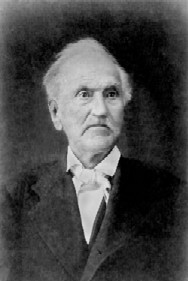
There is much written about Martin Harris and Oliver Cowdery and their magical and superstitious beliefs, but what of David Whitmer? Critics may dismiss Martin Harris for his many irrational statements and beliefs. Critics may dismiss Oliver Cowdery similarly with his use of divining rods or more likely theorize that he was simply in on it with Joseph. But what of David Whitmer? He is often portrayed as the most rational and least superstitious one of the three witnesses and not so easily dismissed.
David Whitmer's superstitious personality
Church History in the Fullness of Times, Religion 341-343 (Institute Student Manual for Church History), page 56-57
Completion of the Translation
Shortly after beginning to assist Joseph Smith with the work of translation, Oliver wrote to David Whitmer in Fayette township. He enthusiastically testified that Joseph Smith had the ancient records and that the work was divine. Soon he sent a few lines of the translation and bore witness that he knew the plates contained a record of the people who once inhabited this continent. David Whitmer, then twenty-four years of age, eagerly showed these letters to his parents and brothers and sisters. Persecution began to intensify in the Harmony area, so late in May, Oliver communicated with David about the possibility of Joseph and Oliver going to stay with the Whitmers in Fayette. In response Peter Whitmer, Sr., David's father, invited Joseph to stay at his farm home as long as was needed to finish the work of translation. David's brother John offered to help as Joseph's scribe. Many people in the Fayette area were anxious to hear more about the work.10
A late May planting was essential for successful fall crops; therefore, David Whitmer had to plow and prepare the soil before he could take his two-horse wagon to pick up Joseph Smith and Oliver Cowdery. At the end of a day of plowing he found he had accomplished in one day what normally would have taken two days to do. David's father was likewise impressed by this apparent miracle. Peter Whitmer, Sr., said, "There must be an overruling hand in this, and I think you would better go down to Pennsylvania as soon as your plaster of paris is sown."11 (Plaster of paris was used to reduce the acidity of the soil.) The next day David went to the fields to sow the plaster, but to his surprise he found the work had been done. His sister, who lived near the field, said that her children had called her to watch three strangers the day before spread the plaster with remarkable skill. She assumed they were men David had hired.12
Grateful for this divine intervention, David Whitmer hurried off on the three-day journey to Harmony. Joseph Smith and Oliver Cowdery met him as he approached the town. Although David had not told them exactly when he was coming, Joseph had seen in vision the details of David's trip to Harmony.13 These three miracles witnessed by David Whitmer exemplified the Prophet's seership and the Lord's intervention for the successful inauguration of the Restoration.
This was the first meeting between Joseph Smith and David Whitmer. As had happened with Oliver Cowdery, David and Joseph quickly became friends. Soon they were on their way to Fayette, some one hundred miles away. On this occasion Moroni took the plates to avoid danger while transporting them. Another unusual event occurred en route. It happened while they were riding along in the wagon. David Whitmer described the event:
"A very pleasant, nice-looking old man suddenly appeared by the side of our wagon and saluted us with, 'good morning, it is very warm,' at the same time wiping his face or forehead with his hand. We returned the salutation, and, by a sign from Joseph, I invited him to ride if he was going our way. But he said very pleasantly, 'No, I am going to Cumorah.' This name was something new to me, I did not know what Cumorah meant. We all gazed at him and at each other, and as I looked around enquiringly of Joseph, the old man instantly disappeared. …
"… It was the messenger who had the plates, who had taken them from Joseph just prior to our starting from Harmony."14
ENDNOTES
10. See History of the Church, 1:48–49; Millennial Star, 9 Dec. 1878, p. 772; Millennial Star, 4 July 1881, pp. 422–23.
Church History in the Fulness of Times, p. 66
11. In Lucy Mack Smith, History of Joseph Smith, p. 148.
Church History in the Fulness of Times, p. 66
12. See Lucy Mack Smith, History of Joseph Smith, pp. 148–49.
Church History in the Fulness of Times, p. 66
13. See "Report of Elders Orson Pratt and Joseph F. Smith," Millennial Star, 9 Dec. 1878, p. 772.
Church History in the Fulness of Times, p. 66
14. "Report of Elders Orson Pratt and Joseph F. Smith," p. 772.
Critic's comment:
The field David plowed
David plowed a field in less time than it normally took him and jumped to the conclusion that it was a sign from God, a miracle. His father planted the suggestion that "there must be an overruling hand in this" so David immediately concluded that there must be a supernatural explanation to his rapid work – the only other explanation David or his father could think of. This is odd and disturbing on many levels since David plowed the field himself.He based his supernatural explanation on nothing other than the time he spent working in the field vs the time he remembers he did it in the past - and his father suggesting an unworldly explanation.Those familiar with statistics call that superstitious practice, counting the hits and ignoring the misses.Church leaders like to tell this story with an air of objectivity, though none is present.
Of course there are plenty more plausible explanations.He was likely excited about the trip he was going to make, to actually meet the prophet, and so he worked faster than normal. There are many other variables which can't be examined such as the density of his crops that year, how much help his father was to him, when he started, how good of a job he did this year compared to other years, how much time it actually took him to do it in prior years vs how much time he remembered that it took, etc.
The field plowed by angels
The next day, his sister said she and her children observed three men working in the field. Since David didn't hire them, he naturally assumes that it was "divine intervention". Well, if David can think that three men working in the field are angels, when his sister and children who saw them thought they were just men he hired, then obviously David is easy to convince with very little evidence.Most people call that gullible.In the social sciences it is called confirmation bias. (Gary Marcus, Kluge: The Haphazard Construction of the Human Mind, p. 53)
So who were the three men? Could have been anybody. Maybe David's dad hired some people and just let it be when David thought it was divine so he had some additional incentive as his dad seemed to think David's getting involved with Joseph was a good thing.
David meeting Joseph
David had made plans to meet Joseph and Oliver and they met David as he approached the town. Since David had not told them exactly when he was coming, he was apparently surprised to have met them on the road. When Joseph explained that he had seen in vision the details of David's trip to Harmony, David again seized on this to determine that a vision was the only explanation for Joseph and Oliver meeting him on the road into the town where they had previously planned to meet.
Amazing! If I had planned in advance to meet someone and they traveled on the same road I was using, of course I would immediately assume that the people must have had a vision to find me.
The Institute Manual then states:
These three miracles witnessed by David Whitmer exemplified the Prophet's seership and the Lord's intervention for the successful inauguration of the Restoration.
What the stories actually demonstrate is the gullibility and magical mind set of David Whitmer. He leaped to the one conclusion he was comfortable with - supernatural explanations for commonplace events easily explained in a commonsense way.
The disappearing traveler
Reminiscent of the vanishing hitchhiker urban legend tales that have been told for hundreds of years in various forms, Whitmer claims to have offered a ride to what later turns out to be Moroni taking a stroll. The man declined the ride, then David and the other men looked at each other and looked around, but the man vanished into thin air.
David said that Joseph told him that the man was in fact the angel Moroni. Isn't it strange that David described the man as "old". In all the painting and depictions of Moroni, he is never described as "old".He was also wiping the sweat off of his forehead because it was very warm. Do angels sweat? Was he dressed right? Joseph mocked a man in print for describing an angel that was not dressed quite right (History of the Church 5:267-268). Why didn't the angel extend his hand to identify himself as the official doctrine states? (D&C 129; Words of Joseph Smith, p. 44; History of the Church, 3:392) Isn't it strange that when David and Oliver were later allowed to be "witnesses" and view the angel, they had already seen him before - so why was it extraordinary to view him again? If David could be convinced that an ordinary looking "old man" wandering down the road wiping his brow due to the warm sun was really an angel (and the very same angel he claimed to see later), then it becomes obvious to most reasonable people that David's testimony of seeing an angel is not convincing. The same is true for Oliver.
The man on the road wasn't anything special. He just happened to leave the road without David noticing, which puzzled him, and Joseph took advantage of the situation.
Editor comment: FARMS verifies the account here and tells how Whitmer later saw this same man/angel near his father's farm and said that Moroni showed the plates to his mother, Mary. They conclude with "Thus, while Whitmer was consistent in asserting that both he and his mother had seen this being, his own statements leave us wondering who this "stranger" really was."
Whitmer's description of the angel
John Murphy interviewed David Whitmer in June, 1880.
When asked in 1880 for a description of the angel who showed him the plates, Whitmer replied that the angel "had no appearance or shape." Asked by the interviewer how he then could bear testimony that he had seen and heard an angel, Whitmer replied, "Have you never had impressions?" To which the interviewer responded, "Then you had impressions as the Quaker when the spirit moves, or as a good Methodist in giving a happy experience, a feeling?" "Just so," replied Whitmer. Whitmer interview with John Murphy, June 1880, in EMD5: 63. Link is here.
FAIR verifies the account here and responds:
Of course, that's the trap because something is like something else doesn't mean that it should be reduced to something else. Because something was a vision doesn't mean that it is less than reality; it's a vision of greater reality. And every one of these witnesses of the Book of Mormon whether the three or eight are consistent.
Editor comment: FAIR is being less than honest. They ignore that Whitmer says that the angel "had no appearance or shape." Whitmer can only "see" something having "no appearance or shape" if it was his over-active imagination. This is the position of reasonable people.In addition, Joseph described Moroni as looking like a man. He said "He had on a loose robe of most exquisite whiteness. It was a whiteness beyond anything earthly I had ever seen.… His hands were naked and his arms also a little above the wrists". Also the statues on every temple and the depictions of Moroni in every painting all show Moroni appearing as a man.
If David perceived Moroni as having "no appearance or shape" but Joseph described him being in the form of a man then apologists have a big discrepancy to explain. Another fair question is, why did Moroni's appearance change from an elderly man sweating due to the heat when he saw him on the road months before, to an invisible, shapeless being with no appearance?
The significant point that apologists want to run away from is that David equates having impressions in his imagination with actually seeing a physical being, an angel. This puts the David Whitmer's "vision" in a completely different context. David imagined that he saw an angel but didn't really see anything at all. This is reminiscent of toddlers with an imaginary friend. Whitmer seems to have only had an "impression" or "feeling" that there was an angel.
Perhaps David said the angel had no appearance or shape because there was no angel.
David Whitmer on God telling him to leave the saints
As stated before. Whitmer made the following well-documented statement:
"If you believe my testimony to the Book of Mormon; if you believe that God spake to us three witnesses by his own voice, then I tell you that in June, 1838, God spake to me again by his own voice from the heavens, and told me to 'separate myself from among the Latter-day Saints'... [Address to all believers in Christ, p27, 1887.]
Critic's cite this as strong evidence that Whitmer is either someone that lied about what God told him, lied about the angel or was so superstitious and impressionable that he was mistaken when he thought he heard God or an angel speaking to him. So which statement was David Whitmer lying about or had been mistaken about?Whitmer does not come off as a trustworthy witness.
LDS apologists claim that this isn't really damaging to David's testimony. Their rebuttal to this issue is here and a critic's response to their rebuttal is here.
Joseph Smith said of David Whitmer
"John Whitmer, David Whitmer, Oliver Cowdery, and Martin Harris are too mean to mention" Smith said of David Whitmer: "God suffered such kind of beings to afflict Job. This poor man who professes to be much of a prophet, has no other dumb ass to ride but David Whitmer, to forbid his madness when he goes up to curse Israel; and this ass not being of the same kind as Balaam's,... he brays out cursings instead of blessings. Poor ass!" (History of the Church, vol. 3, p.228 & 232).
Brief summary of David Whitmer's life
Was born in Harrisburg, Pennsylvania in 1805 and was raised in a Presbyterian home. In 1828 he heard about JS through Oliver Cowdery, while visiting Palmyra NY, on a business trip. He served as a scribe to JS during the alleged translation period in 1829 at the age of 24. He was baptized into the church in 1830. He married Julia Ann Jolly 1831, and they had two children. He left the church in 1937 and was labeled an apostate. He was subsequently EXCOMMUNICATED in 1838. He was requested to lead the RLDS church, but declined their offer and any affiliation with them. He died in Richmond Missouri in 1888 at the age of 83 years old and never re-joined the church.
From the neutral source Wikipedia (on 4/6/13):
Early life
David Whitmer was born near Harrisburg, Pennsylvania, the fourth of nine children of Peter Whitmer, Sr. and Mary Musselman Whitmer. David's ancestry on both sides of his family were German, and the family spoke with a German accent. His grandfather was George Witmer who was born in Prussia, and his great-grandfather was born in Switzerland.[7] By the 1820s, the Whitmer family had moved to a farm in Fayette, in New York's Finger Lakes area.[8]
Role in the early Latter Day Saint movement
Whitmer and his family were among the earliest adherents to the Latter Day Saint movement. Whitmer first heard of Joseph Smith and the Golden Plates in 1828 when he made a business trip to Palmyra, New York, and there talked with his friend Oliver Cowdery, who believed that there "must be some truth to the matter."[9]
Book of Mormon witness
Whitmer eventually accepted the story and brought his father's family to join the Smiths in Palmyra. David Whitmer was baptized in June 1829, nearly a year prior to the formal organization of the Latter Day Saint church. During that same month, Whitmer said that he, along with Joseph Smith, Jr. and Oliver Cowdery saw an angel present the Golden Plates in a vision.[10] Martin Harris reported that he experienced a similar vision with Smith later in the day. Whitmer, Cowdery, and Harris then signed a joint statement declaring their testimony to the reality of the vision. The statement was published in the first edition of the Book of Mormon and has been included in nearly every subsequent edition.[11]
Whitmer later said that Smith had received a revelation that Hiram Page and Oliver Cowdery would sell the copyright of the Book of Mormon in Toronto. After Page and Cowdery returned from Canada empty handed, Whitmer asked Smith why they had been unsuccessful, and Joseph received another revelation "through the stone" that "Some revelations are of God: some revelations are of men: and some revelations are of the devil."[12]
Founding church member
When Smith organized the Latter Day Saint "Church of Christ" (as it was initially called) on April 6, 1830, Whitmer was one of six original members. (In his 1838 history, Joseph Smith said the church was organized at the home of David's father, Peter Whitmer, Sr., in Fayette, New York, but in an 1842 letter, Smith said that the church was organized at Manchester, New York.)[13]
Church offices
Whitmer had been ordained an elder of the church by June 9, 1830, and he was ordained to the office of High Priest by Oliver Cowdery on October 5, 1831. Soon after the organization of the church, Joseph Smith, Jr. set apart Jackson County, Missouri as a "gathering place" for Latter Day Saints. According to Smith, the area had both once been the site of the biblical Garden of Eden, and would be the "center place" of the City of Zion, the New Jerusalem. On July 7, 1834, Joseph Smith ordained Whitmer to be the president of the church in Missouri and his own successor, should the Prophet "not live to God".
By virtue of his position as President of the High Council in Zion, David Whitmer was sustained as "the president of the church in Zion," not merely as a Stake President. Since the Quorum of the Twelve and the First Quorum of the Seventy had not yet been organized, this meant that there was a short period of time—from July 3, 1834, until February 14, 1835—when the High Council in Zion stood in an administrative position next to the First Presidency. It also meant that from July 3, 1834, until December 5, 1834, at which time Oliver Cowdery was made the Associate President of the Church, David Whitmer, as President of the High Council in Zion, was the Prophet's rightful successor."[14]
Although an early revelation dated June 1829 referred to Whitmer and Oliver Cowdery as receiving the same calling as the apostle Paul,[15] Joseph had not yet started a church, or created the office known today as the Quorum of the Twelve Apostles. Cowdery and Whitmer did have a visionary experience and like Paul, were called to preach.[16] They were also called to "search out" twelve "disciples"[17] who later were called "apostles." None of the Three Witnesses were ordained to that apostleship.[18]
Dissented
Whitmer continued to live in Kirtland and his counselors, W.W. Phelps and John Whitmer (David's brother) presided over the church in Missouri until the summer of 1837. After the collapse of the Kirtland Safety Society bank, Smith and his counselor Sidney Rigdon, battered by creditors, moved to Far West, Missouri to evade arrest.[19] The ensuing leadership struggle led to the dissolution of the presidency of the church in Missouri. David Whitmer resigned and W.W. Phelps, John Whitmer, and Oliver Cowdery were excommunicated.[20]
Whitmer and the other excommunicated Latter Day Saints became known as the "dissenters." Some of the dissenters owned land in Caldwell County, Missouri, which they wanted to retain.[21] The church presidency and other members looked unfavorably upon them. Sidney Rigdon preached his Salt Sermon which called for their expulsion from the county. A number of Latter Day Saints formed a secret society known as the Danites, whose stated goal was removal of the dissenters. Eighty prominent Mormons signed the so-called Danite Manifesto, which warned the dissenters to "depart or a more fatal calamity shall befall you." Shortly afterward, Whitmer and his family fled to nearby Richmond, Missouri.
Whitmer and the other dissenters complained to the non-Mormons in northwestern Missouri about their forcible expulsion and the loss of their property, and they began to file lawsuits to recover it. Residents were alarmed by this and a revelation by Smith which said:
Wherefore, the land of Zion shall not be obtained but by purchase or by blood, otherwise there is none inheritance for you. (D&C 63:29) the following verses (63:30-31) detail how Zion would be blessed if the lands were obtained by way of purchase and how they would be scourged by their enemies if the lands were obtained by the shedding of blood which was forbidden. (30) And if by purchase, behold you are blessed; (31) And if by blood, as you are forbidden to shed blood, lo, your enemies are upon you, and ye shall be scourged from city to city, and from synagogue to synagogue, and but few shall stand to receive an inheritance. - [22]
Things escalated bringing about the 1838 Mormon War. As a result of the conflict most of the Latter Day Saints were expelled from Missouri by early 1839.[23]
Whitmer used his position as one of the Three Witnesses to condemn Joseph Smith's church. "If you believe my testimony to the Book of Mormon," wrote Whitmer, "if you believe that God spake to us three witnesses by his own voice, then I tell you that in June, 1838, God spake to me again by his own voice from the heavens and told me to 'separate myself from among the Latter Day Saints, for as they sought to do unto me, so it should be done unto them.'"[24]
Whitmer continued to live in Richmond, where he operated a successful livery stable and became a prominent and respected citizen. In 1867, he was elected to fill an unexpired term as mayor (1867–1868).
President of the Church of Christ (Whitmerite)
After the death of Joseph Smith in 1844, several rival leaders claimed to be Smith's successor, including Brigham Young, Sidney Rigdon, and James J. Strang. Many of Rigdon's followers became disillusioned by 1847 and some, including Apostle William E. M'Lellin and Benjamin Winchester, remembered Whitmer's 1834 ordination to be Smith's successor. At M'Lellin's urging, Whitmer exercised his claim to be Smith's successor and the Church of Christ (Whitmerite) was formed in Kirtland, Ohio. However, Whitmer never joined the body of the new church and it dissolved relatively quickly.
Around this time, fellow Book of Mormon witness Oliver Cowdery, began to correspond with Whitmer. After traveling from Ohio to Kanesville (Council Bluffs), Cowdery met in the Kanesville Tabernacle meeting, called to sustain Brigham Young as the new President of the Church; Cowdery bore his testimony with a conviction to the truthfulness of everything that had happened spiritually with Joseph Smith and the Book of Mormon. Meeting with Young at Winter Quarters, Nebraska, he requested readmission into the Church, where he was re-baptized into the church. Cowdery then traveled to meet with Whitmer in Richmond to persuade him to move west and rejoin the Saints in Utah. Cowdery however succumbed to tuberculosis and died March 3, 1850, believing as did Whitmer.[25]
In January 1876, Whitmer resurrected the Church of Christ (Whitmerite) by ordaining his nephew, John C. Whitmer an elder, and giving him the title First Elder.[26]
In 1887, he published a pamphlet entitled An Address to All Believers in Christ, in which he affirmed his testimony of the Book of Mormon, but denounced the other branches of the Latter Day Saint Movement. David Whitmer died January 25, 1888 in Richmond. The Whitmerite church survived until the 1960s.
Religious views
Whitmer stated his religious views in three publications: A Proclamation published March 24, 1881, An Address To Believers in the Book of Mormon published April 1887, and An Address to All Believers in Christ also published April 1887.
Polygamy
I do not endorse polygamy or spiritual wifeism. It is a great evil, shocking to the moral sense, and the more so, because practiced in the name of religion. It is of man and not God, and is especially forbidden in the Book of Mormon itself.[27]
Name change
I do not endorse the change of the name of the church, for as the wife takes the name of her husband so should the Church of the Lamb of God, take the name of its head, even Christ himself. It is the Church of Christ.[28]
High Priests
As to the High Priesthood, Jesus Christ himself is the last Great High Priest, this too after the order of Melchisedec, as I understand the Holy Scriptures.[29]
The most interviewed Book of Mormon witness
Because Oliver Cowdery died in 1850 at age 43 and Martin Harris died in 1875 at age 91, David Whitmer was the only survivor of the Three Witnesses for 13 years. At Richmond, Missouri, he sometimes received several inquirers daily asking about his connection to the Book of Mormon, including Mormon missionaries who were traveling from Utah to the eastern United States and Europe. Despite his hostility toward the LDS Church, Whitmer always stood by his claim that he had actually seen the Golden Plates.[30]
Nevertheless, his testimonies were recorded differently from one retelling to another.[31] Recounting the vision to Orson Pratt in 1878, Whitmer claimed to have seen not only the Golden Plates but the "Brass Plates, the plates containing the record of the wickedness of the people of the world....the sword of Laban, the Directors (i.e. the ball which Lehi had) and the Interpreters. I saw them just as plain as I see this bed...."[32]
In 1880, John Murphy interviewed Whitmer and later published an account suggesting that perhaps Whitmer's experience was a "delusion or perhaps a cunning scheme." Murphy's account said that Whitmer had not been able to describe the appearance of an angel and had likened Whitmer's experience to the "impressions as the quaker [receives] when the spirit moves, or as a good Methodist in giving a happy experience."[33] Whitmer responded by publishing A Proclamation, reaffirming his testimony and saying,
"It having been represented by one John Murphy, of Polo, Caldwell County, Mo., that I, in a conversation with him last summer, denied my testimony as one of the three witnesses to the BOOK OF MORMON. To the end, therefore, that he may understand me now, if he did not then; and that the world may know the truth, I wish now, standing as it were, in the very sunset of life, and in the fear of God, once for all to make this public statement: That I have never at any time denied that testimony or any part thereof, which has so long since been published with that Book, as one of the three witnesses. Those who know me best, well know that I have always adhered to that testimony. And that no man may be misled or doubt my present views in regard to the same, I do again affirm the truth of all of my statements, as then made and published. He that hath an ear to hear, let him hear; it was no delusion!"[34]
To the Proclamation Whitmer attached an affidavit attesting to his honesty and standing in the community.[35] Whitmer ordered that his testimony to the Book of Mormon be placed on his tombstone.[36]
David Whitmer helps clear up the "spiritual" vs. "natural" viewing of the plates. Responding to the questions of Anthony Metcalf (the same Metcalf who interviewed Harris) Whitmer wrote:
In regards to my testimony to the visitation of the angel, who declared to us Three Witnesses that the Book of Mormon is true, I have this to say: Of course we were in the spirit when we had the view, for no man can behold the face of an angel, except in a spiritual view, but we were in the body also, and everything was as natural to us, as it is at any time. Martin Harris, you say, called it 'being in vision.' We read in the Scriptures, Cornelius saw, in a vision, an angel of God. Daniel saw an angel in a vision, also in other places it states they saw an angel in the spirit. A bright light enveloped us where we were, that filled at noon day, and there in a vision, or in the spirit, we saw and heard just as it is stated in my testimony in the Book of Mormon. I am now passed eighty-two years old, and I have a brother, J. J. Snyder, to do my writing for me, at my dictation. [Signed] David Whitmer.[37]
Notes
- There was no formal beginning. John C. Whitmer was baptized at the age of 44 on September 15, 1875, then ordained an Elder January 28, 1876 and commissioned to "go forth and preach the Gospel...organize a new church...was to be the first Elder." (Andrew Jenson, Edward Stevenson, and Joseph S. Black, "Historical Landmarks," | Deseret News, 37, September 26, 1888, p. 579.)
- On this day David was "re-ordained" (according to his previous ordination by Joseph Smith in July 8, 1834) by William McLellin, Hiram Page, Jacob Whitmer, & John Whitmer. This entailed "holy priesthood," "high priests," and a "presidency" framework. See William E. McLellin, ed., Ensign of Liberty, vol. 1, August 1849.
- Whitmer did not seek the position but acknowledged that he was in fact ordained by Joseph Smith to succeed him. Whitmer was ordained a "prophet, seer, and revelator." (Newell G. Bringhurst and John C. Hamer eds., Scattering of the Saints, Schism within Mormonism, John Whitmer Books, 2007, p. 59.)
- McLellin was based in Kirtland. Whitmer however never traveled to Kirtland or assisted McLellin to grow his branch. McClellin did have a publication called Ensign of Liberty which the Whitmer branch refused after June 1848.
- For the date Whitmer said he left the Mormons: An Address to All Believers in Christ, p. 8.
- The North-West Conservator, Richmond, MO, June 22, 1867.
- Dan Vogel, Early Mormon Documents, Vol. V, 2003, p. 9.
- On March 12, 1825 David was elected sergeant in a newly organized militia called the Seneca Grenadiers.Seneca Farmer, March 23, 1825.
- David Whitmer interview with Kansas City Journal, June 1, 1881, in Early Mormon Documents 5: 74.
- No date nor place for this vision was ever specified.
- Richard Lyman Bushman, Joseph Smith: Rough Stone Rolling (New York: Alfred A. Knopf, 2005), 77-79.
- "Joseph looked into the hat in which he placed the stone, and received a revelation that some of the brethren should go to Toronto, Canada, and that they would sell the copyright of the Book of Mormon. Hiram Page and Oliver Cowdery went to Toronto on this mission, but they failed entirely to sell the copyright, returning without any money. Joseph was at my father's house when they returned. I was there also, and am an eye witness to these facts. Jacob Whitmer and John Whitmer were also present when Hiram Page and Oliver Cowdery returned from Canada. Well, we were all in great trouble; and we asked Joseph how it was that he had received a revelation from the Lord for some brethren to go to Toronto and sell the copyright, and the brethren had utterly failed in their undertaking. Joseph did not know how it was, so he enquired of the Lord about it, and behold the following revelation came through the stone: 'Some revelations are of God: some revelations are of men: and some revelations are of the devil.' So we see that the revelation to go to Toronto and sell the copyright was not of God, but was of the devil or of the heart of man." David Whitmer, An Address to All Believers in Christ, in EMD 5: 198.
- For evidence regarding these contradictory statements, see Richard Lyman Bushman, Joseph Smith: Rough Stone Rolling (New York: Alfred A. Knopf, 2005), 109, 586, n.2.
- Hyrum L. Andrus, Doctrines of the Kingdom, Bookcraft, 1973, 195.
- Doctrine and Covenants, Covenant 18:37
- Galatians 1:1,12,16
- Doctrine and Covenants, Covenant 18:27,37
- The Three Witnesses did not ordain the apostles: "The First Presidency anointed only one apostle, the Twelve's president Thomas B. Marsh. Marsh then anointed the other apostles, and Smith spoke prophetic words to each one but did not anoint them." (D. Michael Quinn, The Mormon Hierarchy: Origins of Power, p.60; see also Joseph Smith diary, 21 Jan. 1836, in History of the Church, 2:379-83; Faulring, An American Prophet's Record, 118-21, in Jessee, Personal Writings of Joseph Smith, 145-46, and in Jessee, Papers of Joseph Smith, 2:156-58.)
- Richard S. Van Wagoner, Sidney Rigdon, Signature Books, 1994, p.193.
- David Whitmer separated from the church and was never excommunicated. See Far West Record, pp. 123-125; Ebenezer Robinson, "Items of Personal History of the Editor," The Return, (Davis City, Iowa: Church of Christ), Vol. 1, No. 9, September 1889, pp. 134-135.
- David Whitmer did not own land. See Saints' Herald, Vol. 34, No. 7, February 5, 1887.
- Joseph Smith, History of the Church, vol. 1, Chapter 27, pp. 374-376; Richard L. Bushman, "Mormon Persecutions in Missouri, 1833," BYU Studies, vol. 3, 1960-1961, no. 1, Autumn 1960; David Whitmer, An Address to all Believers in Christ, 1887, p. 55.
- Bushman, 328-55.
- Whitmer also denounced the RLDS church, now known as the Community Of Christ): "God commanded me by his voice to stand apart from you." (Metcalfe, 1993, p. 176)
- David Whitmer, An Address to All Believers in the Book of Mormon, 1887, p. 1; Scott H. Faulring, "The Return of Oliver Cowdery," Maxwell Institute, Provo, Utah.
- Deseret News; The Return, vol. 3, no. 3, October 1892, pp. 3-5; George Sweich, "David Whitmer and the Church of Christ," Magazine of Western History, New York, vol. 14, May 1891—October 1891, p 520.
- A Proclamation
- A Proclamation
- A Proclamation
- The earliest known signed testimony of David Whitmer was recorded in a letter to Mr. Mark H. Forscutt of March 2, 1875. "Dear Sir: My testimony to the world is written concerning the Book of Mormon. And it is the same that I gave at first, and it is the same as shall stand to my latest hour in life, linger with me in death and shine as gospel truth beyond the limits of life, among the tribunals of heaven. And the nations of the earth will have known to[o] late the divine truth written on the pages of that book is the only sorrow of this servant of the Almighty Father." (Davis, 1981, p. 75)
- Lyndon W. Cook ed,, David Whitmer Interviews, Grandin Book, 1991, p. xxvi.
- David Whitmer interview with Orson Pratt, September 1878, in EMD, 5: 43.
- Hamilton Newspaper, January 21, 1881; Kingston (Missouri) Times, December 16, 1887; "David Whitmer Interview with John Murphy, June 1880," Dan Vogel, ed., Early Morning Documents Signature Books, 2003, vol. 5, p. 63.
- Richmond (Missouri) Conservator, March 24, 1881; Hamiltonian (Missouri) Newspaper, April 8, 1881; Saints' Herald, June 1, 1881, vol. 28, p. 168; David Whitmer, An Address to All Believers in Christ, Richmond, 1887, pp. 8-10; LDS Church Archives; Ebbie Richardson, "David Whitmer," M.A. Thesis, BYU, 1952, pp. 178-180; "David Whitmer: The Independent Missouri Businessman," Improvement Era, vol. 72, April 1969, p. 79; Lyndon W. Cook, pp. 79-80; Dan Vogel, ed., Early Morning Documents Signature Books, 2003, vol. 5, pp. 68-71.
- Dan Vogel, ed., Early Morning Documents Signature Books, 2003, vol. 5, p. 63. Excerpt – Early Mormon Documents, Vol. 5
- David Whitmer at Find a Grave
- Letter of David Whitmer to Anthony Metcalf, Mar. 1887, cit. Anthony Metcalf, Ten Years Before the Mast (Malad, Ida., 1888), p. 74; quoted in Anderson [1981], 86.[full citation needed]
References
Cook, Lyndon W. (ed) (1991). David Whitmer Interviews, A Restoration Witness. Orem, Utah: Grandin Book. ISBN 978-0-910523-38-7.
Davis, Inez Smith (1981). The Story of the Church (10th ed.). Independence, Missouri: Herald House. p. 75.
Metcalfe, Brent Lee (1993). "Apologetic and Critical Studies Assumptions about Book of Mormon Historicity". Dialogue: A Journal of Mormon Thought 26 (3): 153–184.
Vogel, Dan (ed) (1996–2003). Early Mormon Documents. (Vols. 1-5). Salt Lake City, Utah: Signature Books. ISBN 1-56085-072-8.
Summary of the 11 Witnesses
The experiences of the 3 and 8 witnesses should really be looked at separately.The 8 witnesses claimed to have seen some plates.How significant is that?Joseph or others could have easily fabricated a set of plates sufficient to fool people if shown to them briefly as was done with the Kinderhook Plates and the Voree Plates. The 8 witnesses may have really seen some plates but they could not possibly ascertain that the plates were the word of God written thousands of years ago.Grant Palmer notes that some of the 8 witnesses later testified that they had seen James J. Strang's metal plates, after the death of J. Smith.These fellows saw whatever they willed themselves to see.
Did they actually see the plates?
One of the eight witnesses, John Whitmer claimed,
"I now say, I handled those plates; there were fine engravings on both sides. ...they were shown to me by a supernatural power" (History of the Church, Vol. 3, p. 307)
The obvious question is, why was "a supernatural power" needed for the witness John Whitmer to be shown the plates?If he handled the plates, did he handle them while in a visionary state of mind, or in his imagination?
The following summary of the 8 BOM witness's lives was posted by 'justmythoughts' on Nov. 8, 2003 on the LDS critic's web site RFM:
EIGHT WITNESSES:
CHRISTIAN WHITMER - born Jan 18, 1798 Penn.- Married Feb 22, 1827 to Anne Schott. Baptized April 11, 1830 - June 1830 / ordained teacher, 1831 ordained elder, Aug 21, 1833 ordained high priest - Died Nov 27, 1835 - Died 6 years after his testimony in the BOM…BEFORE his other family members were Excommunicated.
JACOB WHITMER - born Jan 27, 1800 Penn - Married Sept 29, 1825 - Baptized April 11, 1830 - 1838 - VOLUNTARILY LEFT THE CHURCH - Died April 21, 1856
PETER WHITMER, JR. - born Sept 27, 1809 Fayette, Seneca Co, NY - Married Oct 14, 1832 Vashti Higley - June 9, 1830 baptized & ordained elder - Oct 25, 1831 ordained high priest - Died Sept 22, 1836 - Died 7 years after his testimony in the BOM…BEFORE his other family members were Excommunicated.
JOHN WHITMER - Son of Peter Whitmer, Sr. and Mary (Musselman). Born August 27, 1802. Married Sarah Maria (Jackson). EXCOMMUNICATED in 1838. Died on 11 July 1878.
HIRAM PAGE - Born 1800 Vermont - Married Nov 10, 1825 to Catherine Whitmer - Baptized April 11, 1830 - June 9, 1830 ordained teacher - Hiram remained affiliated with David Whitmer while considering the possibility of establishing a religious alternative to institutional Mormonism. In 1838 VOLUNTARILY LEFT THE CHURCH when members of Whitmer family were excommunicated. Died Aug 12, 1852
JOSEPH SMITH, SR. - [Father of JS] - Born 1771, Topsfield, Massachusetts - Married Lucy Mack 1796; eleven children - Baptized April 6, 1830 - Mission to St. Lawrence County, New York 1830 - Ordained to the High Priesthood 1831 - Ordained Patriarch to the Church 1833 - Appointed Assistant Counselor to First Presidency 1837 - Died 1840 of consumption, Nauvoo, Illinois.
HYRUM SMITH - [Brother to JS] - Born 1804 Tunbridge, Vermont - Baptized 1829 - Assistant President of the Church, 1834 - Counselor in the First Presidency - Patriarch to the Church - Named Second Elder of the Church following Oliver Cowdery's excommunication - Associate President of the Church - Died in 1844 Carthage, Illinois with his brother JS.
SAMUEL H. SMITH - [Brother to JS] - born March 13, 1808 - b. Tunbridge, Orange Co, VT - Married Aug 13, 1834 Mary Bailey - June 9, 1830 ordained elder - June 3, 1831 ordained high priest - 1834-38 member of Kirtland High Council - March 1838 moved to Far West - January 1841 called to Presiding Bishopric of church - Died July 30, 1844.
[top
Did the 11 witnesses actually see the gold plates?
The following article by Bill McKeever suggests that none of the 11 witnesses actually saw the gold plates with their eyes. The author provides sound reasoning that the plates were only seen in their imagination, while a prop under a cloth was handled by the witnesses. The following article was copied in its entirety and available at the Mormonism research Ministry website Did the Eleven Witnesses Actually See the Gold Plates?
By Bill McKeever
Joseph Smith claimed that in 1823 he was visited by an angel named Moroni and that this angel told him that "there was a book deposited, written upon gold plates, giving an account of the former inhabitants of this continent, and the source from whence they sprang" (Joseph Smith History 1:34). The gold plates were said to be buried in a stone box not far from the Smith family home. Smith had to wait another four years before he was allowed to retrieve the record. Once he received the plates, he was commanded not to allow just anybody to view them. He carefully chose eleven men who believed in his divine calling to become "eyewitnesses" to this grand event. Their "testimonies" are found in the front of every modern edition of the Book of Mormon and are broken down into two categories:
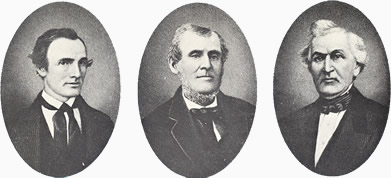 The Three Witnesses (right): Oliver Cowdery, Martin Harris, David Whitmer
The Eight Witnesses: Christian Whitmer, Jacob Whitmer, Peter Whitmer, Jr., John Whitmer, Hiram Page, Joseph Smith, Sr., Hyrum Smith, and Samuel Smith
Of the eleven men, three were directly related to Smith (his father and two brothers). Oliver Cowdery was a distant cousin to Joseph Smith. The four Whitmers were brothers to David Whitmer.
Mormons generally believe that these eleven men actually saw the plates in question, and given what they said in their testimonies, it is easy to see why they draw that conclusion. The three witnesses stated that they "beheld and saw the plates and the engravings thereon." The eight witnesses, in a similar fashion, stated they "saw the engravings," and that they had also "seen and hefted, and know of a surety that the said Smith has got the plates of which we have spoken."
Despite the rather lucid description given by these men, it appears that their familiarity with the plates is not as it first appears. Did the witnesses actually see physical plates with their naked eyes? Or was this some sort of mystical experience that involved "seeing" an object that was not really there?
According to the History of the Church (1:52), Smith stated,
"In the course of the work of translation, we ascertained that three special witnesses were to be provided by the Lord, to whom He would grant that they should see the plates from which this work (the Book of Mormon) should be translated; and that these witnesses should bear record of the same, as will be found recorded, Book of Mormon, page 581 [Book of Ether, chapter 5, verses 2, 3 and 4, p. 487, edition 1920], also page 86 [2 Nephi, chapter 11, verse 3, p. 73, edition 1920]."
As a result, he obtained a revelation from the Lord that can be found in The Doctrine and Covenants 17. It reads:
1 Behold, I say unto you, that you must rely upon my word, which if you do with full purpose of heart, you shall have a view of the plates, and also of the breastplate, the sword of Laban, the Urim and Thummim, which were given to the brother of Jared upon the mount, when he talked with the Lord face to face, and the miraculous directors which were given to Lehi while in the wilderness, on the borders of the Red Sea.
2 And it is by your faith that you shall obtain a view of them, even by that faith which was had by the prophets of old.
3 And after that you have obtained faith, and have seen them with your eyes, you shall testify of them, by the power of God;
4 And this you shall do that my servant Joseph Smith, Jun., may not be destroyed, that I may bring about my righteous purposes unto the children of men in this work.
5 And ye shall testify that you have seen them, even as my servant Joseph Smith, Jun., has seen them; for it is by my power that he has seen them, and it is because he had faith.
Reading these passages, one can't help but notice that the only way the three men would see the plates at all is if they had faith. While it seems clear that faith was a prerequisite to be allowed to see the plates, can we not also conclude that "seeing" the plates also took an act of faith? Smith continued his narrative on 54:
"Not many days after the above commandment was given, we four, viz., Martin Harris, David Whitmer, Oliver Cowdery and myself, agreed to retire into the woods, and try to obtain, by fervent and humble prayer, the fulfilment of the promises given in the above revelation-that they should have a view of the plates. We accordingly made choice of a piece of woods convenient to Mr. Whitmer's house, to which we retired, and having knelt down, we began to pray in much faith to Almighty God to bestow upon us a realization of these promises.
"According to previous arrangement, I commenced prayer to our Heavenly Father, and was followed by each of the others in succession. We did not at the first trial, however, obtain any answer or manifestation of divine favor in our behalf. We again observed the same order of prayer, each calling on and praying fervently to God in rotation, but with the same result as before.
"Upon this, our second failure, Martin Harris proposed that he should withdraw himself from us, believing, as he expressed himself, that his presence was the cause of our not obtaining what we wished for. He accordingly with drew from us, and we knelt down again, and had not been many minutes engaged in prayer, when presently we beheld a light above us in the air, of exceeding brightness; and behold, an angel stood before us. In his hands he held the plates which we had been praying for these to have a view of. He turned over the leaves one by one, so that we could see them, and discern the engravings theron distinctly."
Praying to see the gold plates out in the woods seems rather odd. After all, Smith had already commenced translating the plates. Why not just allow the three men to see the gold record at that location? Why was prayer necessary to see the plates if they were in fact, tangible? Harris' behavior also seems strange if the plates actually existed. How would his doubt be a detriment to seeing a physical object?
Author Dan Vogel offers an interesting point when he writes, "If the printed testimony were all that was available, one would assume that the three witnesses saw the angel and the plates together in a single vision" (American Apocrypha, "The Validity of the Witnesses Testimony," p.82). Delving deeper into Martin Harris' reluctance to hinder the others from seeing the plates due to his doubts, Vogel notes that Smith, Whitmer, and Cowdery saw both an angel and the plates after Harris withdrew from the group. The History of the Church 1:55 recounts how Smith "left David and Oliver and went in pursuit of Martin Harris, whom I found at a considerable distance fervently engaged in prayer." Both men joined in prayer, and according to Smith, "the same vision was opened to our view." It is important to note that Smith never claimed to have carried the plates to either the woods where he, Cowdery, and Whitmer prayed, nor does he say he carried them the "considerable distance" to where Harris was praying, yet he and Harris were still able to "see" them, but only via a vision.
Mormon historian Marvin S. Hill discusses the controversies surrounding the witness's testimonies in his review of Fawn McKay Brodie's classic book titled No Man Knows My History. In his article "Brodie Revisited: A Reappraisal," published in Dialogue: A Journal of Mormon Thought, Hill states;
"What of the prophet's story about gold plates, and what about his witnesses? Given Brodie's assumptions, was there not deception here, if not collusion? Brodie maintains that the Prophet exercised some mysterious influence upon the witnesses which caused them to see the plates, thus making Joseph Smith once more the perpetrator of a religious fraud. The evidence is extremely contradictory in this area, but there is a possibility that the three witnesses saw the plates in vision only, for Stephen Burnett in a letter written in 1838, a few weeks after the event, described Martin Harris' testimony to this effect: 'When I came to hear Martin Harris state in public that he never saw the plates with his natural eyes only in vision or imagination, neither Oliver nor David . . . the last pedestal gave way, in my view our foundations.'"
Hill goes on to note:
"Burnett reported Harris saying that he had 'hefted the plates repeatedly in a box with only a tablecloth or handkerchief over them, but he never saw them only as he saw a city through a mountain.' Nonetheless, Harris said he believed the Book of Mormon to be true. In the revelation given the three witnesses before they viewed the plates they were told, 'it is by your faith that you shall view them' and 'ye shall testify that you have seen them, even as my servant Joseph Smith Jr. has seen them, for it is by my power that he has seen them.' There is testimony from several independent interviewers, all non-Mormon, that Martin Harris and David Whitmer said they saw the plates with their 'spiritual eyes' only. Among others, A. Metcalf and John Gilbert, as well as Reuben P. Harmon and Jesse Townsend, gave testimonies to this effect. This is contradicted, however, by statements like that of David Whitmer in the Saints Herald in 1882, 'these hands handled the plates, these eyes saw the angel.' But Z. H. Gurley elicited from Whitmer a not so positive response to the question, 'did you touch them?' His answer was, 'We did not touch nor handle the plates.'" (Dialogue, Vol.7, No.4, pp.83-84).
Mormon apologists like Milton Backman point to Whitmer's steadfast insistence in his printed testimony and somehow sees this as a validation for actual, physical plates:
"Although there is no reliable evidence that David Whitmer repudiated his testimony as published in the Book of Mormon, a few interviewers assumed that he was contradicting his published declaration when he told them that he saw the plates with his spiritual rather than his natural eyes. Explaining what he meant by this statement, David Whitmer wrote in 1887:
"Of course we were in the spirit when we had the view, for no man can behold the face of an angel, except in a spiritual view, but we were in the body also, and everything was as natural to us, as it is at any time. Martin Harris . . . called it 'being in vision'. . . .A bright light enveloped us where we were . . . and there in a vision, or in the spirit, we saw and heard just as it is stated in my testimony in the Book of Mormon" (Milton V. Backman, Jr., Eyewitness Accounts of the Restoration, pp.138-139. Ellipses his).
All this really proves is that Whitmer equated a "spiritual view" as being as natural to him "as it is at any time." Language that equates things that are "natural" with things seen in a vision should caution any thoughtful person to pause before assuming that any of the witnesses saw physical plates.
What About the Eight Witnesses?
Later comments that could clarify the language used in the testimony of the eight witnesses are scarce, but several historians and researchers recount a statement made by John Whitmer that makes their experience sound similar to the three witnesses. Whitmer was excommunicated from the LDS Church on March 10, 1838 along with W.W. Phelps. Oliver Cowdery and David Whitmer would also be excommunicated a month later. On April 5, 1839 Theodore Turley challenged John Whitmer to either affirm or deny his testimony regarding the gold plates. Whitmer responded by saying the plates 'were shown to me by a supernatural power" (History of the Church 3:307). Why would supernatural power be necessary if the plates actually existed?
Hill commented on a letter written by Hiram Page to the Ensign of Liberty in 1848. In it Page defended his belief that the Book of Mormon was a work of the Lord. However, Hill conceded that Page did not actually say he saw the plates:
"With only a veiled reference to 'what I saw,' Page does not say he saw the plates but that angels confirmed him in his faith. Neither does he say that any coercion was placed upon him to secure his testimony. Despite Page's inconsistencies, it is difficult to know what to make of Harris' affirmation that the eight saw no plates in the face of John Whitmer's testimony. The original testimony of these eight men in the Book of Mormon reads somewhat ambiguously, not making clear whether they handled the plates or the 'leaves' of the translated manuscript. Thus there are some puzzling aspects to the testimonies of the witnesses. If Burnett's statement is given credence it would appear that Joseph Smith extorted a deceptive testimony from the eight witnesses. But why should John Whitmer and Hiram Page adhere to Mormonism and the Book of Mormon so long if they only gave their testimony reluctantly? It may be that like the three witnesses they expressed a genuine religious conviction. The particulars may not have seemed as important as the ultimate truth of the work" (Dialogue, Vol.7, No.4, pp.84-85).
Richard L. Anderson, in his faith-promoting book titled Investigating the Book of Mormon Witnesses, insists that readers must take the testimony of the eleven witnesses at "face value." William D. Russell, a member of the Community of Christ and professor of history of the LDS movement at Graceland University, strongly disagrees.
"Perhaps one should not expect that a book about the witnesses to the Book of Mormon published by Deseret Book Company would be anything other than an attempt to strengthen the reader's faith in the Book of Mormon. This book will be convincing to those already certain that the gold plates actually existed and that the eleven witnesses saw them. And even the detached reader will probably be convinced by Anderson's research that the witnesses were honest men who sincerely believed their signed testimony and probably stuck by their story as long as they lived. But Anderson is really trying to have us conclude more than this. He would have the reader be convinced that because these men were honest and reaffirmed their testimony when asked, they actually saw and handled plates which contained the records of an ancient people. I believe that Anderson-- like the eleven witnesses--is an honest and sincere man when he writes: 'After years of working with their lives and their words, I am deeply convinced that their printed testimonies must be taken at face value' (p. xii). But I don't believe that his research by itself requires this conclusion. As he admits, 'spiritual truths must be spiritually verified' (p. 82). Believers must make a 'leap of faith,' apprehending with their 'spiritual eyes' rather than their 'natural eyes' ("Investigating the Investigation," Dialogue: A Journal of Mormon Thought, Vol.16, No.2, pp.132-133).
It seems foolish to take the testimony of the witnesses at face value if there is further information available that helps us to understand how certain key words were understood and used by the writer/speaker. For example, if a person took the stand in a court room and said he saw the defendant use a gun to steal another person's wallet, such an account would tend to carry significant weight with the jury. However, if the same person said he saw the defendant "in a vision" using a gun to steal a wallet, the strength of the testimony is incredibly weakened. Why? Because rational people do not equate visionary experiences with tangible, physical objects.
There is no denying that Smith did have in his possession something that resembled what could be plates of some sort. However, whatever it was he had was kept from view, usually covered up with a cloth or placed in a box. Mormon historian Richard L. Bushman speaks of Smith's father-in-law, Isaac Hale, who said, "I was allowed to feel the weight of the box and they gave me to understand, that the plates was then in the box – into which I was not allowed to look" (Joseph Smith – Rough Stone Rolling, p.63).
Bushman also notes that during the brief time Martin Harris was Smith's scribe, a curtain was hung between Joseph and Martin "to prevent Harris from seeing the plates" (Rough Stone Rolling, p.66).
Hill records that William Smith said his father "never saw the plates except under a frock" ("Brodie Revisited," Dialogue, Vol.7, No.4, p.84). William said, "In consequence of his vision, and his having the golden plates and refusing to show them, a great persecution arose against the whole family, and he was compelled to remove into Pennsylvania with the plates. He went on to say that his brother translated the plates using the "Urim and Thummim" placed in a hat, the plates were "lying nearby covered up" (A New Witness for Christ in America 2:416,417). This concurs with the description given by his sister-in-law Emma Smith.
Writes Bushman, "Emma said she sat at the same table with Joseph, writing as he dictated, with nothing between them, and the plates wrapped in a linen cloth on the table. When Cowdery took up the job of scribe, he and Joseph translated in the same room where Emma was working. Joseph looked into the seer stone, and the plates lay covered on the table" (Rough Stone Rolling, p.71).
Emma said she "felt the plates as they lay on a table" wrapped in a linen tablecloth. She said the plates were pliable like thick paper and that they "would rustle with a metallic sound when the edges were moved by the thumb" (Rough Stone Rolling, p.70). If that is true, then it is certain that the plates were not made of gold since soft metal pages made of gold would not make such a sound.
Several LDS sources give the eleven men who bore their testimony to the authenticity of the Book of Mormon the special title of eyewitness; however, it appears doubtful that any of them actually saw the plates apart from a supernatural and subjective experience. While they all claimed to have handled what they were told were ancient plates, they did so while the plates were covered up and not visible. That being case, how is their experience any different from others who also claimed to handle the plates? Such persons include Joseph Smith's mother, Lucy Mack Smith. Lucy admitted she never saw the plates, but she claimed to have handled what she was told were plates of "pure gold." As mentioned earlier, Joseph Smith's wife Emma also claimed that she handled the plates when she moved them to "do her work" in the Smith home, though she insisted that she never uncovered them.
I maintain that if the eleven are called eyewitnesses, why not Lucy and Emma as well? After all, their experiences with what they thought were gold plates are really not much different than that of the eleven. Mormons might find this conclusion troubling since it tends to take away some of the mysterious sensation associated with the accepted folklore, but it is a consistent conclusion when it comes to comparing the experiences of those involved. If Mormons want to insist that a person can't be considered an eyewitness to the authenticity of the gold plates unless they actually saw them, then there were no eyewitnesses to Joseph Smith's gold plates.
An account by Joseph's mother (Joseph Smith, The Prophet And His Progenitors For Many Generations, by Lucy Smith, 1853, pp. 138-9; available online here) makes it apparent that Joseph himself did not believe anyone had seen the plates until after the translation was complete:
As soon as the Book of Mormon was translated, Joseph dispatched a messenger to Mr. Smith, bearing intelligence of the completion of the work, and a request that Mr. Smith and myself should come immediately to Waterloo...
Joseph, Martin, Oliver, and David, repaired to a grove, a short distance from the house, where they commenced calling upon the Lord, and continued in earnest supplication, until He permitted an angel to come down from His presence, and declare to them, that all which Joseph had testified of concerning the plates was true.
When they returned to the house, it was between three and four o'clock in the afternoon. Mrs. Whitmer, Mr. Smith, and myself, were sitting in a bedroom at the time. On coming in, Joseph threw himself down beside me, and exclaimed, "Father, mother, you do not know how happy I am; the Lord has now caused the plates to be shown to three more besides myself..."
"The difference between the testimony given the Three Witnesses and that given to the Eight is that the former was attended by a splendid display of the glory and power of God and the ministration of an angel, while the latter was attended by no such display, but was a plain, matter-of-fact exhibition of the plates by the Prophet to his friends; and they not only saw the plates, but handled them and examined the engravings upon them." Annotation in History of the Church of Jesus Christ of Latter-Day Saints, p. 58 (link)
[top
Book of Mormon Witnesses Revisited
Dan Vogel wrote an essay on the BOM witnesses called "The Validity of the Witnesses' Testimonies" which appeared in 2002 in American Apocrypha: Essays on the Book of Mormon.
His essay was critiqued by several LDS apologists including Richard L. Anderson, Stephen C. Harper, Daniel C. Peterson, Richard L. Bushman and Alan Goff.
Vogel has written a response to his critics in which he defends his analysis and provides, clear, concrete reasoning as to why the apologists are wrong regarding the BOM witnesses.
This is a must-read. Vogel brings up many things not mentioned in MormonThink's analysis of the witnesses. Vogel does an excellent job of reconciling the various statements by the witnesses by providing solid reasoning and documentation that shows that the witnesses may have actually seen the plates and hefted them, but only when they were covered in a cloth or box, yet saw the plates uncovered only in a visionary state. These separate events are often blurred into one experience when in fact, they may have been separate events.
Signature Books Article Archived Backup: here
Videos on the Witnesses
Dan Vogel video on the Book of Mormon Witnesses - 9/30/14
Award-wining author Dan Vogel has just come out with his latest video (Sep 2014). In this first of two parts, Dan examines the Three Book of Mormon witnesses and does an in-depth analysis of their testimony.
Since its publication in 1830, the Book of Mormon has been accompanied by the Testimony of Three Witnesses claiming to have seen the an angel with the plates and the Testimony of Eight Witnesses claiming that Joseph Smith showed them the plates, which they were allowed to handle. However, subsequent statements by members of both groups of witnesses indicate that the published Testimonies can be misleading and that using them to recreate the historical events behind them is a mistake. In fact, there is significant evidence that the experiences of the Three Witnesses was more subjective than their published Testimony implies and that the Eight Witnesses' examination of the plates was not completely natural and physical.
Book of Mormon Witnesses - Pt 1 - The Three - Dan Vogel
The second video is now available (Oct 2014) that focuses on the eight witnesses:
In this video, I discuss how relying on the published Testimony of Eight Witnesses has led many to incorrectly assume the experience of the eight men was completely natural and physical. I present evidence that the eight witnesses saw the plates in vision and offer four possible scenarios how that occurred. I also discuss the apologetic resistance to new evidence regarding the experiences of the eight witnesses.
Book of Mormon Witnesses - Pt 2 - The Eight - Dan Vogel
MT Editor Comment: The above videos from 2014 are a great resource that critically analyzes the BOM witness statements and puts them in context. Dan challenges many of the assertions taken by LDS apologist Richard Anderson.
Video on Joseph bringing the Gold Plates Home
The following very informative video by noted Mormon historian Dan Vogel describes the circumstances surrounding how Joseph first brought the plates to his family's house in 1827. In this video, Dan Vogel also shows in detail how the plates may have been fabricated.
Joseph Smith Brings the Plates Home - Dan Vogel
Video Description:
Joseph Smith claimed he translated the Book of Mormon from anciently engraved gold plates, which he took from a stone box in the side of a hill near his home in Manchester, New York. Claiming that he was forbidden by God to show them to anyone, Smith kept the plates carefully wrapped in a cloth or concealed in a wooden box. Believers accept this as God's way of requiring faith, whereas skeptics suspect Smith constructed a set of plates that couldn't pass visual inspection. This is the story of Joseph Smith's bringing the plates home in September 1827.
Responses to these issues by the LDS church
We regret that we could not find this issue discussed in sufficient detail in any church publication or web site. We have, however, discussed this issue with several true-believing members to get their input as well as LDS apologists and summarized their positions.
The witnesses said they did not actually see the plates with their natural eyes.
True believer's response
There are many statements saying the witnesses really saw and handled the plates with their own eyes and hands. Why should I discount these statements because some other visionary statements may have also been made by the witnesses?
Critic's response.
If the plates were real then why would the following phrases also be used when the witnesses described seeing the plates; 'While praying I passed into a state of entrancement, and in that state I saw the angel and the plates', 'I never saw the gold plates, only in a visionary or entranced state', 'he only saw the plates with a spiritual eye', 'a visionary experience', 'seeing with the eyes of understanding', 'as shown in the vision', ' never saw the plates with his natural eyes but only in vision or imagination', 'I did not see them uncovered, but I handled them and hefted them while wrapped in a tow frock', 'they were shown to me by a supernatural power', 'No, I saw them with a spiritual eye', "I did not see them as I do that pencil case, yet I saw them with the eyes of faith; I saw them just as distinctly as I see anything around me - though at the time, they were covered with a cloth", 'he never saw them only as he saw a city through a mountain', etc. (Ref: "Origin and History of the Mormonites," The Eclectic Magazine of Foreign Literature, Science, and Art, late 1850)
In the times Joseph lived people believed in magic. Having visions was not that uncommon. Joseph's family also believed in magic and the power of seer stones. Oliver Cowdery used a divining rod. People believed in something called 'second sight' where people would see things as a vision in their mind. Joseph and his peers believed in it so strongly that they would actually go and try to dig up treasure that they saw in their minds - always to no avail.
To these people that believed in 'second sight', saying they saw something with their natural eyes or in this 'second sight' made no difference to them. To them it was real either way so they would often for simplicity sake say they saw something and leave it at that, which gives the impression that they saw something with their natural eyes as they would see anything else, yet they may have only saw it as a 'second sight' experience.
On the other hand, if they simply saw the plates just like everyone sees any tangible object then why on earth would they say any of these strange statements indicating it was not a normal experience like 'I never saw them only as I see a city through a mountain?' Have you ever tried to look at a city through a mountain???
If these were real tangible plates then none of those absurd statements would have ever been made by the witnesses. Why would you need a vision to see real, physical plates that Joseph said were in a box that he carried around? When Martin Harris was asked "Martin, did you see those plates with your naked eyes?" Martin looked down for an instant, raised his eyes up, and said, 'No, I saw them with a spiritual eye.' Why wouldn't Martin have simply said 'Yes'?
They called it "second sight". We call it imagination. Joseph Smith, Martin Harris, Oliver Cowdery, David Whitmer and other early converts had vivid imaginations, a very different thing than actual physical experience with actual physical objects. Don't modern apologists see the difference between imaginary experiences and reality?
A Prop
Another possibility is that Joseph simply made a prop sufficient to fool people if shown to them briefly. After working people up into a frenzy through constant, intense prayer, he may have uncovered the prop plates he made for a quick viewing. James Strang made the Voree Plates which fooled the public. The hoaxers involved in the Kinderhook Plates also made fake plates sufficient to fool the public under a detailed visual inspection. It would not be that hard for Joseph to make a prop that was perhaps only exposed once very briefly for a minute or so and maybe was under dimly-lit circumstances. Joseph also had at least $3,000 given to him by Martin Harris for the production of the Book of Mormon so he may have even used a small portion of that money for this purpose.
According to several sources, Oliver Cowdery had worked as a blacksmith, in additon to a school teacher. If true, Oliver could have possibly helped with the plate fabrication. Here's several references verifying that Oliver was a blacksmith (emphasis added):
From the LDS Insitute Manual:
"Oliver Cowdery was born 3 October 1806 in Wells, Rutland County, Vermont. He was the youngest of eight children. As he grew up he received an education consisting of reading, writing, and the basic rules of arithmetic. Several of the elder Cowdery brothers had found that business opportunities were limited in Vermont and had moved to western New York. In 1825 Oliver followed and took employment as a clerk in a village general store. He also engaged in blacksmithing and farming.
History of Utah, 1540-1887
Encyclopedia Britannica
1911 Classic Encyclopedia
The three witnesses testified they saw an angel.
True believer's response
Some doubters once asked a world-famous psychologist how three or more people could be simultaneously deceived by an identical vision. His answer was that the vision must have occurred. Plates could have been faked but how about convincing three people that they had all seen an angel?
Critic's response.
I've heard the psychologist argument many times but why then doesn't it also apply to the Shakers that saw angels together or other groups of people that claim to see the Virgin Mary, Big Foot, The Lochness Monster, UFOs, aliens, etc.? Latter-day Saints seem to discount those people easy enough as liars, conspirators, delusional or gullible but for some reason they believe the BOM witnesses for equally fantastic claims.
The three witnesses didn't even see the angel all at the same time. Only David Whitmer and Oliver Cowdery reportedly saw the angel together and Martin some time later perhaps as long as three days later. It is likely they were fasting, engaged in fervent prayer for a long time maybe several hours. Through the power of suggestion, Joseph may have influenced them enough that they thought they saw something. This is exactly what Joseph and the money diggers did. They saw treasure in their minds, convinced themselves it was real and then actually tried to dig it up.
Now if just Oliver was in on it, and said he was seeing something, that may have been enough to convince David Whitmer that he was seeing something too or maybe he would just go along with it so they wouldn't think he was unworthy or lacking faith like they thought of Martin which us why he had to leave the group.
There are so many other possibilities such as the influence of alcohol, drugs, hypnotism, second-sight 1800s thinking, the power of suggestion, they simply lied, dreams, hallucination, hallucinogenic mushrooms or other plants, an accomplice dressed up as angel, money scheme, magician's tricks, peer pressure by witnesses colluding with Joseph, etc. to explain their testimonies. To readily believe the witnesses reported story based merely on reading their testimonies in a book, without looking at all the related facts, is a bit premature.
One important thing to remember is the times that these people lived. If three people today said they saw an angel, and if we actually believed them, we would think they saw it with their own eyes as if we would see anything else. But if someone in the early 1800s said they saw an angel, it may have been a 'second sight' or visionary experience that may have not been real.
Per FARMS regarding an interview with David Whitmer (emphasis added):
"Soon after talking to Whitmer, the recent graduate of the University of Michigan law school recorded in his diary what the witness said. Moyle wrote that "he was somewhat spiritual in his explanation and not as materialistic as I wished. "Whitmer believed that what he saw and heard "was through the power of God." Hence the experience had a definite spiritual quality. He told Nathan Tanner Jr. that his natural eyes "had to be prepared" to see the plates and that he was "overshadowed by the power of God." Thus his experience was indeed spiritual in nature. (David Whitmer and the shaping of Latter-day Saint history.)
Editor comment: Even the interviewer seemed to realize that there is a distinction between "materialistic" or physical witness vs a "spiritual" encounter.
We can't imagine
why someone's eyes had to be prepared to see plates that were supposedly carried around in a tow frock by Joseph Smith. More likely, he had to prepare
himself to experience a "second sight"
vision just like the money diggers did to see the treasure in the hills that Joseph and others tried to dig up but of course never could find.
Drugs
See this very interesting Sunstone Symposium article discussing possible drug use by the early saints:
- Restoration and the Sacred Mushroom
Similar to the above article, the following article discusses the visions reported by many of the early saints and possible links to alcohol and hallucinogenic mushrooms: Mormon Visions and the Gift of the Holy Ghost
If the witnesses lied why wouldn't they have come forward some time in the future to expose Joseph?
True believer's response
Some of the witnesses left the church and had a severe falling out with Joseph. If just one of the witnesses had admitted it was all a hoax, that would have destroyed the church. Why wouldn't any of these people, that later resented Joseph, have done this to get back at him?
Critic's response
Of course his father and brothers would probably always be loyal to Joseph no matter what. But assuming the witnesses were lying, why would the witnesses that were not loyal to Joseph, just admit the truth some time in the future to expose Joseph after leaving the church?
We can think of a few reasons. Many people hated the Mormons. Can you imagine what would happen if Oliver Cowdery had said "I helped create the Mormon hoax. I lied and as a result many of your daughters ended up in polygamous marriages and some of your husbands and sons were killed in skirmishes with the Mormons - please come and tar and feather me at your convenience".
Also fear of the more zealous members of the church such as the Danites or 'Whistlers' which took matters into their own hands when they perceived threats to the church. Also, why would they want to admit they are liars and possibly hurt their careers or reputations when they could simply say nothing further about the matter and get on with their lives?
The Strang Witnesses
Per FAIR's website:
Anyway, three of the eleven witnesses of Strang left the Church and became very hostile enemies and the most telling thing is that none of these Strang witnesses even comment on it afterward.
So if the Strang witnesses could turn their back on their religion but not denounce their original witness of the Strang plates, how is that any different than the BOM witnesses?
Editor comment: Many critics don't think the witnesses lied but rather they may have been misled by Joseph. They probably earnestly believed they saw plates or an angel and in the times they lived, seeing strange, supernatural events or visions wasn't all that unusual.
Wasn't Joseph taking an awful chance by having the plates in a box?
True believer's response
Joseph had the plates in a box and at times left the box under a bed or exposed where his wife Emma could have looked into it if she really wanted to. Wasn't Joseph taking a huge risk if he did not have the golden plates in the box?
Critic's response
Joseph had everyone so afraid that they would be killed instantly if they looked at the plates without God's permission that most would not dare look. They probably thought about the story of Lot's wife that turned to a pillar of salt after looking back at Sodom and Gomorrah. This further illustrates the magical mind set that these people that lived in the early 1800s had.
Also, given Joseph's other absurd explanations to events like why he didn't simply retranslate the lost 116 pages of the BOM, we could picture Joseph saying something like "Oh Emma, the Lord told me you would be tempted to look at the plates and if you did he would have to destroy you. I was desirous that would not happen so I substituted rocks for the plates in the box so you would not be destroyed as I love you so."
More likely at some point he did make a prop that he kept in the box and that may have been sufficient to fool his wife or anyone else that was able to get a glimpse of what was in the box.
Ending summary by critics
What are the facts? Eleven men claimed to witness the existence of plates they believed were the source for the Book of Mormon. Three of these men admitted the experience was subjective and visionary. Each of the first three witnesses saw the plates in a vision for the first time in a different place and time. The other eight witnesses were closely related to Joseph Smith either by blood or marriage. Only three of them claimed to see and handle that which had the appearance of being plates of gold, and could testify Joseph did have something that resembled plates with etchings after signing their name to the testimony document. Many of these witnesses left Joseph Smith and the organization that he started, believing at best that he was a fallen and false prophet. Joseph Smith himself, called into question the general character and reliability of several of these men. This, in spite of the fact that they were close friends and family of Joseph Smith.
By 1847 not a single one of the surviving eleven witnesses (except those related to Joseph Smith) was part of the Mormon Church. Five of these witnesses joined The Church of Christ started by William McLellin; Oliver Cowdery indicated he was supportive of this group though he never joined (BYU Professor D. Michael Quinn, The Mormon Hierarchy, 1994, p. 188). If these men were alive today, the LDS church would label them apostates. They would be cut off from the LDS church and condemned to outer darkness, regardless of whether or not they still believed in the Book of Mormon.
The LDS Church wants an investigator to accept the testimony of these men as reliable; however, it does not want us to accept their later statements that the Church had lapsed into error and blindness.
These historical facts highlight another thread of Mormon history that has been misrepresented by LDS Church leaders. The witnesses' testimonies as a whole are presented as objective, solid, and irrefutable, but upon close examination are seen to be subjective, ambiguous and, at times, contradictory.
Addendum:
Another thread of the traditional Mormon story that is seriously misrepresented by the LDS church has to do with the discovery and translation of the supposed gold plates of the Book of Mormon. The testimony of those who were closest to Joseph Smith state unequivocally that Joseph never used the plates while doing the translation, he used his seer stone in his hat to both discover and translate the Book of Mormon. (Richard Van Wagoner & Steve Walker, "Joseph Smith: 'The Gift of Seeing,'" in Dialogue: A Journal of Mormon Thought, Vol. 15:2, Summer 1982, p. 53) If the plates were never used in the translation process, why the need for witnesses? Does this prove the plates were a true historical artifact versus a prop Joseph put together? No. The witnesses could only testify as to appearance, and Joseph Smith himself was later duped by forged plates in the Kinderhook incident.
- Joel B. Groat
That the Three Witnesses were a gullible sort is illustrated by an incident in July, 1837. Joseph had left on a five-week missionary tour to Canada, only to find on his return that all three of the Witnesses had joined a faction opposing him. This faction rallied around a young girl who claimed to be a seeress by virtue of a black stone in which she read the future. David Whitmer, Martin Harris, and Oliver Cowdery all pledged her their loyalty, and Frederick G. Williams, formerly Joseph's First Counselor, became her scribe. The girl seeress would dance herself into a state of exhaustion, fall to the floor, and burst forth with revelations. (See Lucy Smith: Biographical Sketches, pp. 211-213).
Link is here.
Further Thoughts
Why would Joseph's brother William, who also claimed to be a witness to the plates, make the following statement:
"I did not see them uncovered, but I handled them and hefted them while wrapped in a tow frock and judged them to have weighed about sixty pounds.…Father and my brother Samuel saw them as I did while in the frock. So did Hyrum and others of the family." (Zion's Ensign, p. 6, January 13, 1894).
When William was asked if he wanted to remove the cloth . he replied . "No, for father had just asked if he might not be permitted to do so, and Joseph, putting his hand on them said; 'No, I am instructed not to show them to any one. If I do, I will transgress and lose them again.' Besides, we did not care to have him break the commandment and suffer as he did before." (Zion's Ensign, p. 6, January 13, 1894, cited in Church of Christ broadside.)
Joseph's brother Samuel and Joseph's father are listed as two of the eight witnesses, but based on brother William's statement it appears that Samuel and Joseph Sr. did not see the plates uncovered.
Several other accounts say Joseph had the plates wrapped up in a "tow frock" and would allow people to heft them and feel their weight--but not view them. Many other statements and interviews exist that contradict the official witness' testimonies. While one may attempt to claim the debatable point that none of the witnesses ever denied their testimony, I would point out that to admit to falsifying a written, sworn oath of such importance would be so damaging to the witnesses' reputation that they would never recover from it, and therefore it would be better to remain silent.
Another piece to this baffling puzzle is supplied with a letter by Stephen Burnett:
"I have reflected long and deliberately upon the history of this church & weighed the evidence for & against it loth (sic) to give it up - but when I came to hear Martin Harris state in public that he never saw the plates with his natural eyes only in vision or imagination, neither Oliver [Cowdery] nor David [Whitmer] & that the eight witnesses never saw them & hesitated to sign that instrument for that reason, but were persuaded to do it, the last pedestal gave way, in my view our foundation was sapped & the entire superstructure fell in heap of ruins. "(Stephen Burnett letter to Lyman E. Johnson dated April 15, 1838. Typed transcript from Joseph Smith Papers, Letter book, April 20, 1837 - February 9, 1843, microfilm reel 2, pp. 64-66, LDS archives.)
(Also quoted in Persuitte's Joseph Smith and the Origins of the Book of Mormon, p. 47)
Do you think there is any evidence the plates actually existed? Do you think it is possible that the witness' faith deceived them into thinking the plates existed? My own interpretation of the evidence is that Smith put a heavy object in a box, wrapped a cloth around it and allowed people to lift it but not look inside, claiming conveniently a God-given commandment to show no one lest they be destroyed. He used his substantial manipulative powers, as well as the witnesses' own strong desire to believe, to coach and prod them into thinking they had received revelation. He used the concepts of God, faith, prayer, and guilt to his advantage.
Why the need for witnesses anyway?
We're told to walk by faith and not to base our testimony on archeological or other physical evidence (or the lack of it) and yet the church uses the witnesses as 'evidence' that the church is true. Defenders of the faith often demand that critics explain the witnesses' statements, yet ignore all the other evidence against the church.
Perhaps some of the witnesses were in on it.
Many critics believe Rigdon and Cowdery were in on it, although there's no hardcore evidence to prove that they met prior to their official meeting according to church history. Cowdery and Smith were distant cousins, and they knew each other prior to Oliver becoming his scribe. Church history paints them as meeting up for the first time as relatively unknown to each other, not as familial relations.
Harris was a religious fanatic that Smith may have used as a mark to extort for money. Once he paid into Smith's scam, he had a vested interest in making Smith's claims a reality. Harris was out of reality in many ways. Martin Harris claimed to have seen Jesus in the form of a deer and walked along side and conversed with him for two or three miles.(Interview with John A. Clark, Episcopal priest from Palmyra, found in two Ohio newspapers printed Harris's descriptions of Jesus and the devil, both of whom he had claimed to see.See Dan Vogel, Early Mormon Documents Vol 2 page 271.) This man was not mentally sound, and Smith knew it and took advantage of him.
Also, former apostle William McLellin, who left the church and later wrote against it, once remarked that Oliver Cowdery would bear strong testimony of the BOM when amongst the saints, but when he was half-drunk, he would admit that it was all "a bottle of smoke." Ref: Link is here.
William Smith
According to G. B. Frost, the prophet's brother William Smith said the following:
"William Smith told Joseph if he did not give him some money he would tell where the Book of Mormon came from; and Joseph accordingly gave him what he wanted. G. B. FROST.
"SUFFOLK, ss. September 19, 1842.
"Then personally appeared the aforenamed G. B. Frost, and made oath that the foregoing affidavit, by him subscribed, is true.
"Before me,
"BRADFORD SUMNER,
"Justice of the Peace."
Reference: Mormonism Exposed, John C. Bennett
The following account also is claimed for William Smith:
Wiliam Smith, Joe's younger brother, and one of the Twelve, was the enfant terrible of that holy family. When drunk he was capable of anything, even giving away the key of the whole fraud. He used to beat Joseph and throw him down. He once struck Joe on the forehead and cut a watch-pocket over his eye, so that the prophet had to stay away from church a week or two. One afternoon a number of persons were playing town ball in the flat on the bank of the creek in Kirtland. There was whiskey on the ground, and "Bill" Smith got so drunk that he had to sit down between the roots of a stump and lean back against the stump to sit up. Some of the brethren reminded him that he was announced to preach the next day, and that he would not be allowed to preach if he made such a spectacle of himself. He roared out, I'll be d -- d if I don't preach. If they don't let me preach, by God I'll tell all I know about them plates." He preached. On another occasion, while riding with Mr. Marken, he began to sing an obscene song. Mr. Markell reminded him that he was a preacher and was to preach the next Sunday (Bill and Joe were in a quarrel then). Apostle Bill replied: "I am not going to preach any more. The whole thing ['Mormonisnm] is a d -- d humbug. I'm going to tell all I know about them plates."
Reference: Joseph Smith, The prophet his family and friends, pg 309
The plates couldn't be seen but could be stolen?
No objective party was ever allowed to see the golden book because it was too sacred. However, Joseph had to keep changing the hiding place so it wouldn't get stolen. How is a book is too sacred to be seen, but not to be stolen?
False memories
It's quite possible that some of the details may have been false memories. A false memory is a memory which is a distortion of an actual experience, or a confabulation of an imagined one. Many false memories involve confusing or mixing fragments of memory events, some of which may have happened at different times but which are remembered as occurring together. Many false memories involve an error in source memory. Some involve treating dreams as if they were playbacks of real experiences. Still other false memories are believed to be the result of the prodding, leading, and suggestions of therapists and counselors.
If Joseph Smith (and perhaps Oliver Cowdery if he was in on the deception) may very well have prodded the witnesses through constant telling and retelling of the event that, never really happened, and convinced the witnesses enough that something amazing and spiritual did happen. This may sound far-fetched at first glance, but it is a well-documented phenomenon as discussed in the following link:
Link to false memories
Compare this to the Book of Abraham papyri
Joseph claimed that he had in his possession a sacred manuscript written by Abraham and Joseph who was sold into Egypt. Did he hide the papyri and have a few of his followers sign a paper that they had seen it? No, he put it on display and charged 25 cents to see it. It was there for the world to see. So we see how Joseph Smith treats REAL ancient documents when he has them.
Editor Comments
Both the critics and defenders of the faith have compelling points to make. The editors of this section give their own opinion:
Many of us used to hold on to the witnesses' testimonies as a solid rock when evaluating our own testimonies. Now we're not so sure. There are many things that conflict with the standard accounts told in church regarding their testimonies. In support of the story as told within the church, are statements from witnesses saying things like 'the plates were uncovered into our hands, and we turned the leaves sufficient to satisfy us'.
Yet, if the plates were real then why would the following phrases also be used when describing seeing the plates; 'While praying I passed into a state of entrancement, and in that state I saw the angel and the plates;' 'I never saw the gold plates, only in a visionary or entranced state;' 'he only saw the plates with a spiritual eye;' 'a visionary experience;' 'seeing with the eyes of understanding;' 'as shown in the vision;' ' never saw the plates with his natural eyes but only in vision or imagination;' 'I did not see them uncovered, but I handled them and hefted them while wrapped in a tow frock;' 'they were shown to me by a supernatural power;' 'No, I saw them with a spiritual eye;' 'I did not see them as I do that pencil case, yet I saw them with the eyes of faith; I saw them just as distinctly as I see anything around me - though at the time, they were covered with a cloth;' 'he never saw them only as he saw a city through a mountain,' etc.
There are just so many accounts from nonbiased sources like John H. Gilbert, the typesetter for the Book of Mormon, who did not really say anything disparaging about Mormons or the Book of Mormon, yet said the following:
Martin was in the office when I finished setting up the testimony of the Three Witnesses-- ([Martin] Harris--[Oliver] Cowdery and [David] Whitmer). I said to him, "Martin, did you see those plates with your naked eyes?"Martin looked down for an instant, raised his eyes up, and said, "No, I saw them with a spiritual eye."
Link is here.
So why not simply say, "Yes," Martin? Why do people need a vision to see metal plates?
Perhaps, like Governor Ford may have suggested, the witnesses, after being in fervent prayer and fasting were persuaded that they saw the plates in a box when they really didn't or they got a glimpse of a prop of the plates. But there was obviously something in the box or tow frock. Too many people claim to have seen a container (a box, tow frock, etc.) that they were told held the plates. When Joseph was being chased through the woods, he had to carry the plates. When people came looking for the plates, he had no choice but to hide them in the woods or in some other real, earthly place. He couldn't whisk them away into heaven or some other dimension so whatever he had was a real tangible object. Now the question is what was in the box he claimed held the plates?
If the plates weren't real golden plates, Joseph may just have had rocks or sand in a box as some claimed. Then later on he built a simple prop that would work fine if someone briefly felt them through a cloth container but would probably fail under a close, detailed visual inspection. James Strang made the Voree Plates which fooled the public. The hoaxers involved in the Kinderhook Plates also made fake plates sufficient to fool the public under a detailed visual inspection. So how hard would it be for someone to make a prop that was always kept in a cloth or box?
The Sealed Portion of the Book of Mormon
Why would 2/3 of the Book of Mormon be sealed? The sealed portion was never translated and never will be. It would make sense that if 2/3 of the book were sealed, Joseph would not need to make a lot of individual plates if he made a prop. He could have a solid block of tin or iron or some other metal that would give his plates a lot of weight, but only make a few plates on top with engravings on them to be felt through a cloth or even briefly shown to the witnesses.
The plates were not obviously made of solid gold as that would weigh too much and be too malleable to be useful. The plates were estimated, by heaving the container they were placed in, to be between 40 and 60 pounds. It could have been an alloy. If they were real then an alloy of gold and a lighter metal would be possible. If it was a prop, then polished copper or even tin plates painted gold would have been sufficient to give 'the appearance of gold' for the few plates needed at the top of the block of 'sealed' plates.
Three Witnesses or Eight Witnesses?
The experiences of the 3 and 8 witnesses should really be looked at separately. The 8 witnesses claimed to have seen some plates. OK, how significant is that? Joseph or others could have fabricated a set of plates sufficient to fool people if shown to them briefly as discussed above. The 8 witnesses may have really saw some plates but they could not possibly ascertain that the plates were the word of God written thousands of years ago. OR as Bill McKeever suggests, "all 11 witnesses only saw the plates in their imagination and when they referred to handling the plates, that was only done when they were covered in a cloth".
The 3 witnesses should really be the only focus of real discussion as faking an angel is a lot more difficult than a set of plates. Also, 3 witnesses are a lot less impressive than 11 especially when the 3 witnesses didn't even see the angel all at the same time. So we think their stories are very compelling but every potentially relevant detail of their alleged experience should be scrutinized.
The Angel
If the angel portion isn't real, then why did these men say they saw one? It's harder to fake seeing an angel than fabricating some metal plates. Of course it's also easier to fool or conspire with three people than it is with 11.
When Joseph was asked about what Martin Harris saw, as Martin did not see the angel until later in the day or perhaps three days later than Oliver and David reportedly did, Joseph described the angelic appearance and said that he didn't know what Martin saw, I can only tell you what I saw. This seems to suggest that it was a vision and not a real physical event otherwise why say he couldn't tell what Martin saw when Martin was in the same place as Joseph? If it was simply one of the visions that people of that time period often say they saw, then whatever Martin saw was likely coming from his own mind. Also Martin had a big financial stake in the success of the Book of Mormon and that could have influenced him.
In the times Joseph lived people believed in magic. Having visions was not that uncommon. Joseph's family also believed in magic and the power of seer stones. Oliver Cowdery used a divining rod. People believed in something called 'second sight' where people would see things as a vision in their mind. Joseph and his peers believed in it so strongly that they would actually go and try to dig up treasure that they saw in their minds - always to no avail. So the witnesses may have very well have seen this event as a visionary experience just like many people of that era claim to see strange visions and have 'second-sight' experiences.
Oliver Cowdery
Oliver had a magical mind set common to early 1800s thinking. He believed that divining rods could be used for revelatory purposes. It's also quite possible that Oliver was in on a deception with Joseph, assuming the BOM story isn't true. If so, he could have helped convince the others that they were experiencing something that was not tangible, like the second-sight experiences many people had at the time.
Marti Harris
Martin made so many strange statements that he can hardly be considered the most reliable witness. If someone today testified of some strange spiritual encounter he had, but he also told you he conversed with Jesus who took the form of a deer, saw the Devil with his four feet and donkey head, chipped off a chunk of a stone box that would mysteriously move beneath the ground to avoid capture and that he interpreted simple things like a flickering of a candle as a sign of the Devil, and had creatures appearing on his chest that no one else could see, would you believe his claims of his spiritual encounter?
David Whitmer
We think David Whitmer's statements are particularly interesting when he said "If you believe my testimony to the Book of Mormon; if you believe that God spake to us three witnesses by his own voice, then I tell you that in June, 1838, God spake to me again by his own voice from the heavens, and told me to separate myself from among the Latter-day Saints, for as they sought to do unto me, so should it be done unto them."
If David Whitmer was telling the truth then that means the LDS church after that time was not God's favored church and can't be so today. Or perhaps if he could be deluded enough to believe that God was speaking to him then, he could be deluded enough to claim he saw an angel. If David Whitmer was lying about saying God spoke to him telling him to leave the church, then why believe his statements about him being a witness to the divinity of the Book of Mormon?
The FAIR apologists say that Whitmer was excommunicated the month before God supposedly told him to separate himself from the saints. They believe God told him that so he wouldn't be killed by 'Danite-type' LDS who wished to kill him for some reason.
If God was actually going to make one of his rare direct communications with this elect man, maybe he would have told him to get himself back into his one, true church. Instead He tells him merely to leave the area. Would God want Brother Whitmer to remain out of the church and therefore end up in Outer Darkness as he would be considered someone who knew beyond a shadow of a doubt that the church was true but still left it? Either God isn't very caring or this never happened as FAIR theorizes it did. Either way it doesn't sound like he's the most reliable witness.
Whitmer's main assertion was that the BOM was true but that the church had fallen into apostasy with the changing revelations, adoption of polygamy, etc. That of course is a possibility also. Click here to see a critic's response to FAIR's defense of Whitmer's statement.
Whitmer was also superstitious enough to believe that a divine miracle must have taken place when he plowed his field in less time than he remembered doing so the year before. He readily believed that 3 angels had plowed his field the next day when his sister and children told him they saw three men working in the field. He also claimed to have offered a sweating old man a ride when he was traveling with Joseph and Oliver that he later found out was the angel Moroni. It's never mentioned in church that Whitmer and Cowdery actually met the angel Moroni several months before they had their visions of him. How much stock can we really put into these men's testimonies about seeing an angel when they were so easily persuaded to believe that ordinary-looking men were angels?
So we have to wonder what happened when Oliver and David had their official "witness" of the very same "angel" they had met months before already. Did Moroni say "hey remember me, I was the old guy on the road you offered a ride to a few months back?"
Apologists and the vision
Apologists downplay the "vision" aspect of the comments and say something like it would take a 'kind of vision' to see an angel.
Yet, Oliver and David and David's relatives all supposedly saw angels when not experiencing a vision. They even saw the exact same angel - Moroni. Both David and Oliver saw Moroni months before on the road to Fayette and they were not having a vision. David's sister and children saw three people that are believed to be angels and they were not having a vision. David's mother, Mary saw Moroni in their barn and she was not having a vision.
So why would the witnesses need a vision to see him in the "official" BOM witness account but not any of the other times? And of course, why would they need a vision to see real, metal plates either?
The point is they only saw men in the other sightings of these people later referred to as angels and probably nothing, but what their imagination allowed them to see, when they had their "official" BOM witness.
Do angels sweat?
Per official church sources, David Whitmer and Oliver Cowdery along with Joseph Smith saw Moroni several months before David and Oliver had their reported witness of Moroni. David described the man as "old". In all the painting and depictions of Moroni, he is never described as "old".He was also wiping the sweat off of his forehead because it was very warm. Do angels sweat? Isn't it strange that when David and Oliver were later allowed to be "witnesses" and view the angel, they had already seen him before - so why was it extraordinary to view him again?
If David and Oliver could be convinced that an ordinary looking "old man" wandering down the road wiping his brow due to the warm sun was really an angel (and the very same angel they claimed to see later), then it becomes obvious to most reasonable people that David' and Oliver's testimonies of seeing an angel are not convincing.
Whitmer's description of the angel
John Murphy interviewed David Whitmer in June, 1880.
When asked in 1880 for a description of the angel who showed him the plates, Whitmer replied that the angel "had no appearance or shape." Asked by the interviewer how he then could bear testimony that he had seen and heard an angel, Whitmer replied, "Have you never had impressions?" To which the interviewer responded, "Then you had impressions as the Quaker when the spirit moves, or as a good Methodist in giving a happy experience, a feeling?" "Just so," replied Whitmer. Whitmer interview with John Murphy, June 1880, in EMD5: 63. Link is here.
This puts David Whitmer's vision in a completely different context. David imagined that he saw an angel but didn't really see anything at all. He had an "impression" of an angel, which he probably got as Joseph was describing an angel. David said the angel had no appearance or shape because he wasn't really seeing an angel.
Mark Twain had read the Book of Mormon and commented on the witnesses. Twain rejected the Book of Mormon as scripture. Regarding the testimony of the witnesses, he quipped "I could not feel more satisfied and at rest if the entire Whitmer family had testified." Link is here.
This echoes our feeling about the nature of the eleven witnesses - five were Whitmers, three were Smiths (Joseph's brothers and father) and Hiram Page, who was married to the Whitmer's sister, Catherine. Another Whitmer sister, Elizabeth, married Oliver Cowdery who was also a distant cousin to Joseph Smith himself. So, all the witnesses, except Martin Harris, were related to one another.
After examining all the information we could find on the witnesses, the testimony of the three witnesses come into greater focus and context: rather than being ironclad proclamations of objective truth, they instead are the fruit of popular sentiment based upon blind faith in a lie. They wanted to believe and Smith wanted them to believe. Such a situation could only lead in one direction: that of self-fulfilling prophecy. Unfortunately this "testimony" has no basis in fact whatsoever and proves nothing, except that when people are determined to believe in something, no matter how questionable, nothing will stop them.
Conclusion
To be totally objective, we would conclude that the witnesses neither prove nor disprove the Book of Mormon. It does provide compelling circumstantial evidence to support Joseph. Yet the simple story of the witnesses told in Sunday School is incomplete and there are some issues that make the story seem much less believable once the rest of the history is known. As some church members have said 'the witnesses are not supposed to prove the BOM true' - and they don't.
So in conclusion, we think the witnesses testimonies should be definitely considered when evaluating the validity of the Book of Mormon. However, the testimonies of the witnesses do not appear to be the factual, unquestionably objective event the LDS Church often portrays them to be.
Links
Supporting the critics:
Supporting the church:


 RSS
RSS