Rod of Aaron
While working as scribe for Joseph Smith in the translation of the Book of Mormon, Oliver Cowdery desired to have the gift of translation. Joseph then received a revelation for Mr. Cowdery granting him that gift, as well as an additional gift: “the gift of working with the rod.”[1] This revelation was originally recorded in the Book of Commandments (BOC), then later revised and canonized to become the Doctrine and Covenants (D&C). In this revision the phrase, “the gift of working with the rod,” was changed to, “the gift of Aaron.”[2]
Overview of LDS position
Official LDS church materials refer only to the “gift of Aaron,” which describe it as a spiritual gift to Oliver Cowdery: to assist Joseph in opening up the new dispensation like Aaron did for his brother Moses.[3]
Overview of Critics' position
Critics assert that the original wording in the BOC and the wording in the D&C both indicate that the rod of Aaron is not a spiritual gift, but an actual rod which Oliver could use to prophesy. Historical documents show that Oliver and his father were known to use divining rods as a medium of revelation.[4] This use of a physical object as a means to receive revelation strongly parallels Joseph Smith’s use of a seer stone to translate the Book of Mormon. The “gift of the rod” in the BOC is another indication of how strongly the origins of the LDS church were steeped in local superstitious practices. Just as the LDS church has eliminated official references to seer stones, by eliminating the use of the word “rod” from the scriptures the Church’s origins seem less superstitious.
References
- Book of Commandments, section 7. Link is here.
- D&C Section 8 Link is here.
- Doctrine and Covenants Student Manual (2002, p18-19) Link is here.
- "The Mature Joseph Smith and Treasure Searching," BYU Studies, Vol. 24:4 (1984), pp. 521-30. 72 page PDF file
Contents for this page
Introduction
Member beliefs
Problem summary
A physical object?
Why remove scriptural "rod"?
Using the rod
Do divining rods work?
Editor's comments
Links
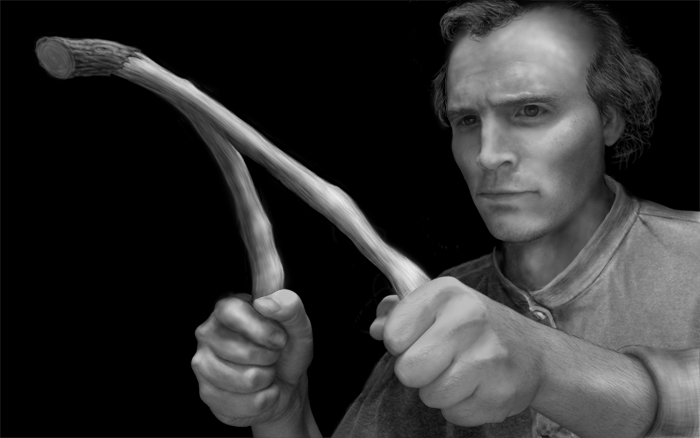
Image from ImagesOfTheRestoration.org
Member beliefs
Oliver Cowdery's Gift
It's not often talked about in Church these days, but in Section 8 of the Doctrine and Covenants it discusses in length the special gift given to Oliver Cowdery called the "gift of Aaron".
The heading to Section 8 provides the context for the discussion:
Revelation given through Joseph Smith the Prophet to Oliver Cowdery, at Harmony, Pennsylvania, April 1829.In the course of the translation of the Book of Mormon, Oliver, who continued to serve as scribe, writing at the Prophet's dictation, desired to be endowed with the gift of translation. The Lord responded to his supplication by granting this revelation.
The revelation states, in relevant part:
- Now this is not all thy gift; for you have another gift, which is the gift of Aaron; behold, it has told you many things;
- Behold, there is no other power, save the power of God, that can cause this gift of Aaron to be with you.
- Therefore, doubt not, for it is the gift of God; and you shall hold it in your hands, and do marvelous works; and no power shall be able to take it away out of your hands, for it is the work of God.
- And, therefore, whatsoever you shall ask me to tell you by that means, that will I grant unto you, and you shall have knowledge concerning it.
- Remember that without faith you can do nothing; therefore ask in faith. Trifle not with these things; do not ask for that which you ought not.
- Ask that you may know the mysteries of God, and that you may translate and receive knowledge from all those ancient records which have been hid up, that are sacred; and according to your faith shall it be done unto you.
(D&C 8:6-11, emphasis added)
From this account, we don't really know much about what exactly the gift of Aaron is that Oliver Cowdery received but most members are under the impression that it has something to do with being the spokesman for God.
Reference:
Link is here.
Problem summary
What is "the gift of Aaron"? The text provides several clues. First, Oliver has a history of using it, since "it has told [him] many things". Second, it is "the gift of God". Third, it is to be held in Oliver's hands (and kept there, impervious to any power). Fourth, it allows Oliver to "do marvelous works". Fifth, it is "the work of God". Sixth, the Lord will speak through it to Oliver and tell him anything he asks while using it. Seventh, it works through faith. Finally, it enables Oliver to translate ancient sacred documents.
With only these clues, the gift of Aaron remains very hard to identify. The task becomes much easier, however, when we look at the original version of the revelation contained in The Book of Commandments, a predecessor volume to The Doctrine and Covenants, used by the LDS Church from 1831 to 1835. Section 7 vs. 3 of the book contains the same wording as the current version, except that the term "gift of Aaron" replaces the following language (in bold):
Now this is not all, for you have another gift, which is the gift of working with the rod: behold it has told you things: behold there is no other power save God, that can cause this rod of nature, to work in your hands.
What is the gift of Aaron? It is a "rod of nature."
What is a "rod of nature"? The historical record indicates that it is a divining rod (or dousing rod), which Oliver Cowdery used as a youth to hunt for buried treasure. See e.g., Dan Vogel, ed., Early Mormon Documents (Salt Lake City: Signature Books, 1998), 1: 603-05, 619-20. Cowdery's use of a divining rod to search for buried treasure evokes similar images of Joseph Smith hunting for treasure with a stone in a hat. Oliver also wished to use his divining rod, in the same way Joseph Smith used his stone and hat, to translate ancient scriptures. Section 8 of the Doctrine and Covenants indicates that the Lord, through Joseph Smith, granted Oliver's request.
If Oliver Cowdery's gift was really a divining rod then this seems to indicate that the origins of the Church are much more involved in folk magic and superstition than we've been lead to believe by the LDS Church's heavily-censored versions of its history.
Was the Rod of Aaron really a physical object?
Some faithful members say that when the Book of Commandments refers to a 'rod' that it isn't really a physical rod but a metaphor and thus cannot be a divining rod. Read the following phrases from the Book of Commandments:
'you shall hold it in your hands.and no power shall be able to take it away out of your hands.'
The scripture refers to a physical object that Oliver held in his hands.
What does the LDS Church say?
The following is taken in its entirety from the Gospel Doctrine study Guide:
DC 8:6 the gift of Aaron
Joseph Fielding Smith
There was another gift bestowed upon Oliver Cowdery, and that was the gift of Aaron. Like Aaron with his rod in his hand going before Moses as a spokesman, so Oliver Cowdery was to go before Joseph Smith. Whatever he should ask the Lord by power of this gift should be granted if asked in faith and in wisdom. Oliver was blessed with the great honor of holding the keys of this dispensation with Joseph Smith, and like Aaron [Ex. 4:10-17], did become a spokesman on numerous occasions. It was Oliver who delivered the first public discourse in this dispensation.(Roy W. Doxey, comp., Latter-day prophets and the Doctrine and Covenants [Salt Lake City: Deseret Book Co., 1978], 1: 82.)
DC 8:8 you shall hold it in your hands
How could Oliver Cowdery hold the gift of Aaron in his hands? A review of the first edition of the Book of Commandments makes this verse more clear. In the original, the preceding verses read as follows:
"Now this is not all, for you have another gift, which is the gift of working with the rod: behold it has told you things: behold there is no other power save God, that can cause this rod of nature, to work in your hands, for it is the work of God." (Melvin J. Petersen, "Preparing Early Revelations for Publication," Ensign, Feb. 1985, 20)
Oliver held this rod (symbolic of the rod of Aaron and the gift of Aaron) in his hands. Oliver was in possession of a rod-an instrument for divining the Lord's will which worked much like a Urim and Thummim. The possession of such a rod explains why the next verse says, 'you shall hold it in your hands.and no power shall be able to take it away out of your hands.'
"It seems evident that the Lord entrusted Oliver with a sacred instrument through which he could translate by the Spirit of revelation. Having received instructions on the use of the sacred instrument which he possessed, Oliver Cowdery sought to translate from the Plates of Mormon, probably through the instrument which had been entrusted into his care. But he failed." (Hyrum L. Andrus, Doctrinal Commentary on the Pearl of Great Price [Salt Lake City: Deseret Book Co., 1967], 6.)
Reference:
Link is here.
Per the LDS gospel doctrine guide, the rod was a physical object - a 'sacred instrument through which he could translate'.
The Church-sponsored Joseph Smith Papers Projects also refers to the rod as a divining rod:
In the revelation, the phrase “the gift of working with the sprout” appears, possibly describing Cowdery's use of a divining rod or similar “thing of Nature.” The phrase was later revised to read “the gift of working with the rod” in the 1833 Book of Commandments and ‘the gift of Aaron” in the 1835 Doctrine and Covenants.
Link is here.
Why did the Church eliminate the word 'rod' from its scriptures?
A logical question is, "why were the scriptures altered from the original revelation to remove any mention of the word 'rod'?" Critics would say that the Church was trying to move away from anything that made its origins seem less Holy and more superstitious. Well meaning, educated, reasonable people learning about the heavy involvement in magic and the occult by early LDS leaders, find adequate justification to label the LDS church, as some sort of cult. Divining rods are viewed as a superstitious tool used by superstitious people and not something God would have his apostles use.
Thoughtful people view the seer stones Joseph Smith used as another magical instrument used to trick the gullible. The LDS Church naturally tries to distance itself from anything that looks like folk magic and superstition used by illiterate sign seekers. Joseph used seer stones all his life, yet the Church would prefer to rewrite its history to lead its members to believe he used an Old Testament-like Urim and Thummim, that he claimed was in a stone box, to translate the Book of Mormon. Joseph's relatives and friends claim that Joseph used a rock he believed had magical properties, placed in his hat. Joseph and Hyrum found this stone while digging a well for a Mr. Chase. The divining rod Oliver Cowdery used is further evidence that the LDS Church's founders were devout believers in the magical power of rocks and sticks. By eliminating the use of the word 'rod' from the scriptures, it makes the Church's origins seem more Godlike and less superstitious.
From an RLDS Church Historian
The money diggers used divining rods to find buried treasure. They were also used as "a medium of revelation." Those who used divining rods were at times referred to as "rodsmen." Richard P. Howard, RLDS church historian, makes some startling admissions in a book published by his church:
Several writers have established that both in Vermont and in western New York in the early 1800's, one of the many forms which enthusiastic religion took was the adaptation of the witch hazel stick.... For example, the 'divining rod' was used effectively by one Nathaniel Wood in Rutland County, Vermont, in 1801. Wood, Winchell, William Cowdery, Jr., and his son, Oliver Cowdery, all had some knowledge of and associations with the various uses, both secular and sacred, of the forked witch hazel rod. Winchell and others used such a rod in seeking buried treasure;... when Joseph Smith met Oliver Cowdery in April, 1829, he found a man peculiarly adept in the use of the forked rod…and against the background of his own experiments with and uses of oracular media, Joseph Smith's April, 1829, affirmations about Cowdery's unnatural powers related to working with the rod are quite understandable....
By the time that Joseph Smith approached the reinterpretation and rewording of this document for the 1835 edition of the Doctrine and Covenants, he had had time and experience necessary to place his 1829 assessment of the meaning of Cowdery's gift of working with the rod in a somewhat more accurate perspective. Both he and Cowdery had developed away from an emphasis on the religious or mystical meanings in such mechanical objects as the water witching rod. Joseph's 1835 wording of this document…left behind the apparent 1829 reliance upon external media, which by 1835 had assumed in Joseph's mind overtones of superstition and speculative experimentation (Restoration Scriptures, Independence, Mo.. 1969, pp.211-14).
We are not aware of any writer in the Utah Mormon church who has been this honest about the change concerning the gift of working with the rod in Joseph Smith's revelation, but Marvin S. Hill, assistant professor of history at BYU, has admitted that "when Oliver Cowdery took up his duties as a scribe for Joseph Smith in 1829 he had a rod in his possession which Joseph Smith sanctioned...." (Dialogue: A Journal of Mormon Thought, Winter 1972, p.78). Marvin Hill goes on to state: "Some of the rodsmen or money diggers who moved into Mormonism were Oliver Cowdery, Martin Harris, Orrin P. Rockwell, Joseph and Newel Knight, and Josiah Stowell." It is interesting to note that Marvin Hill includes two of the three witnesses to the Book of Mormon in his list of "rodsmen or money diggers."* (In Mormonism-Shadow or Reality? pp.47-49, we reproduced a number of affidavits and statements linking Joseph Smith to peep stones, divining rods and money-digging.)
Reference:
Link is here.
What does the LDS Church say?
Brigham Young explained why some alterations were made in the Book of Commandments:
"When revelations are given through an individual appointed to receive them, they are given to the understandings of the people. These revelations, after a lapse of years, become mystified to those who were not personally acquainted with the circumstances at the time they were given." (Journal of Discourses, 3:333.)
Melvin J. Petersen wrote, "The meaning of this revelation as recorded in the Book of Commandments and in the Doctrine and Covenants is not clear. History does not record that Oliver Cowdery or anyone else living at the time it was given had a problem understanding it, but today some of the revelation (as given in the original) is unclear to us." (Melvin J. Petersen, "Preparing Early Revelations for Publication," Ensign, Feb. 1985, 20)
Accordingly, when the text of the revelation was prepared for review in 1835, it was altered. But who changed it? Both Joseph Smith and Oliver Cowdery were part of the "committee to revise the Book of Commandments when the wording of this 1829 revelation was changed." ("The Mature Joseph Smith and Treasure Searching" by Richard Lloyd Anderson Fn, BYU Studies, vol. 24 (1984), Number 4 - Fall 1984)
Oliver Cowdery's experience with a divining rod.
It is known that Oliver Cowdery and his father were 'rodsmen' before Oliver joined the Church.
From D. Michael Quinn's book Early Mormonism and the Magic World View:
... a religious group began using forked divining rods for revelatory purposes in Vermont about 1800. This was not far from the Smiths, or from William Cowdery (father of future Book of Mormon scribe Oliver Cowdery). At Middletown, Vermont, Nathaniel Wood was instructing his followers that "they were descendants of the ancient Jews, and lawful inheritors of the whole country." They believed in alchemy and used a "cleft stick, or rod," to discover "the hidden treasures of the earth" and to receive instructions by"a nod of assent É from the rods," (emphasis in original) including a revelation "that they must build a temple"...
The Wood group's civil prominence, fervor, and open conflict with non-believers led to the so-called "Wood Scrape," a sensational event known far beyond the Cowdery family's residence six miles away. The Wood group's "Fraternity of Rodsmen" boldly prophesied they would inherit that region of the country in an apocalyptic event on 14 January 1802.... This was happening six miles from the Cowderys' home....
From 1800 to 1802, Nathaniel Wood's "use of the rod was mostly as a medium of revelation"... A connection between William Cowdery and the Wood Scrape would help to explain why his son Oliver had a rod through which he received revelations....
To read more on this from Quinn (about 1/3 of the way down):
Link is here.
Also: Dan Vogel, ed., Early Mormon Documents (Salt Lake City: Signature Books, 1998), 1: 603-05, 619-20
More from Church archives
This recent addition to LDS public documents, shows that the critics were correct in that Oliver Cowdery did in fact believe in and used a divining rod. It also states that God causes the divining rod (thing of nature) to work.
Oliver Cowdery lived in a culture steeped in biblical ideas, language and practices. The revelation's reference to Moses likely resonated with him. The Old Testament account of Moses and his brother Aaron recounted several instances of using rods to manifest God's will (see Ex. 7:9-12; Num. 17:8). Many Christians in Joseph Smith and Oliver Cowdery's day similarly believed in divining rods as instruments for revelation. Cowdery was among those who believed in and used a divining rod. 8
The Lord recognized Oliver's ability to use a rod: “thou hast another gift which is the gift of working with the rod.” 9 Confirming the divinity of this gift, the revelation stated: “Behold there is no other power save God that can cause this thing of Nature to work in your hands for it is the work of God.” If Oliver desired, the revelation went on to say, the Lord would add the gift of translation to the revelatory gifts Oliver already possessed (D&C 8:8-11).
Reference: Link is here.
Using the rod
Finding where the temple should be built
Recently the Mormon writer D. Michael Quinn has admitted that "Oliver Cowdery was by revelation given the gift of working with a 'rod of nature...'" (Brigham Young University Studies, Fall 1978, p.82). Dr. Quinn further informs that "during the Nauvoo period Apostle Heber C. Kimball 'inquired by the rod' in prayer." In a footnote in the same article the following is cited from the Anthon H. Lund Journal for July 5,1901: "in the revelation to Oliver Cowdery in May 1829, Bro. [B. H.] Roberts said that the gift which the Lord says he has in his hand meant a stick which was like Aaron's Rod. It is said Bro. Phineas Young [brother-in-law of Oliver Cowdery and brother of Brigham Young] got it from him [Cowdery] and gave it to President Young who had it with him when he arrived in this [Salt Lake] valley and that it was with that stick that he pointed out where the Temple should be built." When Brigham Young famously stuck his cane into the ground and announced "this is the place" in the Salt Lake Valley, his 'cane' was actually Oliver Cowdery's rod.
Reference:
Link is here.
The treasure hunt
In addition to using a divining rod to find water, many rodsmen used a rod in an effort to find treasure. Joseph Smith's interest in treasure hunting continued even after he published the Book of Mormon. Ebenezer Robinson, who was at one time the editor of the Mormon paper, Times and Seasons, gave the following information:
A brother in the church, by the name of Burgess, had come to Kirtland and stated that a large amount of money had been secreted in a cellar of a certain house in Salem, Massachusetts.... We saw the brother Burgess, but Don Carlos Smith told us with regard to the hidden treasure. His statement was credited by the brethren, and steps were taken to try and secure the treasure, of which we will speak more fully in another place" (The Return, vol. 1, p.105).
Ebenezer Robinson goes on to state: "We soon learned that four of the leading men of the church had been to Salem, Massachusetts, in search of the hidden treasure spoken of by Brother Burgess, viz: Joseph Smith, Hyrum Smith, Sidney Rigdon and Oliver Cowdery. They left home on the 25th of July, and returned in September."
Joseph Smith's History tells of this trip: "On Monday afternoon, July 25th, in company with Sidney Rigdon, Brother Hyrum Smith, and Oliver Cowdery, I left Kirtland, ...and arrived in Salem, Massachusetts, early in August, where we hired a house, and occupied the same during the month ..." (History of the Church, vol. 2, p.464).
On August 6, 1836, Joseph Smith received a revelation concerning this treasure hunt, which is still published in the Doctrine and Covenants. In this revelation we read the following:
I, the Lord your God, am not displeased with your coming this journey, notwithstanding your follies.
I have much treasure in this city for you,... and its wealth pertaining to gold and silver shall be yours.
Concern not yourselves about your debts, for I will give you power to pay them. ...inquire diligently concerning the more ancient inhabitants and founders of this city;
For there are more treasure than one for you in this city (Doctrine and Covenants, (111:1, 2, 4, 9, 10).
Mr. Robinson stated that the treasure was never found, and Joseph Smith was unable to pay his debts as the revelation had promised. The Mormon historian B. H. Roberts admitted that the Mormon leaders went to Salem seeking "an earthly treasure," but attempted to change the original meaning of the revelation to avoid embarrassing the church. Therefore he claimed that the other treasures spoken of in the revelation were of a spiritual nature (see Comprehensive History of the Church, vol. 1, p.412). This would be less offensive to modern readers.
Although there's no specific mention of Oliver's rod being used to try to find this treasure, the story illustrates the magical mindset and raw attempts to find money and treasure. This was a major motivation of early church leaders: Joseph Smith, Oliver Cowdery, Hyrum Smith and Sidney Rigdon.
Reference:
Link is here.
Do divining rods really work?
Whenever divining rods are discussed, there are some people, even today, that say they do actually work -at least to find water. Several people still use divining rods today to attempt to find water. As illustrated here:
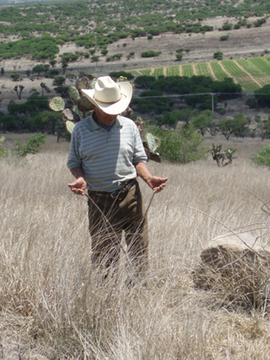
The simple fact is that divining rods are not able to reliably find water or treasure. I watched a show on TV called Exploring Psychic Powers Live (June 7, 1989) that offered a $100,000 prize to anyone that could determine where water was using a divining rod. The dowser tried but failed. The Amazing Randi, a magician and famed debunker of psychics and hoaxers, has a standing $1 million challenge to anyone that can prove paranormal activity, including use of a divining rod in a controlled environment. His challenge has yet to be claimed by anyone using a divining rod. To quote from Randi's site: "No, dowsing does not work, and the majority of claims made for the JREF million-dollar prize are directed at this remarkable self-delusion."
Here's a nice little five-minute video debunking dowsing:
Link is here.
Reference:
Link is here.
True believing LDS member response.
Critics of the church like to imply that the "gift of working with the rod" refers to a typical y-shaped divining rod that Oliver Cowdery used in the superstitious practice of divining for water. Although divining for water was a common practice in those days, other historical records have described the rod, more like that of Aaron's, as a long staff that was held in one hand. If Aaron could have one, why not Oliver?
Reference:
Link is here.
Critic's response.
Aaron (assuming he's even a real person from history) using a staff 4,000 years ago is a little different than Oliver Cowdery using it in the 19th century. Oliver wasn't commanded by God to cast his staff down in front of the Pharaoh to have it turn into a snake and devour the Pharaoh's magician's snakes. Also there's no mention that Aaron used his staff for revelation or for finding water or treasure with. As was a common practice in the desert in 2000 BC, he probably mostly used his staff as a walking stick. Also, since Aaron's staff was given to Moses by Pharaoh, there is a certain symbolism for having Moses or Aaron use this same staff to perform miracles with - particularly in Pharaoh's presence.
If it is not an embarrassment to use a magical rod or staff, or magic stones placed in the bottom of a hat, then why aren't these tools used today by the first elder of the church? What would the faithful members of the church say today if the First Presidency used a magic rock, staff or rod to obtain revelation?
Editor Comments
Both the critics and defenders of the faith have compelling points to make. The editors of this section give their own opinion:
As the church began to grow, the leaders of the early church were apparently embarrassed by the magical practices that were fundamental to the development of the church such as the use of seer stones and divining rods. If we accept the beginnings of the church as actual events, then we must believe that the rod Oliver used was more than just a stick, and that the stone Joseph used to translate the Book of Mormon with was a special, magical type of stone. We can see why the church has moved away from even talking about these things. The church leaders today have distanced themselves from external devices believed to have special power, to receive God's revelations. But the historical record is clear that the early Mormon leaders relied on special 'sticks and stones' in order to produce "the revelations" they claimed were from God.
Links
Supporting the critics:
Supporting the church:
Neutral:


 RSS
RSS