Prophets after Joseph Smith
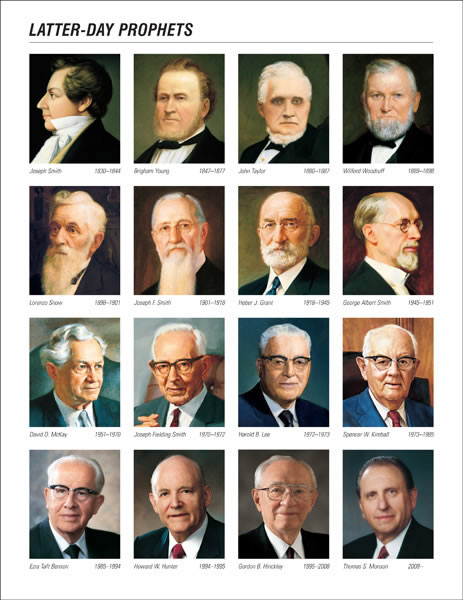
Twice a year, during General Conference, the membership of the LDS Church sustains the president of the Church as a prophet, seer and revelator. The belief that there is a modern prophet on earth to guide the Latter-day Saints is one of the core doctrines of the Church.
Overview of LDS position
What I the Lord have spoken, I have spoken, and I excuse not myself; and though the heavens and the earth pass away, my word shall not pass away, but shall all be fulfilled, whether by mine own voice or by the voice of my servants, it is the same.[1]
Although individuals may receive personal revelation, the prophet (president of the Church) is the only who can receive revelations to guide and direct the Church.[2] He is the man chosen by God to say the things God Himself would say if He were speaking directly to man.[3] The modern prophets' words can be found in the General Conference reports or in Church magazines.
The Lord will never permit me or any other man who stands as President of this Church to lead you astray. It is not in the programme. It is not in the mind of God. If I were to attempt that, the Lord would remove me out of my place, and so He will any other man who attempts to lead the children of men astray from the oracles of God and from their duty.[4]
Overview of Critics' position
Although the Church of Jesus Christ of Latter-day Saints says the prophet (president) of the Church speaks directly for God himself, there have been numerous instances throughout the history of the Church where a prophet made incorrect prophesies, or where he taught things as eternal principles which were later changed or voided. For example, many teachings given by the prophet Brigham Young, often in General Conference, are now specifically denied by the LDS church.[5][6] If prophesies can be false, and doctrines given by one prophet can be invalidated by another, what good is a prophet? If the prophet is only speaking as a prophet sometimes, and as a man at other times (over the pulpit in General Conference), how is a member of the church to tell the difference?
References
- D&C 1:38
-
"[T]he Lord has designated the President of the Church as the only one entitled to receive revelations and directions for the Church as a whole."
Aaronic Priesthood Lesson Manual, Lesson 24.
- Gospel Fundamentals Manual, Chapter 9.
- "Excerpts from Three Addresses by President Wilford Woodruff Regarding the Manifesto," by Wilford Woodruff, Doctrine & Covenants, Official Declaration 1.
- Such as the Adam-God doctrine, taught by Brigham Young, 9 April 1852 in General Conference.
"Self-Government—Mysteries—Recreation and Amusements, Not in Themselves Sinful—Tithing—Adam, Our Father and Our God," Journal of Discourse 1, Discourse 8.
"We warn you against the dissemination of doctrines which are not according to the scriptures and which are alleged to have been taught by some of the General Authorities of past generations. Such, for instance, is the Adam-God theory. We denounce that theory and hope that everyone will be cautioned against this and other kinds of false doctrine."
"Our Own Liahona," President Spencer W. Kimball, General Conference, October 1976.
The withholding of the priesthood for blacks was taught as doctrine by Brigham Young and retaught by prophets until President Kimball. Yet in an essay published in 2013 by the Church, they called this doctrinal teaching a "theory" based on the popular social climate of the times.
"Over time, Church leaders and members advanced many theories to explain the priesthood and temple restrictions. None of these explanations is accepted today as the official doctrine of the Church."
"Race and the Priesthood," Gospel Topics, LDS.org. See MormonThink's complete coverage of this essay.
Contents for this page
Introduction
Member beliefs
Problem summary
Prophet as seer
Purpose of a prophet
Doctrine vs. opinion
Revelations from the Devil?
Strange statements by prophets
Prophets giving interviews
Apostle admits false doctrine
Current vs. dead prophet
Danger of having a prophet
Listen to a wrong prophet?
Challenge a prophet's words?
Biggest error by prophets?
Special witnesses of Christ
How prophets get revelation
Speaking for God?
Response by the Church
Critics' summary
Editor's comments
Links
Member beliefs
One of the great benefits of our religion is that we have an actual modern-day prophet that leads our church. We sustain the current prophet twice a year at General Conference specifically as a prophet, seer and revelator. Although the prophets are men and make mistakes like anyone else, they do not err when conveying God's will to the Church. They serve as God's mouthpiece on important issues and can be called upon at any time to reveal God's will to man.
As members of The Church of Jesus Christ of Latter-day Saints, we are blessed to be led by living prophets—inspired men called to speak for the Lord, just as Moses, Isaiah, Peter, Paul, Nephi, Mormon, and other prophets of the scriptures. We sustain the President of the Church as our prophet, seer, and revelator—the only person on the earth who receives revelation to guide the entire Church. We also sustain the counselors in the First Presidency and the members of the Quorum of the Twelve Apostles as prophets, seers, and revelators.
Like the prophets of old, prophets today testify of Jesus Christ and teach His gospel. They make known God's will and true character. They speak boldly and clearly, denouncing sin and warning of its consequences. At times, they may be inspired to prophesy of future events for our benefit.
You can always trust the living prophets. Their teachings reflect the will of the Lord, who declared: "What I the Lord have spoken, I have spoken, and I excuse not myself; and though the heavens and the earth pass away, my word shall not pass away, but shall all be fulfilled, whether by mine own voice or by the voice of my servants, it is the same" (D&C 1:38).
Your greatest safety lies in strictly following the word of the Lord given through His prophets, particularly the current President of the Church. The Lord warns that those who ignore the words of the living prophets will fall (see D&C 1:14-16). He promises great blessings to those who follow the President of the Church:
"Thou shalt give heed unto all his words and commandments which he shall give unto you as he receiveth them, walking in all holiness before me; For his word ye shall receive, as if from mine own mouth, in all patience and faith. For by doing these things the gates of hell shall not prevail against you; yea, and the Lord God will disperse the powers of darkness from before you, and cause the heavens to shake for your good, and his name's glory" (D&C 21:4-6).
"Prophets," True to the Faith, (2004), 129-30. (Emphasis added.)
Problem summary
No prophet since Joseph Smith has really prophesied, acted as a seer or provided any significant revelation, except things like reversing Joseph Smith's polygamy revelations or reversing Brigham Young's (and succeeding prophets') ban on blacks receiving the priesthood. If we, as Latter-day Saints, believe Joseph Smith restored the gospel and was the first in a long line of prophets, then why have prophets since then not exhibited all of the same gifts that Joseph demonstrated and that the current Church teaches that existing prophets should have?
Here are quotes from apostles decades after Joseph died regarding the seer portion of the prophet's calling:
Orson Pratt declared:
Have any of the other denominations got this gift among them? Go and inquire through all of Christendom… "Can you translate ancient records written in a language that is lost to the knowledge of man?" "No…they have not the power to do it…you must give us credit," he had chided, "of at least professing to have these great and important gifts.
Discourse by Elder Orson Pratt, August 25, 1878, Journal of Discourses, 20:5-6.
Elder John A. Widtsoe highlighted one of the gifts a prophet is capable of when he said
In current practice, the word "translator" is omitted, since should records appear needing translation, the President of the Church may at any time be called, through revelation, to the special labor of translation.
"What is the Meaning of the Title 'Prophet, Seer, and Revelator'?" John A. Widtsoe, Evidences and Reconciliations, Vol. 1, p. 203.
The prophet's role as a seer
Joseph Smith claimed to translate and bring forth many scriptures using his prophetic abilities as a seer and translator. Such works include the Book of Mormon, Book of Abraham, the inspired version of the Holy Bible and the Kinderhook Plates. Why haven't the prophets that followed Joseph performed any prophetic duties as seer for the church?
Devout response
Joseph translated all the important documents that needed translating brought forth before him. There is nothing left in modern times to translate. If there were documents that God wanted translated he would have the current prophet translate them just as Orson Pratt stated.
Critic's response
There are numerous documents that could be translated by modern prophets and provide value to Latter-day Saints, just as the other additional scriptures brought forth by Joseph have. A few immediately come to mind:
The Dead Sea Scrolls
One of the most exciting religious discoveries of the 20th century has been the discovery of the Dead Sea scrolls. Scholars have been all over these documents but why hasn't the LDS prophet tried to decipher these valuable ancient documents instead of just scholars?
Anthon Manuscript
The RLDS Church (Community of Christ) has a document in their possession referred to as the Anthon Manuscript. This is believed to be the original or a copy of the original document that Martin Harris took to professor Anthon to convince Martin that Joseph really was translating an ancient document written in reformed Egyptian. This document is of enormous historical value to the church.
The characters on the so-called 'Anthon Document' match the characters on early 1840s placards promoting the Book of Mormon and also on the front and back covers of the 1980 'gold' edition of the Book of Mormon. This document may not be the original document taken to Professor Anthon, but the characters likely are as they are the same characters used on the covers of the published 1980 edition of the BOM.
If a modern-day prophet could translate these characters and show that this was part of the Book of Mormon then this would add significant credibility to Joseph's ability as seer. Modern linguists have looked at the characters and said they are gibberish but what does our modern-day seer say?
The Kinderhook Plates
For many years LDS scholars debated whether or not the Kinderhook Plates reportedly translated by Joseph were actually real ancient plates or not? The pictures of the plates with the detailed writings were published in the Church-owned Times and Seasons newspaper when Joseph lived, as well as being published in the book History of the Church by Joseph Smith. Any prophet with the seer ability from Brigham Young to our current prophet could have used the pictures of the plates and translated the writings to verify what Joseph said about them as well as to finish the translation.
This would have ended the debate as to what the Kinderhook Plates were. If they were not real plates, they could have determined that also and said as such. If they were real, they could have provided the Saints with additional scripture or at least silence the critics.
The Book of Abraham
The Egyptian papyri found in the Metropolitan Museum of New York in 1966, including facsimile 1 of the Book of Abraham, were given to the church in 1967. Many people have asked why the translation of the papyri by modern-day Egyptologists do not match what Joseph said they mean. Why does our prophet not use his ordained seer ability to translate these documents in the same way Joseph did and see what they mean and why? This way the prophets could answer with surety the many troubling questions by members such as BOA translation problems. Many people have understandably left the church over the BOA. Would this not be a good use of the prophet's seer ability by helping keep members from leaving the church?
Instead of using our prophet's ability as seer, the church has given the papyri to LDS scholars to study. Why would they do this unless the prophets are not really seers as we sustain them to be twice each year?
The Book of Joseph
The Egyptian papyri Joseph had also contained the Book of Joseph, which Joseph never translated. The papyri found in the Metropolitan Museum of New York included some of the Book of Joseph as described by Oliver Cowdery. Why doesn't the prophet translate the Book of Joseph portion?
The Inspired Version of the Holy Bible
Joseph began translating the inspired version of the Bible. Our current LDS versions of the Bible contain footnotes where Joseph had corrected the translation errors made when the Bible was translated over the years, as well as an entire chapter of Matthew. Joseph apparently never finished the work. Why didn't the next prophet, or any subsequent prophet, finish the inspired version of the Bible that the church thought was so important that they altered our version of the King James Bible to include the portions that Joseph did retranslate?
On 10 January 1832, the Lord encouraged the Brethren to continue the translation "until it be finished." (D&C 73:3–4.)
Does it make any sense that the inspired version of the Bible should not be finished merely with the death of the first prophet of the restoration? If we really did have a succession of prophets since Joseph Smith, this important work would have been finished and published as God commanded Joseph to do.
Note: There seems to be some debate as to whether or not Joseph actually finished the inspired translation of the Bible before he was killed. President George Q. Cannon in his Life of Joseph Smith the Prophet: "We have heard President Brigham Young state that the Prophet before his death had spoken to him about going through the translation of the scriptures again and perfecting it upon points of doctrine which the Lord had restrained him from giving in plainness and fulness at the time of which we write [2 February 1833]." (Salt Lake City: Deseret Book Co., 1958, p. 148.)
However, others disagree and said that the JST was ready to be published in its entirety before Joseph died. In either case, the prophets following Joseph should have completed the translation or should have known that the JST was complete and published it as the Lord commanded and as Joseph intended if they were indeed receiving revelation on the matter. The only apparent reason not to publish the JST in the 1840s would be if they didn't know what to do which would be the case if they were ordinary men and not inspired prophets.
Reference: LDS library article Joseph Smith's Efforts to Publish His Bible "Translation", Ensign, January 1983.
The purpose of a prophet
According to President Gordon B. Hinckley (emphasis added):
One of the purposes of a prophet is to seek the wisdom and the will of the Lord and to teach his people accordingly. It was the case with Moses when he led the children of Israel out of Egypt. It was the case for the Old Testament prophets when people were faced with oppression and trouble and difficulty. That is the purpose of a prophet, to give answers to people for the dilemmas in which they find themselves. That is what happens. That is what we see happen. Is it a matter of expediency, political expediency? No! Inspired guidance? Yes!
"This Thing Was Not Done in a Corner," President Gordon B. Hinckley, Priesthood Session, General Conference, October 1996.
Critic's point: If the purpose of a prophet is to give answers to people for the dilemmas in which they find themselves, then why doesn't the prophet inquire of the Lord and give the members clear answers as to the many dilemmas that currently face thousands of Latter-day Saints such as:
- Why doesn't Joseph's translation of the Book of Abraham papyri and facsimiles agree with what Egyptologists say they mean?
- Why were blacks denied the priesthood until 1978?
- Why did Joseph marry 11 men's wives while they were still married to their husbands?
- Why did Joseph start a translation of the fake Kinderhook Plates?
- Why does DNA analysis show that the Native American Indians came from Asia and not Israel as the Book of Mormon teaches?
- etc.
Thousands of people understandably leave the Church because they cannot get official, plausible answers from their leaders to these troubling questions and other dilemmas that trouble them deeply. The prophet could do tremendous good in the lives of these thousands of people and their families if he would just give them the answers they seek. The only reason to not give them these answers is if they don't know the answers. If they can't get these answers as prophets then how are they to fulfill President Hinckley's statement that the purpose of a prophet is to give answers to people for the dilemmas in which they find themselves?
The Profile of a Prophet by President Hugh B. Brown (1883–1975)
An excerpt from the edited and published version of a speech delivered at Brigham Young University on October 4, 1955:
Then we proceeded to prepare what I may call a "profile of a prophet." … We agreed, between us, that the following characteristics should distinguish a man who claims to be a prophet.
A. He will boldly claim that God [has] spoken to him.
B. Any man so claiming would be a dignified man with a dignified message; no table-jumping, no whisperings from the dead, no clairvoyance, but an intelligent statement of truth.
C. Any man claiming to be a prophet of God would declare his message without any fear and without making any weak concessions to public opinion.
D. If he were speaking for God, he could not make concessions although what he taught would be new and contrary to the accepted teachings of the day. A prophet bears witness to what he has seen and heard and seldom tries to make a case by argument. His message and not himself is important.
E. Such a man would speak in the name of the Lord, saying, "Thus saith the Lord," as did Moses, Joshua, and others.
F. Such a man would predict future events in the name of the Lord, and they would come to pass, as did Isaiah and Ezekiel.
G. He would have not only an important message for his time but often a message for all future time, such as Daniel, Jeremiah, and others had.
H. He would have courage and faith enough to endure persecution and to give his life, if need be, for the cause he espoused, such as Peter, Paul, and others did.
I. Such a man would denounce wickedness fearlessly. He would generally be rejected or persecuted by the people of his time, but later generations, the descendants of his persecutors, would build monuments in his honor.
J. He would be able to do superhuman things, things that no man could do without God's help. The consequence or result of his message and work would be convincing evidence of his prophetic calling. "By their fruits ye shall know them" [Matt. 7:20].
K. His teachings would be in strict conformity with scripture, and his words and his writings would become scripture. "For the prophecy came not in old time by the will of man: but holy men of God spake as they were moved by the Holy Ghost" (2 Pet. 1:21).
Now, I have given but an outline which you can fill in and amplify and then measure and judge the Prophet Joseph Smith by the work and stature of other prophets.
As a student of the life of the Prophet Joseph Smith for more than 50 years, I say to you … , by these standards Joseph Smith qualifies as a prophet of God.
I believe that Joseph Smith was a prophet of God because he talked like a prophet. He was the first man since the Apostles of Jesus Christ were slain to make the claim which prophets have always made, [namely,] that God had spoken to him. He lived and died like a prophet. I believe he was a prophet of God because he gave to this world some of the greatest of all revelations. I believe that he was a prophet of God because he predicted many things which have come to pass, things which only God could bring to pass.
"The Profile of a Prophet," Apostle Hugh B.Brown, Ensign, July 2006
Editor Comment: It is debatable whether Joseph met the profile of a prophet as given by Apostle Hugh B. Brown. However, it is almost a certainty that none of the prophets since Joseph Smith met this profile. Certainly none of them did anything 'superhuman' or were able to 'predict future events that come to pass', etc. as Hugh B. Brown has stated that they should be able to do.
What is considered doctrine and what is just a prophet's opinion?
There is some debate within the Church as to what is considered official doctrine and what is just a man's opinion.
Brigham Young said "I have never yet preached a sermon and sent it out to the children of men, that they may not call Scripture" (Journal of Discourses, vol. 13, p. 95)
Some members say that it's not an official revelation unless the prophet ends it with the phrase "thus saith the Lord." The last President of the Church to prophesy or revelate using "Thus Saith the Lord" was Wilford Woodruff (4th President of the Church). Presidents of the Church since his time have not prophesied, seen visions (save a dream by Joseph F. Smith in 1916), nor received any "Thus Saith the Lord" revelations.
For those who believe that only "thus saith the Lord" statements are official revelations, then what value are the prophets to the LDS Church if they haven't had any of these types of revelations in well over 100 years?
Some members believe that if it is not in the four standard works then it is not considered official. Joseph Fielding Smith said,
It makes no difference what is written or what anyone has said, if what has been said is in conflict with what the Lord has revealed, we can set it aside. My words, and the teachings of any other member of the Church, high or low, if they do not square with the revelations, we need not accept them. Let us have this matter clear. We have accepted the four standard works as the measuring yardsticks, or balances, by which we measure every man's doctrine.
"Standard Works Judge Teachings of All Men," Doctrines of Salvation, Joseph Fielding Smith (Salt Lake City: Bookcraft, 1956), 3:203-04.
Using only the Four Standard Works as doctrine leads to the following logical argument: If a modern day prophet reveals something that isn't covered in the four standard works can we then reject it? So what's the point of having a living prophet? What is the value of modern-day prophets since they almost never add to those four scriptures? Of what value is the temple recommend interview since it is not found in the Standard Works?
Most members believe that anything published in the Ensign is considered scripture although some believe that just what is in the "First Presidency Message" of the Ensign should be considered scripture.
Often LDS apologists pick and choose what they consider to be doctrine. If it's a touchy subject such as racist comments made by past prophets, prophecies that didn't come true or teachings from prophets such as the "Adam-God" sermons of Brigham Young, LDS apologists say that was merely a man's opinion and not really God speaking through his appointed mouthpiece.
If that's the case then how do you know if a prophet is speaking doctrine or merely giving his opinion? If the apologists are right then why bother reading The Ensign or why take General Conference seriously if it's just the opinions of individual men?
What I the Lord have spoken, I have spoken, and I excuse not myself; and though the heavens and the earth pass away, my word shall not pass away, but shall all be fulfilled, whether by mine own voice or by the voice of my servants, it is the same.
D&C 1:38
Many of the disconcerting comments made by the prophets have come from the Church publication called The Journal of Discourses. It's often quoted in Church and even by LDS apologists. How much credence should we give to the JofD?
From journalofdiscourses.com:
The Journal of Discourses deservedly ranks as one of the standard works of the Church, and every right-minded Saint will certainly welcome with joy every number (issue) as it comes forth.
President George Q. Cannon, Journal of Discourses, Preface, Vol.8.
Each successive Volume of these Discourses is a rich mine of wealth, containing gems of great value, and the diligent seeker will find ample reward for his labor. After the fathers and mothers of this generation have made them the study of their lives their children's children will find that they are still unexhausted, and rejoice that this Record has been handed down from their fathers to also aid them in following the way of life.
Apostle Orson Pratt, Preface. Volume 3.
It is impossible to give monetary value to the past volumes of this publication,…Those who read the utterances of the servants of God, contained in this book, under the same influence by which the speakers were inspired, cannot fail to receive profit from the perusal.
President Joseph F. Smith, Preface, Vol.18.
We take great pleasure in presenting to the Saints and the world the…the JOURNAL OF DISCOURSES, which they will find contains rich treasures of information concerning the glorious principles of Eternal Life, as revealed through God's anointed servants in these last days. All who read the discourses contained in this Volume are earnestly recommended to adapt them to their lives by practice, and we can confidently assure them that, in doing so, they are laying up a store of knowledge that will save and exalt them in the Celestial kingdom.
Apostle Albert Carrington, Journal of Discourses, Preface, Vol. 15.
The Church has recently issued the following statement on their website:
The Journal of Discourses is not an official publication of The Church of Jesus Christ of Latter-day Saints. It is a compilation of sermons and other materials from the early years of the Church, which were transcribed and then published. It includes practical advice as well as doctrinal discussion, some of which is speculative in nature and some of which is only of historical interest.
Link is here.
On 11 May 2013 a Google search of lds.org was performed typing the following in the search box "journal of discourses" site:https://www.lds.org/ which looks up the exact phrase "journal of discourses" and searches only the site lds.org. There were 236,000 hits (in other words, it was used 236,000 times in the webpages found on lds.org).
In comparison, on the same search date, Google returned a combined number of 279,189 hits for "doctrine and covenants" (154,000) and "doctrine & covenants" (859) and "D&C" (123,000) and "D & C" (1,330). (This search included -dc which excluded references with the book Doctrine and Covenants itself.)
If the Journal of Discourses are currently relegated to the status of not-very-important as the entry from the source above notes, why has it been used so many times of the years by the Church in its official publications? Not only publications, but over the pulpit in General Conferences. A search just of General Conferences from 1971-2013 returned 84,000 hits.
A note must be given that because of the way lds.org is set up, some of the hits for the pages are duplicates because it shows searches within the lds.org site and also foreign languages. These hits should only be used for comparison purposes with other hits, not as a definitive statement on the exact number of occurences of search terms.
Critic's point: Some LDS apologists try to wiggle out with "it's not doctrine," but even they admit it's a long-running series of public transcriptions of sermons by the highest Mormon leaders, often from General Conferences. If even that's not doctrine, then what about conferences, devotionals and other talks at which General Authorities speak today?
The Journal of Discourses is available online: Link is here.
Ezra Taft Benson's talk given at Brigham Young University on February 26, 1980. Reprinted in the Church magazine Liahona, June 1981:
The sixth fundamental in following the prophet is per President Benson:
Sixth: The prophet does not have to say "Thus saith the Lord" to give us scripture.
Sometimes there are those who argue about words. They might say the prophet gave us counsel but that we are not obliged to follow it unless he says it is a commandment. But the Lord says of the Prophet, "Thou shalt give heed unto all his words and commandments which he shall give unto you." (D&C 21:4.)
And speaking of taking counsel from the prophet, in D&C 108:1, the Lord states:
"Verily thus saith the Lord unto you, my servant Lyman: Your sins are forgiven you, because you have obeyed my voice in coming up hither this morning to receive counsel of him whom I have appointed."
Said Brigham Young, "I have never yet preached a sermon and sent it out to the children of men, that they may not call scripture." (Journal of Discourses, 13:95.)
Editor Comment: This talk was quoted twice in the General Conference of October 2010. So it is hard to say that it is not still taught. The first talk was in the Saturday Morning session called "Obedience to the Prophets" by Claudio R. M. Costa. The second talk was in the Saturday Afternoon session called "Our Very Survival" by Kevin R. Duncan.
Approaching Mormon Doctrine
SALT LAKE CITY 4 May 2007 Much misunderstanding about The Church of Jesus Christ of Latter-day Saints revolves around its doctrine. The news media is increasingly asking what distinguishes the Church from other faiths, and reporters like to contrast one set of beliefs with another.
The Church welcomes inquisitiveness, but the challenge of understanding Mormon doctrine is not merely a matter of accessing the abundant information available. Rather, it is a matter of how this information is approached and examined.
The doctrinal tenets of any religion are best understood within a broad context (see here and here), and thoughtful analysis is required to understand them. News reporters pressed by daily deadlines often find that problematic. Therefore, as the Church continues to grow throughout the world and receive increasing media attention, a few simple principles that facilitate a better understanding may be helpful:
Not every statement made by a Church leader, past or present, necessarily constitutes doctrine. A single statement made by a single leader on a single occasion often represents a personal, though well-considered, opinion, but is not meant to be officially binding for the whole Church. With divine inspiration, the First Presidency (the prophet and his two counselors) and the Quorum of the Twelve Apostles (the second-highest governing body of the Church) counsel together to establish doctrine that is consistently proclaimed in official Church publications. This doctrine resides in the four "standard works" of scripture (the Holy Bible, the Book of Mormon, the Doctrine and Covenants and the Pearl of Great Price), official declarations and proclamations, and the Articles of Faith. Isolated statements are often taken out of context, leaving their original meaning distorted.
Some doctrines are more important than others and might be considered core doctrines. For example, the precise location of the Garden of Eden is far less important than doctrine about Jesus Christ and His atoning sacrifice. The mistake that public commentators often make is taking an obscure teaching that is peripheral to the Church's purpose and placing it at the very center. This is especially common among reporters or researchers who rely on how other Christians interpret Latter-day Saint doctrine.
Based on the scriptures, Joseph Smith declared: "The fundamental principles of our religion are the testimony of the Apostles and Prophets, concerning Jesus Christ, that He died, was buried, and rose again the third day, and ascended into heaven; and all other things which pertain to our religion are only appendages to it."
Because different times present different challenges, modern-day prophets receive revelation relevant to the circumstances of their day. This follows the biblical pattern (Amos 3:7), in which God communicated messages and warnings to His people through prophets in order to secure their well-being.In our day, President Gordon B. Hinckley has repeatedly emphasized the importance of the family in our increasingly fractional society. In addition, the Church does not preclude future additions or changes to its teachings or practices. This living, dynamic aspect of the Church provides flexibility in meeting those challenges.According to the Articles of Faith, "We believe all that God has revealed, all that He does now reveal, and we believe that He will yet reveal many great and important things pertaining to the Kingdom of God."
Latter-day Saints place heavy emphasis on the application of their faith in daily life. For example, the active participation of Latter-day Saints in their community and worldwide humanitarian programs reflects concern for other people. As Jesus Christ declared, "By their fruits ye shall know them."
Individual members are encouraged to independently strive to receive their own spiritual confirmation of the truthfulness of Church doctrine. Moreover, the Church exhorts all people to approach the gospel not only intellectually but with the intellect and the spirit, a process in which reason and faith work together.
Those writing or commenting on Latter-day Saint doctrine also need to understand that certain words in the Mormon vocabulary have slightly different meanings and connotations than those same words have in other religions. For example, Latter-day Saints generally view being born again as a process of conversion, whereas many other Christian denominations often view it as a conversion that happens in one defining moment. Sometimes what some may consider an argument or dispute over doctrine is really a misunderstanding of simple differences in terminology.
Journalists, academics and laymen alike are encouraged to pursue their inquiries into the Church by recognizing the broad and complex context within which its doctrines have been declared, in a spirit of reason and good will.
Reference
Editor comment: This article on the Church's official website does not clarify which particular teachings one should take as "doctrine" and which should be considered merely advice. If anything, it seems to muddy the issue when it says that "Individual members are encouraged to independently strive to receive their own spiritual confirmation of the truthfulness of Church doctrine." If doctrine is not identified, how can members receive a confirmation of "Church doctrine"? If the statement also encompasses the concept that members must first gain a spiritual understanding of what is Church doctrine, what is the purpose of modern prophets and apostles?
Can revelations come from the Devil?
Joseph Smith said "Some revelations are of God: some revelations are of man: and some revelations are of the devil."
From David Whitmer, An Address to All Believers in Christ, p.30 - p.31 [It will be on slightly different pages in different editions of Whitmer's pamphlet.]
We were waiting on Martin Harris who was doing his best to sell a part of his farm, in order to raise the necessary funds. After a time Hyrum Smith and others began to get impatient, thinking that Martin Harris was too slow and under transgression for not selling his land at once, even if at a great sacrifice. Brother Hyrum thought they should not wait any longer on Martin Harris, and that the money should be raised in some other way. Brother Hyrum was vexed with Brother Martin, and thought they should get the money by some means outside of him, and not let him have anything to do with the publication of the Book, or receiving any of the profits thereof if any profits should accrue. He was wrong in thus judging Bro. Martin, because he was doing all he could toward selling his land. Brother Hyrum said it had been suggested to him that some of the brethren might go to Toronto, Canada, and sell the copy-right of the Book of Mormon for considerable money: and he persuaded Joseph to inquire of the Lord about it. Joseph concluded to do so. He had not yet given up the stone. Joseph looked into the hat in which he placed the stone, and received a revelation that some of the brethren should go to Toronto, Canada, and that they would sell the copy-right of the Book of Mormon. Hiram Page and Oliver Cowdery went to Toronto on this mission, but they failed entirely to sell the copy-right, returning without any money. Joseph was at my father's house when they returned. I was there also, and am an eye witness to these facts. Jacob Whitmer and John Whitmer were also present when Hiram Page and Oliver Cowdery returned from Canada. Well, we were all in great trouble; and we asked Joseph how it was that he had received a revelation from the Lord for some brethren to go to Toronto and sell the copy-right, and the brethren had utterly failed in their undertaking. Joseph did not know how it was, so he enquired of the Lord about it, and behold the following revelation came through the stone: "Some revelations are of God: some revelations are of man: and some revelations are of the devil." So we see that the revelation to go to Toronto and sell the copy-right was not of God, but was of the devil or of the heart of man. When a man enquires of the Lord concerning a matter, if he is deceived by his own carnal desires, and is in error, he will receive an answer according to his erring heart, but it will not be a revelation from the Lord.
In discussing the "Canadian Copyright Caper" B. H. Roberts quotes this entire passage in Comprehensive History of the Church Vol. 1 pp. 162-66
So just how do we know what revelations are from God, from the devil or from the heart of man if even the Prophet Joseph Smith couldn't tell?
The last line of the quote is significant:
When a man enquires of the Lord concerning a matter, if he is deceived by his own carnal desires, and is in error, he will receive an answer according to his erring heart, but it will not be a revelation from the Lord.
In other words - you may still receive an answer but it will be the wrong one and you will have no idea that it's wrong. You can't really trust any spiritual witness whatsoever, can you?
The Greek Psalter Incident
Professor Henry Caswell, gave Joseph Smith a Greek Psalter to examine and asked him what it was. Joseph of course would know this as he reportedly translated the Book of Mormon from Reformed Egyptian and he translated the Book of Abraham from Egyptian papyri.
Joseph replied that it was a Dictionary of Ancient Egyptian Hieroglyphics. Professor Caswell of course knew Joseph was wrong as this was a known Greek Psalter and definitely not Egyptian.
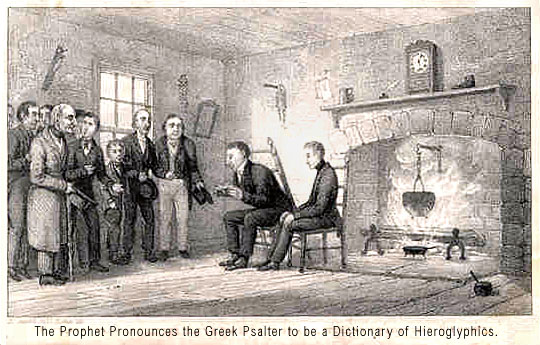
Reference: Link is here. scroll to near the bottom for section called 'THE MORMON PROPHET AND THE GREEK PSALTER.'
Caswell told this incident to Mormon apostle Dr. William Richards who said "Sometimes Mr. Smith speaks as mere man. If he gave a wrong opinion respecting the book, he spoke as a mere man."
Now assuming this was actual event as reported in the newspapers at the time, should this be considered a prophetic statement or just Joseph's opinion?
It's very convenient to say Joseph speaks as a man whenever he's proved wrong and a prophet whenever his statements haven't been proven one way or the other yet.
Prophecies
There are of course many prophecies of Joseph Smith that did not come true: Link is here.
Link is here.
Link is here.
Prophecies of Brigham Young: Link is here.
How do we know when to believe a prophet?
References
- An Insider's View of Mormon Origins, Grant Palmer pp. 35-36.
- Greek Psalter
Strange statements made by the prophets?
In order to show that these men were very human, here are a few quotes to consider from the modern-day prophets [emphasis added]:
Adam is God Quotes
How much unbelief exists in the minds of Latter-day Saints in regard to one particular doctrine which I revealed to them, and which God revealed to me - namely that Adam is our father and God ..Then he said, 'I want my children who are in the spirit world to come and live here. I once dwelt upon an earth something like this, in a mortal state. I was faithful. I received my crown and exaltation...I want my children that were born to me in the spirit world to come here and take tabernacles of flesh that their spirits may have a house, a tabernacle...' (Brigham Young, Deseret Weekly News, June 18, 1873, page 308; Deseret Evening News, June 14, 1873)
Who was the Savior begotten by?....Who did beget him? His Father, and his father is our God, and the Father of our spirits, and he is the framer of the body, the God and Father of our Lord Jesus Christ. Who is he? He is Father Adam; Michael; the Ancient of Days. (President Brigham Young, Feb. 19, 1854, Brigham Young Collection, LDS Archives; ; Brigham Young Addresses, 1850-1854, Vol. 2, by Elden J. Watson, sheet 179 (in chronological order), Historical Dept. Church, Ms d 1234, Box 48 Fd. 11; also in Adam Is God???, pp. 9-10; Adam-God Maze, p.101)
Some have grumbled because I believe our God to be so near to us as Father Adam. There are many who know that doctrine to be true. (Brigham Young, October 7, 1857, Journal of Discourses 5:331).
Some years ago I advanced a doctrine with regard to Adam being our Father and God...It is one of the most glorious revealments of the economy of heaven... (President Brigham Young, in the Tabernacle, General Conference, October 8, 1861, 10:30 a.m.; Brigham Young Addresses, 1860-1864, Vol. 4, by Elden J. Watson, sheet 134 (in chronological order), Historical Dept. Church, Ms d 1234, Box 49 fd 8)
I tell you more: Adam is the father of our spirits. He lived upon an earth, he did abide his creation and did honor to his calling and priesthood and obeyed his master or lord, and probably many of his wives did the same, and they lived and died upon an earth and then were resurrected again to immortality and eternal life. (Brigham Young, October 8, 1854, Brigham Young Addresses, 18509-1854, Vol. 2, by Elden J. Watson, sheet 221 (in chronological order), Historical Dept. Church, Box 49 fd 12)
Hinckley's comments on Brigham Young's Adam is God statements:
"Brigham Young said if you went to Heaven and saw God it would be Adam and Eve. I don't know what he meant by that." Pointing to a grim-faced portrait of the Lion of the Lord, as Young was called, Hinckley said, "There he is, right there. I'm not going to worry about what he said about those things." I asked whether Mormon theology was a form of polytheism. "I don't have the remotest idea what you mean," Hinckley said impatiently.
- Hinckley Interview in Lives of the Saint, New Yorker, January 2002
Link is here.
Murder of Unfaithful Spouse is Justified
"Suppose you found your brother in bed with your wife, and put a javelin through both of them, you would be justified, and they would atone for their sins, and be received into the kingdom of God. I would at once do so in such a case; under such circumstances. I have no wife whom I love so well that I would not put a javelin through her heart, and I would do it with clean hands." (Brigham Young, Journal of Discourses, Vol. 3, p. 247)
Racism
"Shall I tell you the law of God in regard to the African race? If the white man who belongs to the chosen seed mixes his blood with the seed of Cain, the penalty, under the law of God, is death on the spot. This will always be so." (Brigham Young, Journal of Discourses, Volume 10, page 110.)
You see some classes of the human family that are black, uncouth, un- comely, disagreeable and low in their habits, wild, and seemingly deprived of nearly all the blessings of the intelligence that is generally bestowed upon mankind. The first man that committed the odious crime of killing one of his brethren will be cursed the longest of any one of the children of Adam. Cain slew his brother. Cain might have been killed, and that would have put a termination to that line of human beings. This was not to be, and the Lord put a mark upon him, which is the flat nose and black skin. Trace mankind down to after the flood, and then another curse is pronounced upon the same race - that they should be the "servant of servants;" and they will be, until that curse is removed; and the Abolitionists cannot help it, nor in the least alter that decree. How long is that race to endure the dreadful curse that is upon them? That curse will remain upon them, [p.291] and they never can hold the Priesthood or share in it until all the other descendants of Adam have received the promises and enjoyed the blessings of the Priesthood and the keys thereof. Until the last ones of the residue of Adam's children are brought up to that favourable position, the children of Cain cannot receive the first ordinances of the Priesthood. They were the first that were cursed, and they will be the last from whom the curse will be removed. When the residue of the family of Adam come up and receive their blessings, then the curse will be removed from the seed of Cain, and they will receive blessings in like proportion. - (Journal of Discourses 7:290-291, October 9, 1859)
"You may inquire of the intelligent of the world whether they can tell why the aborigines of this country are dark, loathsome, ignorant, and sunken into the depths of degradation ...When the Lord has a people, he makes covenants with them and gives unto them promises: then, if they transgress his law, change his ordinances, and break his covenants he has made with them, he will put a mark upon them, as in the case of the Lamanites and other portions of the house of Israel; but by-and-by they will become a white and delightsome people" (Brigham Young, Journal of Discourses 7:336).
It is not the prerogative of the President of the United States to meddle with this matter, and Congress is not allowed, according to the [p.40] Constitution, to legislate upon it. If Utah was admitted into the Union as a sovereign State, and we chose to introduce slavery here, it is not their business to meddle with it; and even if we treated our slaves in an oppressive manner, it is still none of their business and they ought not to meddle with it. - JofD 4:39-40 (Aug 31, 1856)
Utah will never be admitted to the Union if the church has to abandon polygamy
I heard the revelation on polygamy, and I believed it with all my heart, and I know it is from God - I know that he revealed it from heaven; I know that it is true, and understand the bearings of it and why it is. "Do you think that we shall ever be admitted as a State into the Union without denying the principle of polygamy?" If we are not admitted until then, we shall never be admitted. - JofD 11:269 (Aug 19, 1866)
Science: Rock will decay; Gold and silver grow, same as hair
The elements of which this terra firma is composed, are every moment either composing or decomposing. They commence to organize or to compose, and continue to grow until they arrive at their zenith of perfection, and then they begin to decompose. When you find a rock that has arrived at its greatest perfection, you may know that the work of decaying has begun. Let the practical chemist make his observations upon a portion of the matter of which this earth is composed; and he will find, that just as quick as it is at its perfection, that very instant it begins to decompose.…
Gold and silver grow, and so does every other kind of metal, the same as the hair upon my head, or the wheat in the field; they do not grow as fast, but they are all the time composing or decomposing. - JofD 1:219 (October 9, 1852)
Moon Men
Brigham Young's statement:
Oliver B. Huntington recorded in his diary: "The inhabitants of the moon are more of a uniform size than the inhabitants of the earth, being six feet in height. They dress very much like the Quaker style and are quite general in style or fashion of dress. They live to be very old; coming generally near a thousand years. This is the description of them as given by Joseph [Smith] the Seer, and he could see whatever he asked the Father in the name of Jesus to see" - Journal of Oliver B. Huntington, Vol 2, p 166, emphasis added
Brigham Young:
"I will tell you who the real fanatics are: they are they who adopt false principles and ideas as facts, and try to establish a superstructure upon, a false foundation. They are the fanatics; and however ardent and zealous they may be, they may reason or argue on false premises till doomsday, and the result will be false. If our religion is of this character we want to know it; we would like to find a philosopher who can prove it to us. We are called ignorant; so we are: but what of it? Are not all ignorant? I rather think so. Who can tell us of the inhabitants of this little planet that shines of an evening, called the moon? When we view its face we may see what is termed "the man in the moon," and what some philosophers declare are the shadows of mountains. But these sayings are very vague, and amount to nothing; and when you inquire about the inhabitants of that sphere you find that the most learned are as ignorant in regard to them as the most ignorant of their fellows. So it is with regard to the inhabitants of the sun. Do you think it is inhabited? I rather think it is. Do you think there is any life there? No question of it; it was not made in vain. It was made to give light to those who dwell upon it, and to other planets; and so will this earth when it is celestialized. Every planet in its first rude, organic state receives not the glory of God upon it, but is opaque; but when celestialized, every planet that God brings into existence is a body of light, but not till then. Christ is the light of this planet." - Journal of Discourses Vol. 13, p.271.
Joseph Smith being a God
Brigham Young said:
"Joseph [Smith] will stand at the head of this Church and will be their president, prophet and God to the people in this dispensation." (Kelly, Journal of John D. Lee, entry for February 16, 1847, page 83)
Brigham Young:
"Some have thought it strange what I have said Concerning Adam But the period will Come when this people of [sic; if] faithful will be willing to adopt Joseph Smith as their Prophet Seer Revelator & God But not the father of their spirits for that was our Father Adam."
(Wilford Woodruff's Journal, Vol. 6, p.508, December 11, 1869
For more gems from Brigham Young: Link is here.
Physically Challenged Individuals
The prophet Harold B. Lee said:
The privilege of obtaining a mortal body on this earth is seemingly so priceless that those in the spirit world, even though unfaithful or not valiant, [some] were undoubtedly permitted to take mortal bodies although under penalty of racial or physical or nationalistic limitations.
(Harold B. Lee, Decisions for Successful Living, 1973, Chapter 19)
References
"And after the flood we are told that the curse that had been pronounced upon Cain was continued through Ham's wife, as he had married a wife of that seed. And why did it pass through the flood? because it was necessary that the devil should have a representation upon the earth as well as God;..." Journal of Discourses, Vol. 22, page 304
"...the one-wife system not only degenerates the human family, both physically and intellectually, but it is entirely incompatible with philosophical notions of immortality; it is a lure to temptation, and has always proved a curse to a people."
Millennial Star, Vol. 15, p. 227
During General Conference in April, 1898, he made this startling prophecy:
"I will say here that I shall not live to see it, you may not live to see it; but these thousands of Latter-day Saint children that belong to the Sabbath schools, I believe many of them will stand in the flesh when the Lord Jesus Christ visits Zion of God here in the mountains of Israel." (Conference Reports, April 1898, p.57).
Of course everyone that was in that congregation in 1898 has since perished w/o seeing Christ appear in the flesh to Israel.
President Woodruff made another interesting statement in 1888; at the dedication of the Manti Temple. He said:
"We will not end the practice of plural marriage until the coming of the Son of Man". (Journal of John Henry Smith, 21 May 1888, LDS Church Archives)
Of course the LDS Church changed the practice of plural marriage and the Son of Man hasn't come yet.
"And if any man mingle his seed with the seed of Cain the only way he could get rid of it or have Salvation would be to come forward and have his head cut off and spill his blood upon the ground- it would also take the life of his children."
(Wilford Woodruff Journal)
"Wake Up, Ye Elders of Israel, and live to God and none else; and learn to do as you are told, both old and young: learn to do as you are told for the future... if you are told by your leader to do a thing, do it. None of your business whether it is right or wrong" Journal of Discourses, Vol. 6, p. 32, November 8, 1852.
Perhaps that kind of obedience explains the travesty at Mountain Meadows and the undertones of racism and homophobia.
"Not only was Cain called upon to suffer, but because of his wickedness he became the father of an inferior race." (The Way to Perfection, p.101.)
Answers to Gospel Questions, (1958 Deseret Book) Vol 2 under Chapter 43: 'Guided Missiles and Interplanetary Travel,' Joseph Fielding Smith wrote (p. 191):
"All of these wonders will take place before Christ comes. Naturally the wonders in the heavens that man has created will be numbered among the signs which have been predicted--the airplanes, the guided missiles, and man-made planets that revolve around the earth.Keep it in mind, however, that such man-made planets belong to this earth, and it is doubtful that man will ever be permitted to make any instrument or ship to travel through space and visit the moon or any distant planet. . . .
"The Lord will permit men to go just so far and no farther; and when they get beyond the proper bounds he will check them. . . .
"Man is Limited to His Own Earth
"When man was placed on this earth it became his probationary, or mortal home. Here he is destined to stay until his earth-life is completed, subject to all the mortal conditions outlined in the beginning.There is no prophecy or edict ever given that mortals should ever should seek dominions beyond this earth while they dwell in mortality. Here we are, and here we should be content to stay. All this talk about space travel and the visiting of other worlds brings to mind vividly an attempt long ago made by foolish men who tried to build to heaven."
Stake Conference Talk:
"May 14,1961 - Apostle Joseph Fielding Smith announces to stake conference in Honolulu: 'We will never get a man into space. This earth is man's sphere and it was never intended that he should get away from it.' Smith, the Twelve's president and next in succession as LDS President, adds: 'The moon is a superior planet to the earth and it was never intended that man should go there. You can write it down in your books that this will never happen.' In May 1962, he privately instructs that this view be taught to 'the boys and girls in the Seminary System.' On 20 July 1969 U.S. Astronauts are first men to walk on moon. Six months later Joseph Fielding Smith becomes church president." Reference: Yahoo answers
The funny part is that after Apollo 15's journey to the moon, the astronaut team brought JFS a Utah State Flag that they had taken with them to the moon. They gave him the flag in 1971 as a token of his "failed prophecy." (The Mormon Hierarchy : Extensions of Power, Michael Quinn, Page 862, in appendix 5).
When asked about his statement discounting that man would ever reach the moon, former church President Joseph Fielding Smith said, simply, "Well, I was wrong."
NOTE: This story is repeated in the March 2015 Ensign, When Doubts and Questions Arise
"The day of the Lamanites in nigh. For years they have been growing delightsome... The children in the home placement program in Utah are often lighter than their brothers and sisters in the hogans on the reservation...There was the doctor in a Utah city who for two years had had an Indian boy in his home who stated that he was some shades lighter than the younger brother just coming into the program from the reservation. These young members of the Church are changing to whiteness and to delightsomeness. Spencer W. Kimball; The Improvement Era, Dec. 1960, p. 923)
The Hofmann Forgeries
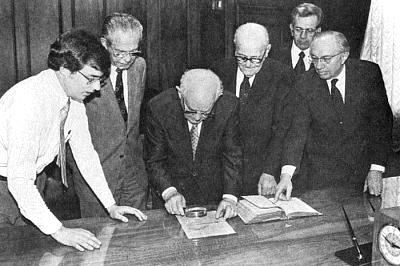
The Brethren (Church leaders) claim to have "the Spirit of Discernment"; meaning if any tries to deceive them or the Saints, they will immediately be detected and exposed (Mormon Doctrine, p.197). On Oct. 15th, 1985, two pipe-bombs went off in Salt Lake Valley. One of them killed a Mormon bishop named Steve Christensen. The other killed a Mormon woman named Kathy Sheets; a mother of two and wife of another Mormon bishop. The next day, one block north of Temple Square, another pipe bomb exploded; seriously injuring Mark Hofmann, a Mormon "documents" dealer.
The bombings made national and international news. At first the bombings were blamed on an unknown "Mormon fanatic"; upset that Hofmann was "discovering" old Mormon documents embarrassing to the Church. But soon police knew that Hofmann was the bomber in all three bombings. The last bomb he had dropped while getting out of his car; seriously injuring him.
In April, 1980, Mark Hofmann started finding old Mormon documents. At first the documents confirmed LDS history, but soon his "finds" were making Joseph Smith appear to be a fraud and occultist. Hofmann was selling the most embarrassing documents directly (face-to-face) to President Gordon B. Hinckley; then acting President of the Church (all other members of the First Presidency were ill).
Hinckley paid Mark Hofmann hundreds of thousands of dollars directly to Hofmann, then hid the documents in the First Presidency's Vault; only admitting (sometimes) that the Church had the document after it was "leaked" to the Media. After Hinckley would buy a document (one of Hofmann's forgeries which made Joseph Smith or Brigham Young look bad), Hinckley would file the document in the First Presidency's Vault. Hofmann then "leaked" photocopies of the documents to the Press, and blamed Church archivists for the leaks. Incredible as it now seems, Hinckley believed Hofmann! At that time only one Mormon (Darrick Evenson) came forward to proclaim Mark Hofmann a "fraud" and his documents "forgeries". Evenson was dismissed as a "conspiracy nut"; his letters to President Hinckley intercepted and filed-away by LDS Church Security.
After police arrested Hofmann, Church leaders such as Hugh Pinnock told police, "You have the wrong man...Hofmann is innocent!" In 1987 Hofmann confessed to forging hundreds of documents and to murdering two innocent people as a way to cover it up and lead police away from him. When it was all over the New York Times reported that "the Church routinely acquires and suppresses history documents in order to deceive its members and the public." (Feb. 11, 1987). The story is told in The Mormon Murders and A Gathering of Saints; both books still in most U.S. libraries.
Where was their Spirit of Discernment? Even the Tanners, who are considered some of the biggest enemies of the Church, said that the documents were likely fakes but the Church bought them anyway.
Some Latter-day Saints speculate that the Church bought them knowing that they were fakes but better to keep them out of critic's hands. That makes no sense. It would have been much more powerful for the LDS Church to declare them fakes and have experts verify that. But this story shows that the leaders exercised no discernment.
Apostle Dallin H. Oaks tried to show that the document didn't really alter the Church's foundational claims by claiming that the 'salamander' mentioned in Hofmann's document could be interpreted as a 'mythical being thought to be able to live in fire' (even though Hofmann said he substituted the word salamander for toad from another early church document which clearly shows that the context of salamander was a small lizard and not some 'mythical being'). An apostle should have had the power of discernment to find out that the document was a forgery instead of trying to justify it's content.
Note: Apostle Dalin Oaks gave a talk responding to the incident called Recent Events Involving Church History and Forged Documents.
Reference:
The apostles and other General Authorities have said many more disconcerting things. Here's just one of the more respected general authorities - apostle Bruce R. McKonkie [emphasis added]:
"It is also to the Book of Mormon to which we turn for the plainest description of the Catholic Church as the great and abominable church. Nephi saw this 'church which is the most abominable above all other churches' in vision. He 'saw the devil that he was the foundation of it' and also the murders, wealth, harlotry, persecutions, and evil desires that historically have been a part of this satanic organization.(Bruce R. McConkie, Mormon Doctrine [1958], 130.)
McKonkie also reiterated what Joseph Fielding Smith taught:
"Negroes in this life are denied the Priesthood; under no circumstances can they hold this delegation of authority from the Almighty. (Abra. 1:20-27.) The gospel message of salvation is not carried affirmatively to them... negroes are not equal with other races where the receipt of certain spiritual blessings are concerned, particularly the priesthood and the temple blessings that flow therefrom, but this inequality is not of man's origin. It is the Lord's doing, is based on his eternal laws of justice, and grows out of the lack of Spiritual valiance of those concerned in their first estate." (Mormon Doctrine, 1966, pp. 527-528)
As we understand it, the President of the Church, David O'McKay, had the reference to the Catholic Church removed in later editions. The "negroes" reference was also removed, but the edition we used had it. Mormon Doctrine was a book that influenced at least two generations of Latter-day Saints. We recognize that Church leaders are fallible, but it leaves us to wonder which statements made by General Authorities are authoritative and which are not.
The devout will say that it is up to the individual to determine for themselves through prayer and inspiration the truth of a leader's words. But that begs the question, "What then is the purpose of the General Authorities of the Church if each member needs to verify their words, supposedly spoken/written under the influence of the spirit?"
Apostle James E. Talmage said the following in conference (emphasis added):
"The ten tribes shall come; they are not lost unto the Lord; they shall be brought forth as hath been predicted; and I say unto you there are those now living—aye, some here present—who shall live to read the records of the Lost Tribes of Israel, which shall be made one with the record of the Jews, or the Holy Bible, and the record of the Nephites, or the Book of Mormon, even as the Lord hath predicted" (in Conference Report, Oct. 1916, p. 76) Link is here.
Obviously this prophecy hasn't come true. All the attendees have very likely passed on. Even if an infant was in the congregation, he would be a hundred years old and that doesn't leave much time for this to happen.
Public interviews with the recent prophets
Being a Prophet
Gordon B. Hinckley appeared on two nationally televised interviews and when asked if he was a prophet his answer was 'Well, I'm sustained as such'.
Critic's point: What about a simple "yes" or "no"? To give a vague answer like that perhaps implies that everyone thinks he's a prophet but maybe he doesn't think so.
MT Comment: In the following interview, GBH says he is prophet but seems to say it in such a way as to elicit laughter - perhaps that's just his style or his trying to be humble.
Reference of one of these interviews (San Francisco Chroncile, 4/13/1997). (underlining added):
Q: What do you see as some of the differences between Mormon theology and other Christian theologies?
A: Well, in the first place, it's the restoration itself. The Catholic Church is here, the Protestant churches are outgrowths from the Catholic Church. We are not part of the Catholic Church, and we're not protesting anything. We say that we are a restoration of the church that existed anciently, and that's the reason we have the name "Latter-day Saints." In the early days of the church, back in the days of the Apostles, they were called saints as Christians. We're the latter-day saints. And that's one thing that's different. Modern revelation. We believe all that God has revealed, all that he does now reveal, we believe he has yet to reveal many great and important things pertaining to the Kingdom of God. So, we believe in the principle of continuous revelations.
Q: You are the president, prophet, seer and revelator of the Mormon Church?
A: I am so sustained, yes. (Laughter)
Q: Now, how would that compare to the Catholic Church? Do you see yourself as Catholics would see the pope?
A: Oh, I think in that we're both seen as the head officer of the church, yes.
Read more:
Link is here.
Men can become Gods
Excerpt from President Hinckley's interview with Time:
Q: Just another related question that comes up is the statements in the King Follet discourse by the Prophet.
A: Yeah
Q:…about that, God the Father was once a man as we were. This is something that Christian writers are always addressing. Is this the teaching of the church today, that God the Father was once a man like we are?
A: I don't know that we teach it. I don't know that we emphasize it. I haven't heard it discussed for a long time in public discourse. I don't know. I don't know all the circumstances under which that statement was made. I understand the philosophical background behind it. But I don't know a lot about it and I don't know that others know a lot about it.
Link is here.
Critic's point: This doctrine has been clearly taught in the church since Joseph Smith's time. Every member knows this.
"The doctrine that God was once a man and has progressed to become a God is unique to this church." (The Teachings of Brigham Young, 1997, p. 34).
President Gordon B. Hinckley is also on record as saying:
"On the other hand, the whole design of the gospel is to lead us onward and upward to greater achievement, even, eventually, to godhood. This great possibility was enunciated by the Prophet Joseph Smith in the King Follet sermon (see Teachings of the Prophet Joseph Smith, pp. 342-62); and emphasized by President Lorenzo Snow. It is this grand and incomparable concept: As God now is, man may become!" - Prophet Gordon B. Hinckley, General Conference, October 1994
Editor Comment: Some of us think this is a very defensible belief. We don't know why GBH doesn't just say Yes, we believe this and here's why. To say otherwise confuses the members to the point that many people don't know for sure what the doctrine is. The same dialogue said to the members should be the same dialogue said to the public so we don't appear to be hiding anything.
Polygamy
From Larry King Live Interview:
Gordon B. Hinckley: I condemn it, yes, as a practice, because I think it is not doctrinal. It is not legal. And this church takes the position that we will abide by the law. We believe in being subject to kings, presidents, rulers, magistrates in honoring, obeying and sustaining the law.
Critic's point: Polygamy is clearly doctrinal and still believed to be practiced in the next life. Men who have had their wife die can be sealed to their second wife with the belief that they will be married to both women (or more) in the next life. Also the saints practiced it in the 1800s when it was illegal so why bother making a big deal about obeying the law now when the LDS Church didn't obey the law for 50 years?
Revelation
Gordon B. Hinckley: Now we don't need a lot of continuing revelation. We have a great, basic reservoir of revelation. But if a problem arises, as it does occasionally, a vexatious thing with which we have to deal, we go to the Lord in prayer. We discuss it as a First Presidency and as a Council of the Twelve Apostles. We pray about it and then comes the whisperings of a still small voice. And we know the direction we should take and we proceed accordingly.
DR: And this is a revelation?
Gordon B. Hinckley: This is a revelation.
DR: How often have you received such revelations?
Gordon B. Hinckley: Oh, I don't know. I feel satisfied that in some circumstances we've had such revelation. It's a very sacred thing that we don't like to talk about a lot. A very sacred thing.
DR: But it's a special experience?
Gordon B. Hinckley: I think it's a real thing. It's a very real thing. And a special experience.
Interview with Don Lattin of The San Francisco Chronicle (underlining added):
DL: And this belief in contemporary revelation and prophecy? As the prophet, tell us how that works. How do you receive divine revelation? What does it feel like?
GBH: Let me say first that we have a great body of revelation, the vast majority of which came from the prophet Joseph Smith. We don't need much revelation. We need to pay more attention to the revelation we've already received.
Now, if a problem should arise on which we don't have an answer, we pray about it, we may fast about it, and it comes. Quietly. Usually no voice of any kind, but just a perception in the mind. I liken it to Elijah's experience. When he sought the Lord, there was a great wind, and the Lord was not in the wind.And there was an earthquake, and the Lord was not in the earthquake.And a fire, and the Lord was not in the fire.But in a still, small voice. Now that's the way it works."
Reference: San Francisco Chronicle, 4/13/1997
The Ensign
I hope that prayer will take on a new luster in our lives. None of us knows what lies ahead. We may speculate, but we do not know.
"
Till We Meet Again," President Gordon B. Hinckley, October 2001 General Conference,
Ensign, November 2001.
Washington Times Article
"Revelation no longer comes by vision," Mr. Hinckley said, "but in the 'still, small voice,' like that heard by Elijah." "We wrestle with a problem, we discuss it, we think about it, we pray about it," he said... "And the answer comes in a remarkable and wonderful way." (Washington Times, Dec. 3, 1996, page A8)
Critic's point: Many within the Church believe that revelation still comes to the apostles and prophets through visitations and audible voices, as it did at the time of Joseph Smith. Many members are disappointed when they learn that the modern General Authorities receive their revelations the same way the general Church membership does: through thoughts and feelings. For a world with so many social problems, why would President Hinckley say, "Now we don't need a lot of continuing revelation." And, "We don't need much revelation." If there was ever a time for revelation, it would be today.
Apostle admits that the Church sometimes teaches false doctrine
LDS Apostle Bruce R. McConkie admitted that Brigham Young was guilty of teaching things that were "out of harmony with the gospel" (p. 6). In fact, McConkie makes the amazing confession that "I do not know all of the providences of the Lord, but I do know that he permits false doctrine to be taught in and out of the Church and that such teaching is part of the sifting process of mortality" (p. 7).
Critic's point: Such a statement should be disconcerting to the average Latter-day Saint who has heard his leaders time and time again insist that, "God will never allow the prophet of the church to lead the church astray." Since when has teaching false doctrine not been a method of leading people astray? And of course, how do we know which doctrines that have been taught by the Church are false and which are true?
Reference
A current prophet should be listened to over a dead prophet
"Beware of those who would pit the dead prophets against the living prophets, for the living prophets always take precedence." (Fourteen fundamentals in following the prophet,
Elder Ezra Taft Benson, Feb 26, 1980
The prophets since Joseph Smith have been wrong about some important doctrinal and historical matters. Brigham Young was obviously incorrect when he taught that Adam was our God.
Early prophets of the restoration clearly believed and taught certain things but they were changed by later prophets when science proved the earlier prophets' teachings incorrect e.g. Joseph F. Smith's explicit denial of evolution.
It's taught that a living prophet's words should be taken over a dead prophet's. A current prophet can trump a previous one. So if the current prophet can say that a previous prophet was wrong about doctrine, church policy or anything really, then how do we know what the current prophet says won't be deemed invalid by the next prophet?
The Term 'Mormon' - An example of how God changes his mind?
Despite failed efforts over almost two centuries to have people refer to the LDS Church as the Church of Jesus Christ of Latter-day Saints instead of the nickname 'Mormon', the leaders up till 2018 have elected to embrace the term Mormon.
President Gordon B. Hinckley:
“‘The Mormon church,’ of course, is a nickname. And nicknames have a way of becoming fixed,” he preached in the October 1990 General Conference. “I suppose that regardless of our efforts, we may never convert the world to general use of the full and correct name of the church. Because of the shortness of the word ‘Mormon’ and the ease with which it is spoken and written, they will continue to call us the Mormons, the Mormon church, and so forth.”
Hinckley recalled a member in England telling him: “While I’m thankful for the privilege of being a follower of Jesus Christ and a member of the church which bears his name, I am not ashamed of the nickname ‘Mormon.’”
When someone asked him about it, the man replied, “‘Mormon’ means ‘more good.’”
Hinckley knew that wasn’t the actual meaning, but adopted the man’s thinking about the tag.
“We may not be able to change the nickname,” the affable leader concluded, “but we can make it shine with added luster.”
After all, Hinckley said, Mormon is the “name of a man who was a great [Book of Mormon] prophet who struggled to save his nation, and also the name of a book which is a mighty testament of eternal truth, a veritable witness of the divinity of the Lord Jesus Christ.”
From the Church Newsroom website:
The Church's national media campaign called “I’m a Mormon” (launched in 2010) included television spots, billboards, and ads on buses and on the Internet. The ads give a glimpse into the lives of Latter-day Saints from all over the world and refer people to the mormon.org website, where they can read the profiles of tens of thousands of Mormons, chat live with representatives who will answer questions about the faith and watch dozens of videos about members of the Church.
Starting in 2010 under President Monson, the Church spent millions of dollars promoted advertising in countries across the world showing ads featuring all kinds of different people stating who they were, what their profession was, what there hobbies were, etc and then always ended it with the tag line "and I'm a Mormon". The idea was apparently to show how diverse the LDS membership is.
Members were told to be proud to say "I am a Mormon" and thousands of members created their own profiles and videos on church websites to say just that.
President Nelson reverses past prophets' acceptance of the term 'Mormon'.
August 16, 2018 President Nelson issued a statement to the press. From the Deseret News:
SALT LAKE CITY — President Russell M. Nelson of The Church of Jesus Christ of Latter-day Saints announced Thursday that church leaders have launched a major effort to use the full name of the church instead of nicknames or abbreviations.
"The Lord has impressed upon my mind the importance of the name He has revealed for His Church, even The Church of Jesus Christ of Latter-day Saints," President Nelson said in a statement. "We have work before us to bring ourselves in harmony with His will. In recent weeks, various Church leaders and departments have initiated the necessary steps to do so."
A style guide released by the church alongside the statement said, "Please avoid using the abbreviation 'LDS' or the nickname 'Mormon' as substitutes for the name of the Church, as in 'Mormon Church,' 'LDS Church,' or 'Church of the Latter-day Saints.'"
This was followed up with pronouncements at the next general conference to change the name of The Mormon Tabernacle Choir and to avoid using the term Mormon in almost every way possible except for things like the 'Book of Mormon'.
Deseret News
Nelson further states:
SALT LAKE CITY (AP) — The president of the Mormon church reiterated Sunday that he wants members, the media and others to use the faith's full name, saying nicknames are "a major victory for Satan."
Addressing The Church of Jesus Christ of Latter-day Saints' twice-yearly conference in Salt Lake City, Russell M. Nelson said the church's name "is not negotiable."
"When the Savior clearly states what the name of his church should be, and even precedes his declaration with, 'Thus shall my church be called,' he is serious," Nelson said. "And if we allow nicknames to be used and adopt or even sponsor those nicknames ourselves, he is offended."
U.S. News
Editor comments: So the question is did God all of a sudden change his mind on how the Church and its members should treat the use of the term 'Mormon' or is this just the whims of whoever happens to be the prophet at the time? Nelson in 2018 used the phrase "The Lord has impressed upon me..." which implies it was from God.
There is evidence to suggest that Nelson wanted this change 28 years earlier. In a conference talk of April 1990 Elder Nelson, then an apostle, admonished against using the nickname "Mormon". However, at the very next conference in October 1990 President Hinckley gave a talk over-ruling Elder Nelson and calling Elder Nelson out by name -- saying that the use of the nickname name "Mormon" is an honor and should be proudly used to refer to the church and its members. Soon therafter the Church began the "I am a Mormon" campaign. So did Nelson not really get the 'inspiration' from God in 1990 when President Hinckley embraced the name Mormon? Which prophet was correct and what will the next prophet do, especially if Nelson's proclamation doesn't work out as he hopes?
It seems likely to me that Nelson has wanted to do this change (and probably various other changes he has made to the Church like eliminating home teachers and visiting teachers) for a long time and was determined to do them when he got the power as prophet regardless of what the previous prophets said about these things. The inconsistency of these views and how they could all come from God telling one prophet one thing and another prophet another needs explained. Perhaps the most simple explanation is that these men do what they want to do, whether they think it's revelation from God or not is another matter.
The danger of having a prophet
What if the prophet gives bad counsel that the members take as being God's will? If a current prophet is later proved wrong by a future prophet about something minor then that's not a big deal. But what if it's something important?
Your Life or Your Virtue
At least three of the prophets have written that it is better for a woman to die resisting a rapist than live. In President Spencer W. Kimball's book The Miracle of Forgiveness he says:
"It is better to die in defending one's virtue than to live having lost it without a struggle."
The Prophet David O. McKay is quoted in President Kimball's book as follows:
'…Your virtue is worth more than your life. Please young folk, preserve your virtue even if you lose your lives.
The Prophet Heber J. Grant is also quoted in President Kimball's book:
'...There is no true Latter-day Saint who would not rather bury a son or daughter than to have him or her lose his or her chastity -- realizing that chastity is of more value than anything else in all the world.'
We would imagine some women, who have been raped, might not agree with these prophets. We can't imagine what it would be like if one of us had a wife or daughter that was raped, but we can all for sure say we would rather her be a live, recovering victim, that did all she could to stay alive, than a dead victim. We wonder how many women may have given up their lives following this teaching?
Science or Religion
Imagine if the prophet said that cloning organs is wrong and God does not approve of it. We as good Latter-day Saints would not consider getting organs cloned even if a loved one's life depended on it. Now what if in 20 years or so public opinion changes enough to where cloning of organs is socially acceptable and the next prophet says that cloning organs is OK. Well it's a little late now for the person that followed the current prophet's counsel to not use a cloned organ to save his loved one.
Our hearts goes out to the gay people in the church. The church leaders have taught that feeling that way is wrong, immoral and totally a choice made per the individual. As scientists learn more about how our brains work, it's apparent that there is a genetic predisposition to homosexuality in many people. The leaders often make these people feel as if they have no hope and are destined for damnation. Many gay people in the church have committed suicide as a result of our leaders' teachings which seem to be in conflict with science.
So it's very important, perhaps even life-threatening, to be able to know when a prophet is speaking for God and when he is merely giving his own opinion. But to many faithful, it's more important to follow the prophet than it is for the prophet to be right:
top]
Should we listen to a prophet even if he's wrong?
President Heber J. Grant as quoted by Apostle Marion G. Romney (emphasis added):
I was taken back in my thoughts a quarter of a century to an experience I had with President Heber J. Grant. We were discussing some criticism that had been directed against an action taken by him in his official capacity. Putting his arm across my back and resting his hand on my left shoulder, he said, "My boy, you always keep your eye on the President of the Church, and if he tells you to do something wrong, and you do it, the Lord will bless you for it."
And then he added, "You don't need to worry, however; the Lord will never let his mouthpiece lead his people astray."
"The Covenant of the Priesthood," Ensign, July 1972.
Conference Report, October 1960, p. 78
If we think the prophet is wrong can we challenge him?
If the prophet can be wrong about important issues, even doctrinal issues, then can we as members of the kingdom challenge the prophet on controversial topics? Often critics cite the following couple of quotes from Church magazines provide the answer:
We cannot serve God and mammon. Whose side are we on? When the prophet speaks the debate is over.
"The Debate Is Over," N. Eldon Tanner (First Counselor in the First Presidency), Ensign, August 1979.
"When our leaders speak, the thinking has been done. When they propose a plan-it is God's plan. When they point the way, there is no discussion, it should mark the end of controversy," stated a part of the ward teaching message printed in the Improvement Era, June 1945, p. 345.
However, some members also cite other talks that church leaders have given that states that the prophets are not always inspired such as this quote from Harold B. Lee:
It is not to be thought that every word spoken by the General Authorities is inspired, or that they are moved upon by the Holy Ghost in everything they write. I don't care what his position is, if he writes something or speaks something that goes beyond anything that you can find in the standard church works, unless that one be the prophet, seer, and reve-lator -- please note that one exception -- you may immediately say, "Well, that is his own idea." And if he says something that contradicts what is found in the standard church works, you may know by that same token that it is false, regardless of the position of the man who says it.
"Sustaining the General Authorities of the Church," Improvement Era, June 1945, pg. 354.
Further reading: Mormon Liberals: Friends or Foes?, David Bailey
A Final testimony, Hugh B. Brown
Editor comment: It's kind of hard to answer this question with just a few quotes from various church leaders. However, we can say with some surety that if you publicly disagree with the church leadership over certain issues, you will be subject to church discipline.
Perhaps the biggest error made by the prophets
If the ban preventing blacks from having the priesthood was instituted by Joseph Smith then that would give the ban more legitimacy, as Joseph was the first and by far the most doctrinal of the Latter-day prophets. However, if the ban was made by the prophets after Joseph then perhaps they were in error, as Brigham Young was in error regarding the Adam-God sermons.
Joseph himself ordained a former slave, a black man named Elijah Abel as an elder with the priesthood in 1836. Brother Abel was a fairly prominent member that served in the 3rd Quorum of the Seventy starting in 1839. He served three missions for the Church. Another black man, Walker Lewis also received the priesthood during Joseph's leadership - he was ordained an elder in 1844 by William Smith, Joseph's brother. Joseph Smith was not a racist - he was friends with a black convert (Elijah Abel) whom he allowed to be ordained to the higher priesthood. However, Brigham Young refused that same man from being endowed in the Nauvoo temple with the rest of the Saints. Perhaps the racism came from Brigham moving forward because we've seen no evidence that Joseph felt that way and we could find no official church policy on blacks written during Joseph's life. He was out to win over all men regardless of race, nationality or color. When Joseph ran for president of the United States, he made ending slavery a key issue of his campaign.
If the prophets after Joseph Smith were responsible for the ban on blacks from receiving the priesthood, and if indeed this was a false doctrine, then how could any of those men possibly be prophets? For men of God to deny an entire race the benefit of the priesthood for 150 years is inexcusable. The Church would have been much better off to have been governed by a group of men, that did not claim divine authority, and therefore could have been responsive to the will of the members.
The church members, in at least the last half of the 1900s, did not want the priesthood ban on the blacks. It was embarrassing. God's true church should have been on the forefront of civil rights not the last major church to adopt it. Many of us felt ashamed as a Latter-day Saint growing up in the 1970s being taught that blacks were cursed from Cain and were less valiant in the pre-existence. We never liked that doctrine and always wondered if it was really true. We all believed it back then but now we think it's much more likely that the prophets were in error. The Church will not confirm that it was a mistake. The Church will not make any official comment on the reasons for the ban.
If Brigham Young instituted the priesthood ban on blacks without being directed to from God then this is just too serious to ignore. And if all the prophets since Brigham Young until Spencer W. Kimball let it go unchallenged, then how can anyone say these men are truly prophets of God? It's ironic that all the other Christian churches, that do not claim to have prophets, allowed blacks the same rights as whites long before the prophet-led LDS Church did. If the LDS prophets made this big of an error then why should they be believed on other matters?
Elijah Abel Reference: dailyutahchronicle.com
Special witnesses of Christ
We've all heard that one of the important reasons that we have a prophet and apostles in modern times (as well as ancient times) is for them to act as a "special witnesses" of Christ. What does this mean? Many members believe it means that these 15 men may have actually seen Christ or have some sort of definitive experience that would eliminate any possible doubt as to the validity of God's true church on earth.
We've heard that when missionaries are visited by apostles and they give them the opportunity to ask them any questions, it almost always come up that someone asks the big question, "Have you actually seen Christ?" The usual response is something vague like, "If I have, it would be too special to talk about."
A member of my stake presidency was talking to me about Gordon B. Hinckley's interview with Mike Wallace and said that Wallace asked him if he'd ever seen Christ (this may have been off-camera). Hinckley responded that he has not seen Christ. The stake presidency member said that GBH "had to say that" to Mike Wallace so it wouldn't be paraded around on National TV but that "we all know" that GBH has seen Christ.
It's obvious that many Latter-day Saints believe that the special witnesses that we call prophets and apostles have actually seen Christ. What do the prophets and apostles themselves say? [emphasis added]:
Joseph F. Smith, 6th LDS President
The sixth president of the LDS Church testified under oath before Congress in the Reed Smoot Hearings that he, as prophet of the Church, has not received any revelations and that he only gets impressions from God the same as any good Methodist would get.
The actual dialogue:
"Senator Dubios: Have you received any revelations from God, which has been submitted by you and the apostles to the body of the church in their semiannual conference, which revelation has been sustained by that conference, through the upholding of their hands?
Mr. Smith: Since when?
Senator Dubios: Since you became President of the Church.
Mr. Smith: NO, SIR; NONE WHATEVER.
Senator Dubios: Have you received any individual revelations yourself, since you became President of the church under your own definition, even, of a revelation?
Mr. Smith: I CANNOT SAY THAT I HAVE.
Senator Dubois: Can you say that you have not?
Mr. Smith: No; I cannot say that I have not.
Senator Dubois: Then you do not know whether you have received any such revelation as you have described or whether you have not?
Mr. Smith: Well, I can say this: That if I live as I should in the line of my duties, I AM SUSCEPTIBLE, I THINK, of the impressions of the Spirit of the Lord upon my mind at any time, JUST AS ANY GOOD METHODIST or any other good church member might be. And so far as that is concerned, I say yes; I have had impressions of the Spirit upon my mind very frequently, but they ARE NOT IN THE SENSE OF REVELATIONS." (Reed Smoot Case, Vol. 1, pages 483-484).
"On page 99 of the same volume Joseph F. Smith stated: 'I have NEVER PRETENDED TO NOR DO I PROFESS TO HAVE RECEIVED REVELATIONS.'
Critic's point: From this it is plain to see that just because a man is ordained a "Prophet, Seer, and Revelator," it does not necessarily mean that he is any of those things. If Joseph F. Smith was only as susceptible to the impressions of the Spirit of the Lord as "any good Methodist any other good church member" then why should his word be trusted above that of a good Methodist or any other member of the church?
References
President George Albert Smith
Mar 25, 1950 - President George Albert Smith writes, "I have not seen the Father or the Son, neither have I heard their voices in an audible way, but I have felt their presence and have enjoyed the whispering of the Still Small Voice that comes from them, the result of which has given me a testimony of the truth."
"The Vocation of David Wright: An Essay in Analytic Biography1" byBruce W. Jorgensenin "Dialogue: A Journal of Mormon Thought," Vol. 11, No. 2 Summer 1978, p. 48-49
Critic's point: George Albert Smith was not just an apostle when he wrote this, he was Church President, THE PROPHET etc. His testimony as a prophet doesn't really sound like he's a 'special witness'. His testimony is similar to the average member.
Brigham Young
I have flattered myself, if I am as faithful as I know how to be to my God, and my brethren, and to all my covenants, and faithful in the discharge of my duty, when I have lived to be as old as was Moses when the Lord appeared to him, that perhaps I then may hold communion with the Lord, as did Moses. I am not now in that position, though I know much more than I did twenty, ten, or five years ago. But have I yet lived to the state of perfection that I can commune in person with the Father and the Son at my will and pleasure? No, - though I hold myself in readiness that he can wield me at his will and pleasure. If I am faithful until I am eighty years of age, perhaps the Lord will appear to me and personally dictate me in the management of his Church and people. A little over twenty years, and if I am faithful, perhaps I will obtain that favour with my Father and God.
Journal of Discourses, 7:243. Brigham Young, September 1, 1859
And what shall we say of our Heavenly Father? He is also a man in perfection, and the father of the man Jesus Christ, and the father of our spirits; He lives far above the influence and power of sin, and holds in his hands the destinies of all. We have not seen the person of the Father, neither have we seen that of the Son; but we have seen the children of the Father, and the brethren of the Savior, who are in every way like them in physical appearance and organization. Although mankind of the same color look alike, yet there exist expressions of the features by which one person can be distinguished from another. The human family all resemble one another in the main characteristics of humanity, and all resemble the Savior who died for us; and could we see him in the flesh, as he appeared to the ancients, we should very likely find that some men are more like him that others in feature and form, as we often see men who are more like Joseph Smith than others are.
Journal of Discourses, 11:42. Brigham Young, January 8, 1865
It is our desire to be prepared for a celestial seat with our Father in heaven. It was observed by brother Grant that we have not seen God, that we cannot converse with Him; and it is true that men in their sins do not know much about God. When you hear a man pour out eternal things, how well you feel, to what a nearness you seem to be brought with God. What a delight it was to hear brother Joseph talk upon the great principles of eternity; he would bring them down to the capacity of a child, and he would unite heaven with earth, this is the beauty of our religion.
Journal of Discourses, 4:54. Brigham Young, September 21, 1856
Critic's point:
If Brigham Young, being the very first prophet after Joseph, never had Jesus or the Father appear or communicate with him then it is very unlikely that any modern prophet has ever had a visitation or direct communication from Deity either.
Heber C. Kimball
How many times I have heard it - "We believe what brother Brigham says, and we believe this, and we believe that; but here is brother Heber, - he is a kind of wild, kind of enthusiastic; he is full of visions and wild notions." Tell me one notion I have had that is not correct. Say you, "Some things you have prophesied have come to pass, but we do not know whether the rest will or not." I do not profess to be a Prophet. I never called myself so; but I actually believe I am, because people are all the time telling me that I am. I do not boast of that. I say that every man and woman who will live their religion, be humble, and be dictated by the Holy Ghost, the spirit of prophecy will be upon them.
Journal of Discourses, 5:177. Heber C. Kimball, August 23, 1857
Gordon B. Hinckley
see above
Apostle Neal Maxwell and Apostle Dallin Oaks
In an interview with Steve Benson (President Ezra Taft Benson's grandson), Apostle Neal Maxwell and Apostle Dallin Oaks were reportedly asked "What personal spiritual experiences have you had which gave you your testimonies as special witnesses for Christ?"
Per Steve Benson:
In response, Apostle Oaks summoned up memories of his days as a college student at the University of Chicago. Back then, he said, he thought he "knew a lot" about the gospel. He admitted, however, that he had "questions about the Church"--although he did not elaborate for us exactly what they might have been.
Oaks said a local LDS Institute teacher helped him work out the answers.
Apostle Maxwell hearkened back to his days as a boy, when he said he observed his father give a healing "priesthood blessing" to his sister, whom Maxwell thought was dead.
This, brothers and sisters, was the sum total of their answers--answers that I did not need to travel 700 miles to Salt Lake to hear. I could have saved everyone a lot of time and trouble if I had just stayed home, gone to the next fast and testimony meeting at our local ward and listened to regular members bear personal witness to the same kind of experiences.
There was no testimony bearing from these modern-day Peters and Pauls of personal visits, in the Flesh, from the Father or the Son.
There was no telling of any "road to Damascus" story.
There was no recounting of angelic visitations.
There was no description of rushing winds or flames of fire.
In short, there was "no there there."
Reference: Steve Benson article on TwinCentral.com
Changes in the Gospel Principles Manual
It seems that even the apostles shy from away stating that they are really a true, literal witness of Christ:
This change to the 2009 edition of Gospel Principles (the relevant changes are in capital letters) reflects this:
1997 edition:
"Twelve Apostles, who are special witnesses of Jesus Christ, teach the gospel in all parts of the world."
2009 edition:
"Twelve Apostles, who are special witnesses of THE NAME OF Jesus Christ, teach the gospel and regulate the affairs of the Church in all parts of the world."
What's to witness? ANY Christian believes in "the name of Jesus Christ." So in what way are the so-called apostles any more special than anyone else?
This link shows all the changes made in 2009 in the Gospel Principles book. For the particular example given above, scroll about halfway down to chapter 17.
Link is here.
Summary
All the accounts we've ever heard about the prophets and apostles are similar to these. Their testimonies are simply no different than any other member's testimony. There's nothing special or divine in their testimonies that eliminates the room for doubt about the LDS Church being God's one true church on earth. In fact these testimonies, as well as the average members' testimonies, aren't really any different than the testimonies of members of other faiths.
Think about how many apostles left the church in the early days. Many left after hearing Martin Harris say publicly that he did not see the plates with his natural eyes but only in a vision or imagination, and the same was true for all the other witnesses. If these "special witnesses" of Christ really had a "special" witness, then one would think they would not have left the church merely over what Martin Harris said.
How do prophets receive revelation?
Since we receive so little revelation in modern times, some members wonder if the prophets really still do receive revelation.
In 2005, President Gordon B. Hinckley said:
We have the standard works which have been accepted as scripture by action of the membership of the Church. Then the question naturally arises, Has other revelation been received since, and is it being received today?
I have no doubt of it.
My Church service includes 3 1/2 years as an Assistant to the Twelve, which group became part of the First Quorum of the Seventy; 20 years as a member of the Quorum of the Twelve Apostles; and 24 years as a member of the Quorum of the First Presidency, as President for the last 10 years. I have seen many changes which I am absolutely certain came of revelation.
President Hinckley goes on to say that the concept of small temples and the changing of how the costs of financing local Church operations came about by revelation. He seems quite confident that the modern prophets receive revelation. We have to wonder, how does this occur?
From time to time, I have been interviewed by representatives of the media. Almost invariably they have asked, "How does revelation come to the prophet of the Church?"
I reply that it comes now as it has come in the past. Concerning this, I have recounted to these media representatives the experience of Elijah following his contest with the priests of Baal:
"And, behold, the Lord passed by, and a great and strong wind rent the mountains, and brake in pieces the rocks before the Lord; but the Lord was not in the wind: and after the wind an earthquake; but the Lord was not in the earthquake:
"And after the earthquake a fire; but the Lord was not in the fire: and after the fire a still small voice" (1 Kgs. 19:11–12).
That is the way it is. There is a still, small voice. It comes in response to prayer. It comes by the whispering of the Spirit. It may come in the silence of the night.
Do I have any question of that? None whatever. I have seen it in instance after instance. Perhaps the most widely publicized revelation in recent years was that given to President Spencer W. Kimball (1895–1985) concerning the eligibility of all worthy men to be ordained to the priesthood (see Official Declaration 2). The outcome of that revelation has been tremendous.
"The Quorum of the First Presidency," President Gordon B. Hinckley, Ensign, December 2005.
Revelation through dreams
Apostle Hugh B. Brown said "Revelation may come through dreams or visions, the visitation of angels, or, on occasion such as with Moses, by face-to-face communication with the Lord" (Hugh B. Brown, 131st Semi-annual conference, 1961).
Critic's comment: GBH said that revelation "comes now as it has come in the past". Joseph Smith received revelation through a stone that he put in a hat. Oliver Cowdery received revelation through a stick. Why don't the modern prophets receive revelation through physical objects or perhaps they do but it isn't talked about?
Editor comment: Of all the methods listed above by which prophets can receive revelation, is it any wonder that the methods used by the modern-day prophets are the most subjective and open to the most interpretation as to whether it is from God or merely their own thoughts?
In an interview with Larry King, GBH said "It isn't necessarily a voice heard. Impressions come."
King then asks GBH "And that came from something higher than you?"
GBH responds " I think so."
That doesn't really sound like GBH is sure if his revelation is from God or not.
The "still small voice" and "impressions" that GBH refers to seem so subjective and not definitive. How could any prophet really know if "the still small voice" or their own "impressions" are really revelation or just thoughts in their head?
Speaking for God?
We testify also that there is, since 1830 when The Church of Jesus Christ of Latter-day Saints was organized, and will continue to be, so long as time shall last, a prophet, recognized of God and his people, who will continue to interpret the mind and will of the Lord.
"Revelation: The Word of the Lord to His Prophets," President Spencer W. Kimball, May 1977 Ensign. (Emphasis added.)
The Church of Jesus Christ of Latter-day Saints positions itself as the sole conduit for God's word and will to the earth so that individuals can gain salvation in the highest kingdom in the next life. They believe the LDS Church is "the only true and living church upon the face of the whole earth" (D&C 1:30)
If the Church is the only dispenser of God's complete will, and to avoid being cut off and damned, then there must be a way to know if what the Church teaches is in fact God's will.
The Church teaches two ways to learn God's will: the Holy Ghost[1] or God's servants (scriptures, talks, articles, etc).[2]
In the Church, the "servants" charged with speaking on God's behalf are the First Presidency and Quorum of the Twelve Apostles. Each of these 15 men are called, "prophet, seer and revelator." ("Prophet, Seer, and Revelator," Encyclopedia of Mormonism)
Collectively, over the past 185 years, these men have produced a large body of spoken and written words ranging from official doctrine to opinion and commentary. They've addressed such topics as: where God lives; how to return to Him; priesthood permissions; prohibitions; polygamy; chastity; what kind of underwear temple-endowed members must wear; gender roles; earrings; tattoos; modesty; abortion; communism; how the sun receives its light; appearance of people who live on the moon; etc. But how do we know when a prophet reveals God's word or their own thoughts?
The purpose of this piece is to explore when LDS prophets (any of the governing 15) speak God's word. This is prerequisite to discussing any church doctrine or policy. Are the words under discussion actually God's will? How does one know? If prophets can express their own opinions, why do their followers assume their words are divine?
Disagreements about the doctrine and history of the LDS Church are often framed around whether words spoken by one prophet are true, and if they agree with words spoken by another prophet. The term often used in such discussions is "infallible" ('incapable of error,' Merriam-Webster online dictionary) Are prophets incapable or error? Joseph Smith is recorded as saying, "I visited with a brother and sister from Michigan, who thought that 'a prophet is always a prophet'; but I told them that a prophet is a prophet only when he was acting as such." (Joseph Smith, History of the Church, 5:265) This is often referenced to show that Joseph did not see himself as infallible—only some of his words should be taken as God's words. Common sense also dictates that no human is infallible, whether a prophet or not.
Such disagreements should instead focus on if and when prophets are speaking God's word or their own thoughts. Without knowing this, how is a member to know when a prophet's words are wheat and when they are chaff; doctrine or advice; divine or human?
On August 17, 1949, the First Presidency released a statement saying,
The attitude of the Church with reference to Negroes remains as it has always stood. It is not a matter of the declaration of a policy but of direct commandment from the Lord, on which is founded the doctrine of the Church from the days of its organization, to the effect that Negroes may become members of the Church but that they are not entitled to the priesthood at the present time.
The First Presidency on the Negro Question, 17 Aug. 1949. (Emphasis added.)
LDS prophets repeatedly reaffirmed that African Americans couldn't receive the priesthood in many official settings. Joseph Smith's statement that "a prophet is a prophet only when he was acting as such" seems to fly in the face of the First Presidencies of 1947, 1949 and 1969 who were clearly acting in their capacity as prophets when they gave their official statements, only to be retracted by a later prophet.[3]
Is it possible that it was God's will for 140 years that blacks were cursed, and that His will was also presented in the LDS Church's 2013 essay on "Race and the Priesthood": prophets, seers and revelators before 1978 were simply wrong and sharing theories instead of God's word and will? It cannot be both it was God's will and it was not God's will.
How could prophets think they spoke God's word while acting in official capacities, only for us to find out they were speaking theories? Why did these men speak as if they were speaking for God? (the link goes to a piece we have that is titled, "As if they were speaking for God" that examines this crucial idea) Where was God's word in correcting such a grievous error that caused untold numbers of His children to be deprived of receiving the blessings of the priesthood?
The 1969 First Presidency Statement specifically declares the role revelation played in their statement—"revelation assures us" it is God's will that blacks be denied the priesthood because of their behavior in the "pre-existence."3 The 2013 essay specifically condemns such thinking as a "theory." For men who believe they have God's secrets revealed to them and interpret God's mind and will, why did they preach erroneous "theories"?
There are few choices to make sense of the contradiction the 2013 essay uncovers: 1) prophets only think they speak for God but really don't; 2) God is not the benevolent, unchanging being the Church claims and it is His fault for the changes. The latter seems to be the position the Church takes when it says things like, we don't know why God wants it this way, but He does. (See for example the 1969 First Presidency quote that "for reasons which we believe are known to God, but which He has not made fully known to man" as referenced in footnote [3]) One day He will fix it, but He hasn't told us when.
Regardless of the reason, why was an omnipotent God lax in correcting the errors? Why would an all-knowing God allow prophets to teach theories He knew would cause confusion? Why would a God who reveals His secrets to prophets not reveal this information? For men who interpret the mind and will of God, why weren't they? If the prophets were not speaking God's word, they were leading the people astray.
In the October 2014 General Conference, Elder M. Russell Ballard directly contested this idea that prophets, seers and revelators can lead people astray when he said
"…the leaders of the Church…will not and cannot lead you astray.
"Stay in the Boat and Hold On!" Elder M. Russell Ballard, General Conference, October 2014. (Emphasis added.)
In LDS Church canon, Official Declaration 1 corroborates Ballard's statement:
The Lord will never permit me or any other man who stands as President of this Church to lead you astray. It is not in the programme. It is not in the mind of God. If I were to attempt that, the Lord would remove me out of my place, and so He will any other man who attempts to lead the children of men astray from the oracles of God and from their duty.
Sixty-first Semiannual General Conference of the Church, Monday, October 6, 1890, Salt Lake City, Utah. Reported in Deseret Evening News, October 11, 1890, p. 2. (Emphasis added.)
Canon is the epitome of God's word in LDS theology: it is doctrine. Since 1908 this manifesto has been printed in the Doctrine and Covenants. If this statement from Woodruff that "the Lord will never permit [the] President of this Church to lead you astray" is false doctrine, there has been plenty of time for correction. Yet it stands as more proof against what is learned in the 2013 essay: God's prophets led people astray with their own theories concerning blacks and the priesthood.
On February 26, 1980, Elder Ezra Taft Benson gave a talk at BYU.[4] This talk espouses 14 fundamental truths about the prophet of the Church. Of those 14, the following are relevant to the discussion:
1. The prophet is the only man who speaks for the Lord in everything.
2. The living prophet is more vital to us than the standard works.
4. The prophet will never lead the church astray.
5. The prophet is not required to have any particular earthly training or credentials to speak on any subject or act on any matter at any time.
6. The prophet does not have to say "Thus Saith the Lord," to give us scripture.
14. The prophet and the presidency—the living prophet and the First Presidency—follow them and be blessed—reject them and suffer.
I testify that these fourteen fundamentals in following the living prophet are true.
First Presidency Message, "Fourteen Fundamentals in Following the Prophet," President Ezra Taft Benson, Of the Quorum of the Twelve, Liahona, June 1981. (Emphasis added.)
When Benson "testif[ied] that these fourteen fundamentals…are true," what did he mean? What testimony did he have? How did he receive that testimony? In the LDS Church, one testifies when they know that the things they are speaking are the truth because the spirit has provided that confirmation.[5] It sounds like Benson believed he was speaking God's word. And that leaves an important choice for the member: Ezra Taft Benson was wrong, and he testified of something that was not true, meaning he lied or was deceived, or these fourteen fundamentals are indeed true principles.
Some claim that the "Fourteen Fundamentals in Following the Prophet" are not doctrinal. However, there has been ample time for erroneous doctrine found there to have been officially corrected. Additionally, the Church allows references to the "Fourteen Fundamentals" in their official publications, thereby endorsing the words and doctrine found in that talk as official. (As of 10 December 2014 general conference talks, magazines and manuals published by the Church quote from Benson's "Fourteen Fundamentals" at least 19 times.)[6]
Taking these Church-approved Fourteen Fundamentals, how must one interpret the teachings of Brigham Young in 1852 and the First Presidencies in the 1940s and 1960s regarding blacks and the priesthood? The voice of God through His prophets on these matters was spoken as doctrine. The 2013 essay says they weren't.[7]
If prophets, seers and revelators cannot discern God's words from their own, how can a member discern when a prophet's words are God's words?
One would hope that simply because one was a prophet acting in that official capacity, that words spoken at that time would in fact be the word of God. As has been shown, that isn't the case. There must be another way for people to determine if and when God's prophet is speaking His word.
It is taught that through personal revelation Church members can know if God's servants are speaking God's word.[8] This seems reasonable, until one decides to take that course of action and receives personal revelation in direct opposition to God's servants.
Adrian Larsen, Denver Snuffer, Kate Kelly, Alan Rock Waterman and others have faced censure or excommunication because they did not receive a conviction that their leaders were in the right. Adrian Larsen said:
I have not yet met [the Lord] in the flesh, though I actively seek this gift. I have heard His voice, and He has spoken to me.
"40 Days on Death Row," by Adrian Larsen on his blog To The Remnant, quote found in the comment section dated November 15, 2014. The post talks about his excommunication.
Although an ardent believer in Joseph Smith and the Book of Mormon, Adrian was excommunicated for sharing his thoughts that one can gain their own testimony of truth without the leadership of the Church.
This highlights one of the problems with the idea that one can gain their own testimony of what a prophet says: If one receives a personal witness that the prophet's words are not God's word, and the person reveals that to anyone else, they can be found guilty of apostasy.
Sometimes members' actions contradict Church doctrine and lead others astray. While uncommon, some members in effect choose to take themselves out of the Church by actively teaching and publicly attempting to change doctrine to comply with their personal beliefs.
"Church Responds to Church Discipline Questions," 11 June 2014, LDS Newsroom. (Emphasis added.)
Adrian Larsen believes the leaders are the ones not following the doctrine, and he pointed it out. What we see is that apostasy is not simply just not following Church "doctrine," but not following Church leaders:
[W]e must each guard against personal apostasy by keeping covenants, obeying the commandments, following Church leaders, partaking of the sacrament, and constantly strengthening our testimonies through daily scripture study, prayer, and service.
"Apostasy," Gospel Topics, LDS.org (Emphasis added.)
Whose truth should then be believed, personal revelation or God's servants?
A major problem with the teaching that personal revelation should be used to determine if a prophet is speaking God's word is that it then marginalizes the need for prophets. If one has to pray to find out if prophets speak truth, why not just go to God in the first place and skip the middlemen? Shouldn't each person find their own path to God and not simply follow the leaders blindly?
Some say that it is not blindly following leaders, but rather it is showing obedience to what the leaders say.[9] However, no matter what kind of lip-service the Church and its leaders pay to the idea that individuals should find out on their own if leaders are giving God's word, it is assumed/believed that the leaders are in fact speaking God's truth.[10] This becomes the touchstone for whether or not personal revelation is indeed from God: does it match what the leaders say? If not, it is not from God. So what is the point in prayer?
For example, President Uchtdorf's teachings seem to flatly contradict the idea that personal revelation should be sought for confirming the truthfulness of a leader's words. In fact, he seems to remove the direct relationship a person should have with the divine when he says:
In the midst of the ominous problems of our day, Heavenly Father provides us with prophets to answer our petitions for divine guidance…
and
Today, we have … apostles, seers, and revelators who are watchmen on the tower, messengers of supernal, healing truth…God speaks to us through them.
"Sustaining Our Prophets and Apostles." Lds.org website.
At best this means that if our personal revelation is different than the prophets' words, then their words trump the individual's. At worst, prophets, apostles, seers and revelators stand between the individual and God and it is through them that we have access to God's will and word.
It is confusing to members when they are told that they should follow the prophet, but that they should seek confirmation that the prophet is correct, but the prophet is always correct.
In fact, Elder Ballard admits that prophets can make requests of people that aren't important to their eternal salvation, but obedience to those non-consequential requests do have eternal consequences when he said,
Wearing two pairs of earrings may or may not have eternal consequences for this young woman, but her willingness to obey the prophet will.
"Sustaining Our Prophets and Apostles." Lds.org website. (Emphasis added.)
In other words, God may not care about how many earrings people have, but He allows His prophet to let the people believe He cares, but He might damn those who have more than one pair because they didn't "obey the prophet." The implication is that the prophet dictates to God what God must do.
One could find statements contradicting what is put forth above to show that the Church believes individual revelation is of great worth. Or following the prophets "blindly" is not what the Church teaches. Or that prophets, apostles, seers, revelators, servants, leaders, etc., are simply fallible, mortal men, trying the best they can. And herein lies the problem: The leaders continue to perpetuate the belief they speak God's word even when they speak contradictory and confusing things. If God allows them to misrepresent His word, why should we trust them or a God who allows that? If they are wrong about one thing they spoke as God's mouthpiece, how many other things are they wrong about? Why should one trust anything these men say?
This piece relied heavily on the discrepancies surrounding the "Race and the Priesthood" essay. However, many other topics and doctrines could just as easily be used to point out the problems of deciphering if and when a prophet speaks God's word and will because of the confusing and contradictory words that have been spoken concerning so many things in the last 185 years by leaders of the Church of Jesus Christ of Latter-day Saints.
Endnotes
[1]
…if it is right I will cause that your bosom shall burn within you; therefore, you shall feel that it is right…" (D&C 9:8); "[God] will tell you in your mind and in your heart, by the Holy Ghost, which shall come upon you and which shall dwell in your heart…this is the spirit of revelation…
D&C 8:2-3
back to body
[2]
Surely the Lord God will do nothing, but he revealeth his secret unto his servants the prophets,
Amos 3:7
One of the purposes of a prophet is to seek the wisdom and the will of the Lord and to teach his people accordingly. …That is the purpose of a prophet, to give answers to people for the dilemmas in which they find themselves. That is what happens. That is what we see happen.
"This Thing Was Not Done in a Corner," President Gordon B. Hinckley, October 1996 General conference.
[W]hether by mine own voice or by the voice of my servants, it is the same…
D&C 1:38
…they who will not hear the voice of the Lord, neither the voice of his servants, neither give heed to the words of the prophets and apostles, shall be cut off from among the people…
D&C 1:14
back to body
[3] The 2013 Church essay "Race and the Priesthood" gives this Brigham Young speech before the Utah Legislature on 5 February 1852 as the beginning of the doctrine that blacks could not hold the priesthood (all capitalization, punctuation, spelling as found in the original):
the Lord told Cain he should not receive the blessings of priesthood until the last of posterity of Abel had received the priesthood until the redemption of earth if there never was a prophet or Apostle of Jesus Christ spoke it before I tell you this people that commonly called Negros are children of Cain I know they are I know they cannot bear rule in priesthood first sense of word for the curse upon them was to continue on them was to remain until the residue of posterity of Michael and his wife receive the blessings they should bear rule and hold the keys of priesthood until times of restitution come the curse wiped off from the earth [more/from?] Michael's seed fullest extent then Cain's seed had in remembrance and the time come when that should be wiped off
now then in kingdom of God on earth a man who has the African blood in him cannot hold one one jot nor tittle of priesthood now I ask for what for upon earth they was the true eternal principles Lord Almighty has ordained who can help it angels cannot all powers cannot take away the eternal I Am what I Am I take it off at my pleasure and not one particle of power can that posterity of Cain have until the time comes the Lord says have it that time will come they are under curse so are we they will come and have the privilege of all we have the privilege and more. [remainder of line blank]
In the kingdom of God on the earth the Africans cannot hold one particle of power in government they are the subjects the eternal servants of residue of children and the residue of children through the benign influence of the Spirit of the Lord have the privilege of saying to posterity of Cain inasmuch as the Lord [is?] will you may receive the Spirit of Lord by baptism that is the end of their privilege and no power on earth give them any more power
but let me tell you further let my seed mingle with seed of Cain brings the curse upon me and my generations reap the same rewards as Cain in the priesthood tell you what it do if he were to mingle their seed with the seed of Cain bring not only curse upon them selves but entail it on their children get rid of it
As referenced in "Race and the Priesthood," fn. 9. Document retrieved 12 December 2014. A link to the document is found in footnote 9, but the text above is a little more readable.
On July 17, 1947, the First Presidency released this statement:
From the days of the Prophet Joseph Smith even until now, it has been the doctrine of the Church, never questioned by Church leaders, that the Negroes are not entitled to the full blessings of the Gospel.
Statement of The First Presidency on the Negro Question, July 17 1947, quoted in Mormonism and the Negro, pp. 46-7. (Emphasis added.)
On August 17, 1949, the First Presidency released a statement saying,
The attitude of the Church with reference to Negroes remains as it has always stood. It is not a matter of the declaration of a policy but of direct commandment from the Lord, on which is founded the doctrine of the Church from the days of its organization, to the effect that Negroes may become members of the Church but that they are not entitled to the priesthood at the present time.
The First Presidency on the Negro Question, 17 Aug. 1949. (Emphasis added.)
On December 15, 1969, the then First Presidency released the following:
In view of confusion that has arisen, it was decided at a meeting of the First Presidency and the Quorum of the Twelve to restate the position of the Church with regard to the Negro both in society and in the Church.
A word of explanation concerning the position of the Church.
The Church of Jesus Christ of Latter-day Saints owes its origin, its existence, and its hope for the future to the principle of continuous revelation. "We believe all that God has revealed, all that He does now reveal, and we believe that He will yet reveal many great and important things pertaining to the Kingdom of God."
From the beginning of this dispensation, Joseph Smith and all succeeding presidents of the Church have taught that Negroes…were not yet to receive the priesthood, for reasons which we believe are known to God, but which He has not made fully known to man.
Our living prophet, President David O. McKay, has said, "The seeming discrimination by the Church toward the Negro is not something which originated with man; but goes back into the beginning with God….
"Revelation assures us that this plan antedates man's mortal existence, extending back to man's pre-existent state."
Until God reveals His will in this matter, to him whom we sustain as a prophet, we are bound by that same will. Priesthood, when it is conferred on any man comes as a blessing from God, not of men.
[W]e believe that this work is directed by God and that the conferring of the priesthood must await His revelation. To do otherwise would be to deny the very premise on which the Church is established.
"Letter of the First Presidency Clarifies Church's Position on the Negro," Era February 1970, pp. 70-71.
On December 8, 2013, the LDS Church's official website, lds.org, released an essay addressing "Race and the Priesthood." Within that essay are the following admissions:
Over time, Church leaders and members advanced many theories to explain the priesthood and temple restrictions. None of these explanations is accepted today as the official doctrine of the Church.
…Today, the Church disavows the theories advanced in the past that black skin is a sign of divine disfavor or curse, or that it reflects actions in a premortal life; that mixed-race marriages are a sin; or that blacks or people of any other race or ethnicity are inferior in any way to anyone else. Church leaders today unequivocally condemn all racism, past and present, in any form.
"Race and the Priesthood," Gospel Topics.
back to body
[4] According to President Spencer W. Kimball's son, Edward Kimball, President Kimball was a bit uncomfortable with some of the content of Benson's talk. (D. Michael Quinn, The Mormon Hierarchy: Extensions of Power, Signature Books: Salt Lake City, UT, 1997.) However, a year and a half later, while Spencer W. Kimball was still President of the Church, the speech was published as the First Presidency Message in the official Church publication Liahona (and the Filipino version called Tambuli). Additionally, the talk continues to be used today (see fn. 5 below).
back to body
[5]
And this is the ensample unto them, that they shall speak as they are moved upon by the Holy Ghost. And whatsoever they shall speak when moved upon by the Holy Ghost shall be scripture, shall be the will of the Lord, shall be the mind of the Lord, shall be the word of the Lord, shall be the voice of the Lord, and the power of God unto salvation. Behold, this is the promise of the Lord unto you, O ye my servants."
D&C 68:3-5
back to body
[6]A list of 19 places "Fourteen Fundamentals in Following the Prophet" has appeared (some quote all 14 fundamentals, some just quote parts of the talk):
- From the Church's website, a page titled, "Sustaining Our Prophets and Apostles" which appeared in late 2012, all 14 fundamentals listed in sidebar.
- "Chapter 11: Follow the Living Prophet," Teachings of Presidents of the Church: Ezra Taft Benson, (2014), 146-55, fn 13, the body of the chapter seems to have most of the 14 fundamentals grouped into four categories.
- "Follow the Prophet," by Elder Kent D. Watson of the Seventy, Asia Area Leader Message - January 2013, all 14 fundamentals listed.
- "Lesson 29: Doctrine and Covenants 21," Doctrine and Covenants and Church History Seminary Teacher Manual (2013), all 14 fundamentals listed.
- "Obedience to the Prophets," Claudio R. M. Costa Of the Presidency of the Seventy, October 2010 General Conference, all 14 fundamentals listed.
- "Our Very Survival," Kevin R. Duncan Of the Seventy, October 2010 General Conference, all 14 fundamentals listed.
- "Chapter 2: The Living Prophet: The President of the Church," Teachings of the Living Prophets Student Manual, (2010), 14-27, all 14 fundamentals listed twice.
- "Chapter 7: Studying General Conference Addresses," Teachings of the Living Prophets Student Manual, (2010), 84-93 ("President Ezra Taft Benson (1899-1994) taught a principle that is fundamental to this course…'Therefore, the most important reading we can do is any of the words of the prophet … contained each month in our Church magazines. Our marching orders for each six months are found in the general conference addresses…'").
- "Chapter 2: The Living Prophet: The President of the Church," Teachings of the Living Prophets Teacher Manual, (2010), 8-12, ("The teachings and directions of the living prophet take precedence over what former prophets have said." "Assign the other half of the class to read President Benson's second and third 'fundamentals' from page 23 in the student manual.").
- "Doctrine and Covenants 90," Doctrine and Covenants and Church History Seminary Teacher Resource Manual, (2001), 152-54, ("If we want to know how well we stand with the Lord, then let us ask ourselves how well we stand with His mortal captain. How closely do our lives harmonize with the words of the Lord's anointed—the living prophet, the President of the Church, and with the Quorum of the First Presidency?") and on pp 247-49, ("Prophets must often warn of the consequences of violating God's laws. They do not preach that which is popular with the world. President Ezra Taft Benson taught that 'popularity is never a test of truth.').
- "Jeremiah 20-29," Old Testament Teacher Resource Manual, (2003), 180, ("How we respond to the words of a living prophet when he tells us what we need to know, but would rather not hear, is a test of our faithfulness.").
- "Chapter 6: Doctrine and Covenants 6, 8-9: 'This Is the Spirit of Revelation'," Doctrine and Covenants and Church History Video Guide, (2001), 10-12, ("There will be times when you will have to choose between the revelations of God and the reasoning of men—between the prophet and the politician or professor. Said the Prophet Joseph Smith: 'Whatever God requires is right, no matter what it is, although we may not see the reason thereof until long after the events transpire.'").
- "Alma 43-58," Book of Mormon Teacher Resource Manual, (2004), 184-191, ("The living prophet is more vital to us than the standard works.").
- "Jeremiah 23: False Prophets," Old Testament Seminary Student Study Guide, (2002), 160, ("The prophet tells us what we need to know, not always what we want to know").
- "Lesson 113: Helaman 13," Book of Mormon Seminary Teacher Manual, 2012, ("How we respond to the words of a living prophet when he tells us what we need to know, but would rather not hear, is a test of our faithfulness,") - and Book of Mormon Student Study Guide, (2000), 153-154.
- "If Thou Wilt Enter into Life, Keep the Commandments," Elder Robert D. Hales, May 1996 Ensign, ("President Ezra Taft Benson taught that 'popularity is never a test of truth'").
- Bibliography, Old Testament Student Manual Kings-Malachi, (1982), 107-8, simply references the talk.
- "Lesson 8: Prophets Interpret Scripture," Scripture Study-The Power of the Word Teacher Manual, "(2001), 25-26, simply references the talk.
- "The Power of God unto Salvation," R. Kelly Haws, Seminaries and Institutes of Religion Satellite Broadcast, August 6, 2013, simply references the talk.
back to body
[7] In June 2007, the Church's PR and news arm, LDS Newsroom (mormonnewsroom.org) tried to help establish what is doctrine when they issued this statement:
Not every statement made by a Church leader, past or present, necessarily constitutes doctrine. A single statement made by a single leader on a single occasion often represents a personal, though well-considered, opinion, but is not meant to be officially binding for the whole Church. With divine inspiration, the First Presidency (the prophet and his two counselors) and the Quorum of the Twelve Apostles (the second-highest governing body of the Church) counsel together to establish doctrine that is consistently proclaimed in official Church publications. This doctrine resides in the four "standard works" of scripture (the Holy Bible, the Book of Mormon, the Doctrine and Covenants and the Pearl of Great Price), official declarations and proclamations, and the Articles of Faith. Isolated statements are often taken out of context, leaving their original meaning distorted.
"Approaching Mormon Doctrine" (May 4, 2007), Newsroom of the Church of Jesus Christ of Latter-day Saints. (Emphasis added.)
This LDS Newsroom article does not meet its own test for whether or not it is doctrine, therefore, it is not a doctrinal proclamation for how to determine what Church doctrine is, if it is actually correct. Assuming for a moment that LDS Newsroom correctly shows a way to determine Church doctrine, and using these criteria to assess the policy against blacks holding the priesthood, it does seem to prove that the ban on blacks was doctrine and therefore binding. But again, this disagrees with the 2013 essay, "Race and the Priesthood."
back to body
[8]
I am more afraid that this people have so much confidence in their leaders that they will not inquire for themselves of God whether they are led by him. I am fearful they settle down in a state of blind self security. Let every man and woman know, by the whispering of the Spirit of God to themselves, whether their leaders are walking in the path the Lord dictates, or not.
Found on the Church's official site, Church History, as quoted from Discourses of Brigham Young, sel. John A. Widtsoe [1954], 135. (Emphasis added.)
Such is the way many approach the dilemma of contradicting statements made by prophets, seers and revelators who claim they are speaking God's word. What better source to go to then to verify God's word with God Himself? As explained at LDS Newsroom:
Belief in prophets and apostles at the head of the Church does not mean that members blindly follow their leaders. While the prophet of God receives revelation and inspiration to guide the Church as a whole, revelation flows at every level, including to the leaders of congregations and to individual families and members. In fact, individual members are expected to seek that kind of divine guidance to help them in their own lives, in their responsibilities in the Church and even in temporal pursuits, including their occupations. Members are also expected to prayerfully seek their own "testimony" or conviction of the principles their leaders teach them.
"Modern Prophets and Continuing Revelation," Newsroom of the Church of Jesus Christ of Latter-day Saints. (Emphasis added.)
back to body
[9] In an April 2002 General Conference talk, R. Conrad Schultz of the Second Quorum of the Seventy, seems to agree that one shouldn't simply follow God's servants when he said:
[Satan persuades] us that 'blindly' following the prophets and obeying the commandments is not thinking for ourselves. He teaches that it is not intelligent to do something just because we are told to do so by a living prophet or by prophets who speak to us from the scriptures. Our unquestioning obedience to the Lord's commandments is not blind obedience.
"Faith Obedience," R. Conrad Schultz, April 2002 General Conference. (Emphasis added.)
It is clear that Schultz is equating "Lord's commandments" to what "a living prophet or by prophets who speak to us." It is also telling that he doesn't say that people should not have unquestioning obedience, in fact he implies they should, it's just that such unquestioning obedience is not called "blind obedience." He goes on later to quote President Harold B. Lee:
'We must learn to give heed to the words and commandments that the Lord shall give through his prophet. … There will be some things that take patience and faith.'
Then President Lee added a warning when he went on to say that we may not always like what comes from the authority of the Church, because it may conflict with our personal views or interfere with some of our social life. However, if we will listen to and do these things as if from the mouth of the Lord Himself, we will not be deceived and great blessings will be ours.
"Faith Obedience," R. Conrad Schultz, April 2002 General Conference. (Emphasis added.)
If we listen to and do what things? The things the authority of the Church tells us to do. Schultz says we must be obedient, but he says that obedience isn't "blind" obedience, but rather "faith obedience" which is "a matter of trust. The question is simple: Do we trust our Heavenly Father? Do we trust our prophets?" (ibid)
The difference he is trying to make is that "blind obedience" means one simply obeys with no thought or reason whereas one who has "faith obedience" obeys because they believe in the person they are obeying.
But is there really a difference between these two obediences? Faith, according to LDS doctrine, "is things which are hoped for and not seen" (Ether 12:6). Isn't not seeing the thing you hope for the same as being blind to that thing? So if one has faith in the person they are obeying, they are blind to the outcomes the person has given for being obedient to them.
The two words are used by Shultz to make the hearer feel certain ways. "Blind obedience" has a negative connotation and "faith obedience" has a positive one. But both of them are obedience—doing what the leaders tell you to do.
A definition for obedience: "compliance with an order, request, or law or submission to another's authority." ("Obedience." The Oxford American College Dictionary, through Google.com. 2014)
Regardless of how one labels obedience, it is still obedience: particularly, obedience to God's servants. This is circular reasoning, and generally bad policy. To know if someone is telling the truth, believe they are telling the truth and do what they say "as if from the mouth of the Lord Himself, [and you] will not be deceived."
back to body
[10] It has been demonstrated that leaders can be wrong and sometimes they do not speak God's word. Although many leaders within the Church say that individuals should seek confirmation of a leader's words on their own, many quotes prove that they already assume that the leaders are speaking God's words:
President Henry B. Eyring, First Counselor in the First Presidency, says, 'We must... follow [the Lord's] servants.'
'In the midst of the ominous problems of our day, Heavenly Father provides us with prophets to answer our petitions for divine guidance,' says President Dieter F. Uchtdorf, Second Counselor in the First Presidency.
'Today, we have … apostles, seers, and revelators who are watchmen on the tower, messengers of supernal, healing truth,' he says. 'God speaks to us through them. They are profoundly aware of the different circumstances we members are living in. They are in this world but not of this world.'
When we follow the President of the Church as the prophet who leads the Church, President Uchtdorf says, 'It is our responsibility not only to listen but also to act upon his word...'
Elder M. Russell Ballard of the Quorum of the Twelve Apostles says, 'I cannot stress enough the importance of listening to and following the prophet and the apostles...there is one clear, unpolluted, unbiased voice that you can always count on. And that is the voice of the living prophet and the apostles.'
'It is no small thing to have a prophet of God in our midst. Great and wonderful are the blessings that come into our lives as we listen to the word of the Lord given to us through him. At the same time, knowing that President [Thomas S. Monson] is God's prophet also endows us with responsibility. When we hear the counsel of the Lord expressed through the words of the President of the Church, our response should be positive and prompt.
Elder Ballard shares a story of a 17-year-old girl who, after hearing the counsel of fifteenth President of the Church Gordon B. Hinckley (1910-2008) to only wear one modest pair of earrings, 'came home from the fireside, took off the second set of earrings, and said to her parents, 'If President Hinckley says we should only wear one set of earrings, that's good enough for me.''
Elder Ballard continues, 'Wearing two pairs of earrings may or may not have eternal consequences for this young woman, but her willingness to obey the prophet will. And if she will obey him now, on something relatively simple, how much easier it will be to follow him when greater issues are at stake.' He continues, 'I make you a promise. It is a simple one, but it is true. If you will listen to the living prophet and the apostles and heed our counsel, you will not go astray.'
'I caution you to not disregard the counsel of the President of the Church. He has spoken to you plainly. Study his words and strive to obey them. They are true and come from God.'
Elder Quentin L. Cook of the Quorum of the Twelve Apostles teaches that the best way to respond to problems and peril is to follow the living prophets. '...the importance of heeding the words of the prophets. This is one sure way to respond to physical and spiritual dangers of all kinds.'
'…If we follow the prophet, we can look to the future with great optimism.'
"Sustaining Our Prophets and Apostles." Lds.org website. (Emphasis added.)
President Dieter F. Uchtdorf said,
"[God] has not abandoned us today but continues to reveal His will to us through His prophets. Our fate and the fate of our world hinge on our hearing and heeding the revealed word of God to His children."
"God's priceless instructions to humankind are found in the Bible, the Book of Mormon, the Doctrine and Covenants, and the Pearl of Great Price. In addition, the Lord speaks to us through His servants, as He will again at the upcoming general conference."
"Why Do We Need Prophets?" President Dieter F. Uchtdorf, Second Counselor in the First Presidency, First Presidency Message, March 2012 Ensign.
Responses to these issues by the LDS church
We regret that we could not find these issues discussed comprehensively in any church publication or web site. However we found several responses from LDS apologists and LDS leaders which we cite below.
"[Anti-Mormons] ask why "the Mormon leaders," as prophets, did not detect the fraud perpetrated on the Church by Mark Hofmann (p. 19). The answer lies in Joseph Smith's declaration that "a prophet was a prophet only when acting as such." I presume that President Hinckley need not have been exercising prophetic gifts when he made business purchases for the Church. Moreover, we have, in the Bible, examples of prophets who believed lies (Joshua 9:3-27; 1 Kings 13:14-19). As human beings, even prophets can make mistakes, though when they act as prophet and president we should accept their word and live accordingly." (Review of Books on the Book of Mormon, p.210)
It's important to understand that God, not Church leaders, is omnipotent and omniscient (i.e., all powerful and all knowing). While Church leaders are true prophets and apostles, they are only blessed with inspiration inasmuch as (1) they ask for it, and (2) the Lord chooses to give it to them. People who believe that prophets are omniscient have a flawed understanding of the workings of the Lord. Only God is perfect and free from all error."
- by W. John Walsh
Elder McConkie explained the problems specifically about what he himself said regarding his comments about Negroes. (It should be noted that this was told to a group of CES teachers and not in General conference or published in any Church Magazines.)
There are statements in our literature by the early Brethren that we have interpreted to mean that the Negroes would not receive the priesthood in mortality. I have said the same things, and people write me letters and say, "You said such and such, and how is it now that we do such and such?" All I can say is that it is time disbelieving people repented and got in line and believed in a living, modern prophet. Forget everything that I have said, or what President Brigham Young or George Q. Cannon or whoever has said in days past that is contrary to the present revelation. We spoke with a limited understanding and without the light and knowledge that now has come into the world.
It doesn't make a particle of difference what anybody ever said about the Negro matter before the first day of June 1978. It is a new day and a new arrangement, and the Lord has now given the revelation that sheds light out into the world on this subject. As to any slivers of light or any particles of darkness of the past, we forget about them. We now do what meridian Israel did when the Lord said the gospel should go to the Gentiles. We forget all the statements that limited the gospel to the house of Israel, and we start going to the Gentiles.
(From a dialog between Robert Millet and Greg Johnson held at Mt. Olympus Presbyterian, April 23, 2006):
"If you want to know what constitutes the doctrine of the church... 1) Is this doctrine or idea found within the standard works.2) Is it found in what we would call official declarations or proclamations... 3) Is this a doctrine that is taught by the apostles or the first presidency in general conference or other official church gatherings today. 4) Is this found in the general handbooks of the church or in the approved curriculum material of the church. If it doesn't meet one of those four criteria it is not the doctrine of the church. To be sure Brigham Young and a few others taught that [Adam-God] for a period of years. But by the criteria I have just given you it would not qualify as being the doctrine of the church because frankly when President Young passed away that doctrine passed away with him. It has been formally addressed by Spencer W. Kimball in general conference as not being a doctrine that is sound and true.
Now the immediate response I'll get from someone is 'wait a minute, Brigham Young was the president of the church at the time.' That's right. And he preached it in general conference. That is correct. My response to that would be, and this is a little tough sometimes, but I have pretty good authority on this one from President Hinckley, and it goes something like this, 'Latter-day Saints do not believe in either apostolic or prophetic infallibility.' Now what does that mean? It means that while we love and sustain and uphold and revere our church leaders, as Joseph Smith once said, 'I never told you I was perfect.' And he said if anyone should expect perfection from me I should expect it from them. So we believe it is perfectly possible for a person who even in a church position of that sort to say something that is in the long run proven not to be so, not to be true." Link is here.
Critic's response
This appears to be the logic of apologists:
- Prophets only get inspiration when they ask for it
- Prophets only get inspiration when the Lord gives it to them (after they've asked for it of course).
- God is perfect, his prophets are not.
- Therefore prophets making gross errors like purchasing forged documents on behalf of the Church does not make them false prophets.
If only a prophet can receive revelation for the whole church, what about his purchase of the Hofmann forgeries? Was he not acting for the entire church when doing so? How can one determine when the LDS prophet is acting in the name of the Lord or not because there are countless examples where one would believe he is acting in the name of the Lord and yet it is later proven to be false.
Here are just three examples:
- All the talks given by Brigham Young in the tabernacle during conference where things were said that have since been recounted. The most significant ones are blood atonement and Adam-God.
- Wilford Woodruff gave the manifesto in 1890 ending plural marriage yet continued to allow plural marriages to take place well after that date.
- Gordon B. Hinckley purchasing supposed historical documents using church funds that are later proved to be forged. What makes this event so significant is that the church leaders had already begun a campaign defending the material in the documents, such as the appearance of a salamander to Joseph Smith.
This is not an issue of faith. LDS leaders have proven time and time again that their actions, done on behalf of the church, are false. How do you know when you should trust them and when they are in error?
If Elder McConkie can say 'Forget everything that I have said, or what President Brigham Young or George Q. Cannon or whoever has said in days past that is contrary to the present revelation' then that makes the point that ANYTHING that a current church official says may very well be wrong and denounced by a future leader - so what's the value of a prophet if you don't know if he speaks the truth?
Response to Millet
Millet's apologetic is null because canonized LDS doctrine states that God will never allow a living prophet to lead the church astray; and that if a prophet attempted to lead the church astray, God would remove him.
Obviously, Brigham Young taught what is now considered to be a false and heretical doctrine (Adam-God) for 25 years---leading the church astray from correct teachings---but he was never removed from his position. And when apostle Orson Pratt correctly stated that the doctrine was false and heretical, Young censured and demoted him. Also, other church members who challenged or protested the doctrine were excommunicated for disagreeing with the prophet.
Joseph Smith once said, 'I never told you I was perfect.' And he said "if anyone should expect perfection from me I should expect it from them." This doesn't work because Hinckley can't expect perfection from us because we do not claim to be prophets, seers, and revelators as is his title! We don't expect perfection from the prophet as a man but we certainly can expect more from him than he can expect from us.
Ending summary by critics
The world could certainly use a prophet in this day and age to give God's will concerning controversial issues like stem cell research, the death penalty, euthenasia or cloning organs. The LDS prophets are very silent on such issues. We suppose the rest of the world wouldn't believe them but the 15 million members of the LDS Church who believed them could act to bring legislation that supports God's will like have done with family issues such as abortion and same sex marriage.
The prophets, seers and revelators sustained since Joseph Smith haven't prophesied, acted as seers or provided any real revelation except undoing what Joseph Smith revealed, such as ending polygamy or allowing black men to have the priesthood. Why hasn't any prophet since Joseph exhibited the same prophetic, seer and revelatory gifts that Joseph had?
Members are leaving in ever-increasing numbers because of problems they find in the Book of Mormon. Why doesn't the prophet answer difficult questions about the Book of Mormon such as why horses, elephants, wheat, barley, steel, silk, glass, etc. were not in the Americas during BOM times, although the BOM claims they were? Instead, they turn to LDS apologists and organizations like FARMS and FAIR. Why are LDS scholars trying to answer these issues instead of revealed answers from God to His prophet and apostles?
Getting a public, straight answer from the LDS leaders on doctrine is next to impossible. The articles in the Ensign are no longer considered scripture as far as it's correct. Past prophets' and apostles' declarations were thought of as doctrine at the time they were given, but are now often dismissed as theories. How does a member know when a prophet or apostle is speaking as a man and when he is speaking for God in his prophetic or apostolic role?
The issue here is not official declarations of "doctrine," the issue here is one of responsibility. When General Authorities speak (or have spoken) from the pulpit, or when the church publishes and distributes their teachings, are they responsible for representing God as His "special witness"? If they are, but later their words are said by current leaders to be merely the words of a man, or simply theories, then what special role are they filling as apostles and prophets? If they are not responsible for representing God as His "special witness," then why are they called as such? If they are speaking as mere men, they deceive the people by assuming a greater role than that which they have.
The Church can't have it both ways. They can't tell themselves and potential converts that their leaders are inspired in their teachings to the Church, and that the prophets will never lead the Church astray, and then cry, "They were speaking as men," when a General Conference talk, article or teaching becomes embarrassing. One or the other is false.
The problem with declaring that you have absolute truth, is that when you're demonstratively wrong in your teachings, as the Church has been, it's hard to rationalize it, because then people want to ask questions like, "If you were wrong about blacks back then, how do you know you're not wrong about the things you are teaching today?"
To sum it up: Prophets who don't "prophesy" are not prophets. Seers who don't "see" are not seers. Revelators who don't "reveal" are not revelators.
Editor Comments
Both the critics and defenders of the faith have compelling points to make. The editors of this section give their own opinion:
The phrase "prophet, seer and revelator" that we attach to the head of the LDS Church now seems to be more titles than actual statements of the leader's duties. We've heard that Gordon B. Hinckley preferred the title of "president" over the title of "prophet" which is probably more fitting as the church in modern times is indeed a corporation.
We want to believe that modern prophets and apostles have some special ability, above and beyond the general membership, to communicate with God, but the evidence doesn't seem to support that. We want a prophet to be bold and committed in a public interview and say, "Yes, we do believe men can become Gods and here's why." Is that expecting too much?
When is a prophet a prophet?
We've all heard the phrase that a prophet is only a prophet when he is speaking as such. We wouldn't expect to hold Thomas S. Monson accountable if he said the Yankees will win the World Series and they lose or when Joseph F. Smith said man would never get to the moon. But when these agents of God speak before the church in an official capacity, they need to be accountable for what they say.
At BYU, in the "Teachings of the Living Prophets" class, we were taught that General Conference talks were scripture, as are all talks by General Authorities, which are inspired by the Holy Ghost. So how do we know which talks are inspired by the Holy Ghost and which are not? We assume that we should use our own judgement which may lead to disagreements among the members.
In light of the many untrue things that the past leaders have said, Faithful LDS say that we need to decide when each prophet is speaking as a prophet and when he's speaking just as a man.
Conclusion: We need to be a prophet just to figure out when a prophet is speaking for God and when he's merely giving his own opinion. So what real value is our prophet?
President acting as a Seer
I once asked in Sunday school what would have happened if Joseph Smith was killed before he finished the translation of the Book of Mormon. Would the Book of Mormon have ended mid-sentence in 3rd Nephi if Joseph was killed at that point of the translation? I was told that the next person called to be a prophet would have finished the work with the same ability that Joseph had.
That answer made sense to me. If we do indeed have a succession of prophets then we needn't fear the inevitable death of the current prophet. The work will continue with the next prophet.
So does it make any sense that the inspired version of the Bible should not be finished and published merely with the death of the first prophet of the restoration? If we really did have a succession of prophets since Joseph Smith, this important work would have been finished and published.
Why didn't Brigham Young or any of the prophets that followed finish the inspired version of the Bible that Joseph started? Joseph was commanded to finish it but it has never been published by the LDS Church, why?
Going back further, why didn't the New Testament end with the death of Jesus? Why didn't the Old Testament end with the death of Moses? The reason is that there was a succession of prophets that continued the work of the previous prophets until there was apostasy. Why would this end with the death of Joseph Smith unless that signaled another apostasy? Or perhaps the LDS Church doesn't have (or has ever had) any real prophets.
Also there are many items as mentioned above, that having a real seer would have been invaluable such as the Book of Abraham papyri, Book of Joseph papyri, Dead Sea Scrolls, Anthon Manuscript, Kinderhook Plates, etc. In addition a seer would be able to determine if actual early church documents that are uncovered are real or forgeries. Also ancient religious documents continue to be discovered such as the recent Book of Judas writings. A seer could be very useful to the LDS people not to mention the world. Yet despite all the good a seer could do, not one person that we consider a prophet, seer and revelator since Joseph Smith has acted as a seer in any way at all.
We realize that we as a church can't just all of a sudden change the title of the prophet, seer and revelator of the church to merely president or some other worldly title. But perhaps we're kidding ourselves if we regard him as anything more than just a man running the church with merely his own intelligence, opinions and self-induced revelation.
Revelation
We believe that Joseph Smith F. Smith, sixth president of the church, was telling the truth when he told congress that he didn't receive revelations, and that any inspiration he received wasn't anything more than any good Methodist might receive.
We also don't believe that Gordon B. Hinckley's description of revelation he has is anything more than a group of 15 men that discuss issues, debate them and jointly decide on the best course of action.
To illustrate the point, in 1969 all the apostles met and unanimously voted to end the ban on blacks holding the priesthood. However, apostle Harold B. Lee and President David O'McKay were not there. So when they reconvened with all the brethren they voted again and this time the measure was struck down. Doesn't really sound like revelation to us.
Negative Revelation
Although we don't normally quote from unverified sources, we decided to add this account from someone we know that worked in the administrative staff at the MTC during the time of the announcement in 1978, reversing the ban on blacks having the priesthood:
We were told, by visiting General Authorities and others from the Church Office Building, that it was not a revelation, but a "negative revelation".
That is, the First Presidency and the Twelve decided to tell the Lord that they were going to change the policy regarding blacks and the LDS priesthood "unless He gave them a sign to the contrary."
In the absence of any sign, they changed the policy. No one officially coming over from SLC to the MTC at the time denied this story. It was later that I heard the word "revelation" actually used in conjunction with it. But Elder Le Grand Richard's statements in his interview with Chris Vlachos and Wesley P. Walters supports this version of the events.
Perhaps many revelations are received this way? Defining revelation can be very subjective. To some people revelation means the Lord audibly told someone to do something or explained something. To others it may just be the absence of the Lord contradicting what they have thoughtfully studied out in their mind.
The Biggest Error
From studying the issue of blacks and the priesthood it seems that the teaching that blacks were cursed from Cain and were less valiant in the pre-existence is Mormon folklore and not really church doctrine. Although confirming that is impossible as the LDS Church will not issue any statements to confirm or deny that.
Since two or three black men received the priesthood under Joseph's leadership, and no church policy was made during Joseph's time, then it seems likely that the priesthood ban on blacks happened during Brigham Young's leadership.
If the ban on the blacks having the priesthood for 150 years was not really God's will, or even the reasons for it, as instituted by Brigham Young and endorsed by every prophet until Spencer W. Kimball, then these men are not receiving God's will for the church and cannot be regarded as prophets.
The Bottom Line
The real point of this essay is to say that the entire belief in the LDS Church rests on one man, Joseph Smith. The other people that we have regarded as prophets haven't really done anything prophetic. If the prophets since Joseph Smith haven't really been prophets, then our total belief in the LDS Church relies on Joseph Smith's testimony. If that one man was a deceiver, deluded, mislead by Satan or just someone that was trying to make a better religion without any direct instruction from God, then maybe the LDS Church isn't what it claims to be. The leaders of the church since Joseph may have been intelligent, charismatic and good leaders, but the title of prophet, seer and revelator doesn't seem to apply.
Links
Supporting the critics:
Supporting the church:
Newspaper Article:
Salt Lake Freethinking Examiner: Follow the Prophet! Sometimes? The contradiction of LDS Leadership


 RSS
RSS